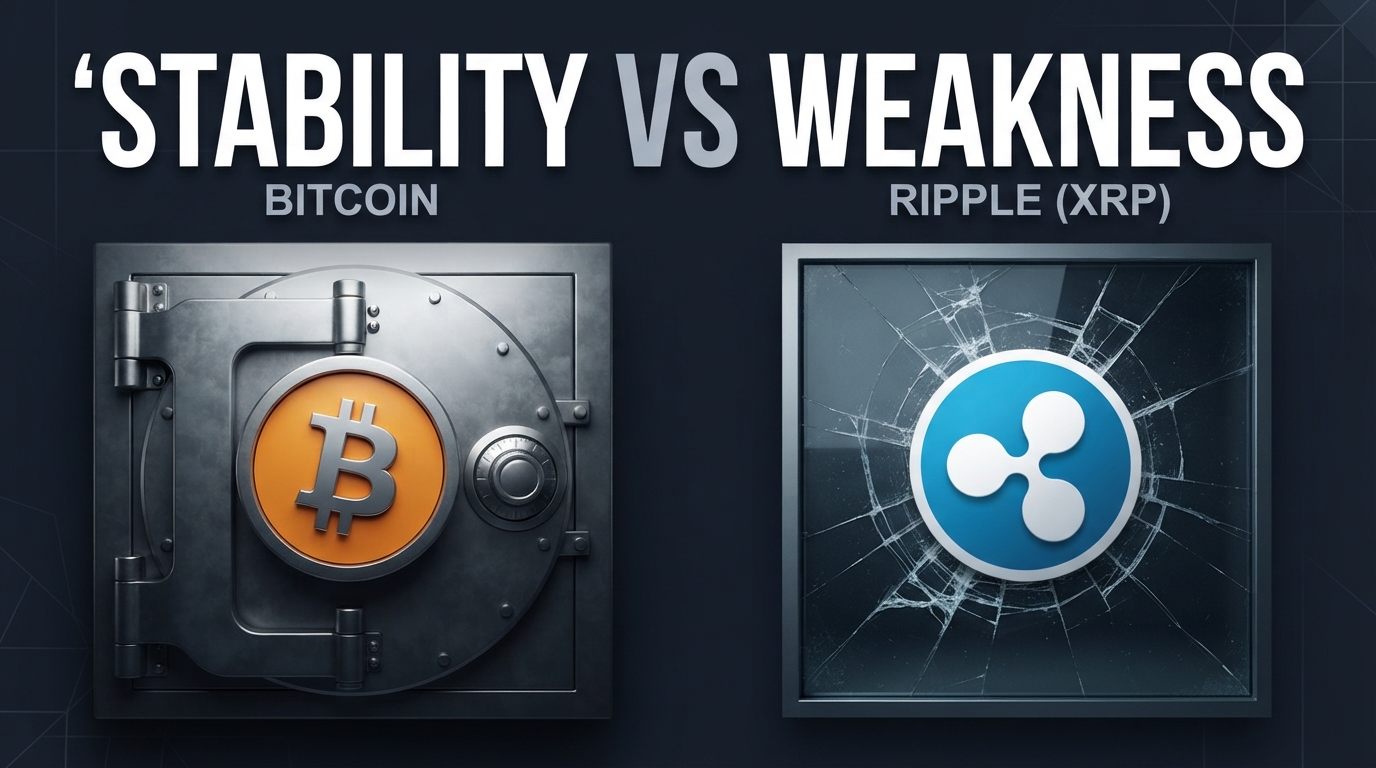
XRP concerns over support collapse vs. BTC holding steady at $62.4k

Konam

@konam

XRP 지지선 붕괴 우려 vs BTC 62.4k달러 버텨내는 힘

XRP concerns over support collapse vs. BTC holding steady at $62.4k

The cryptocurrency market is currently showing a clear divergence, with different assets heading in completely different directions. Bitcoin, which acts as the pillar of the market, continues to hold its support levels firmly despite unexpected hardware wallet security issues, while XRP appears to be sliding into a technical downward structure as buying pressure dries up.

In the case of Bitcoin, even with news regarding wallet security vulnerabilities that could have shaken investor sentiment, it is maintaining a sideways trend while defending the crucial $62,400 range. While short-term moving average trends are somewhat sluggish, indicating lingering downward pressure, it appears that the defensive wall of buyers is still holding firm at key support levels.

Conversely, XRP is gradually fading from market interest and showing technical fatigue. The bearish alignment of medium-to-long-term moving averages is deepening, and the relative weakness is evident as there is no significant trading volume to drive a rebound. As expectations related to legal disputes, which previously fueled price gains, have diluted, investor buying sentiment has significantly shriveled.

This contrast between the leader's resilience and the lack of momentum in individual assets suggests that the market has entered a phase of endurance rather than an unconditional, across-the-board rally. In this analysis, we will closely examine the opposing order structures and key price points for both assets to evaluate the decisive scenarios that will determine future moves.

BTC defending $62.4k — An institutional line of defense overcoming security anxieties

Bitcoin recently faced psychological selling pressure due to concerns about security vulnerabilities at hardware wallet manufacturer Coldcard, but it is firmly defending the core $62,400 support level. Despite the momentary tension caused by the unexpected security news, bottom-fishing buying has entered near key price levels, preventing further downside.

From a technical perspective, the bearish alignment of short- and long-term moving averages indicates that short-term downside pressure remains. However, the recent increase in trading volume by over 40% can be interpreted as a sign that aggressive bottom-fishing buying is firmly in place, absorbing the sell-off as it occurs.

In particular, the overall trend strength in the market remains at a very low level, making it difficult for the current dip to evolve into a unilateral crash. Momentum indicators, which track the balance of power, are also lingering in the middle ground without leaning to either side, meaning that neither buyers nor sellers have gained dominance as the price continues to consolidate within a range.

Ultimately, the $62,400 level appears to be acting as a strong floor, supported by institutional buying flows through spot ETFs. However, as short-term resistance levels remain overhead, a wait-and-see approach observing the range-bound trend around this support is more valid than betting on a hasty upward reversal.

XRP trend weakening — Lack of buying and deepening bearish alignment

XRP is losing its short-term direction and continues a lethargic downward trend. Unlike Bitcoin, which is accumulating strength while defending its support, the XRP market is seeing a noticeable decrease in participation from buyers. Technically, the bearish alignment—where short- and long-term moving averages fall in order from the top—is becoming increasingly clear. In this structure, overhead averages act as resistance every time there is a rebound, leading to easy exit selling, making a rapid shift toward an upward trend quite challenging.

With buying momentum significantly constrained, there are few willing buyers even as the price drops. Momentum indicators showing market downside strength indicate that current price action is fully out of overbought territory and entering a stagnant phase. Usually, long downtrends lead to bottom-fishing buying, but currently, new inflows are stagnant, delaying the formation of support. Indicators tracking trend energy also remain directionless, so it is necessary to remain open to the possibility of continued downward pressure for the time being.

The weakening technical structure is rooted in the declining influence of past price-supporting factors and increased sell volume recently. As expectations regarding litigation or regulations that fueled price action have dulled, new momentum has weakened. Notably, the visible increase in trading volume during the recent slide serves as a warning that with a thin pool of waiting buyers, even a small amount of disappointed selling can easily lead to a deeper drop. Therefore, it is necessary to calmly observe whether lower support levels hold rather than chasing moves prematurely.

Benchmarks for trend reversal and future watch points

For Bitcoin to maintain market trust and turn back to an uptrend, support around the $62,400 level is key. The market is currently in a state where the downtrend has paused and a sideways consolidation is underway; while it holds this crucial price level, attempts to accumulate strength and break out to the top of the range may emerge. Conversely, if selling pressure intensifies and the price breaks below $62,400 without recovery, the market's short-term trend could steepen toward further corrections. In this case, one must prepare for a scenario where buyers retreat to the sidelines.

For XRP, the priority is proving its downward rigidity to break the current lethargic slide. In the short term, it is better to observe the market for signs of slowing downside momentum and recovering buying volume rather than entering prematurely. If the current slipping trend stabilizes, price volatility narrows, and support buying is confirmed near long-term average costs, this could be interpreted as a sign of bottom-forming. However, if even that fails and the price continues to make lower lows, there is a risk that additional technical selling will emerge, leading to an even deeper correction.

This market landscape shows a decoupling—or divergence—where the institutional defensive strength of Bitcoin contrasts with the negative factors affecting individual assets. As the technical flows of the two assets differ, it is important for investors to establish response criteria based on the respective support and resistance levels rather than expecting an unconditional, simultaneous rise. It is necessary to closely track the overall market trading volume along with Bitcoin's price trend to spot clear signals of a trend reversal.

No comments yet.