CoinNess
Binance has resumed withdrawals for multiple cryptocurrencies on the Ethereum and Solana networks. This is expected to restore user asset mobility and facilitate trading activities.
Use the arrow keys to inspect candles, and + or − to zoom.
Binance has resumed withdrawals for multiple cryptocurrencies on the Ethereum and Solana networks. This is expected to restore user asset mobility and facilitate trading activities.
Binance is gradually reopening withdrawals for a new batch of assets, starting Nov. 3, focusing on BSC, Ethereum, and Solana networks. Deposits remain unaffected, and Binance will cover losses from stolen funds.
AMP's 24-hour trading volume has dropped by over 60%, with a test of the $0.000830 support level anticipated. This suggests a decrease in trading participation despite price increases, which should be considered alongside supply concentration.
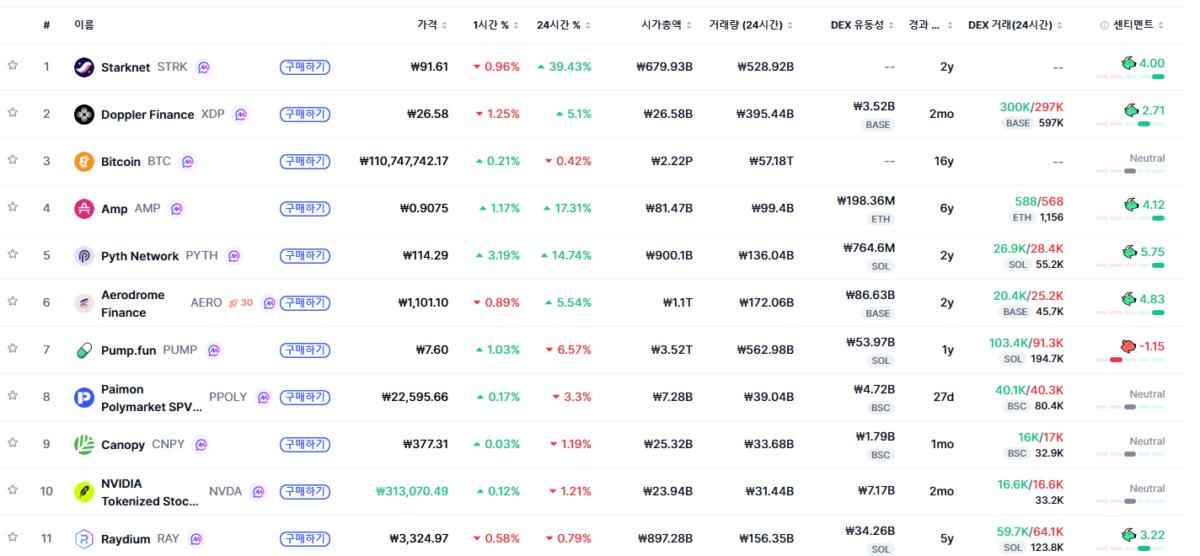
Globally, STRK was searched the most, while in the Korean market, PONS took the lead. The global market saw many rising stocks, whereas the Korean market had more declining stocks. Some stocks like BTC, PONS, and JUP garnered attention in both markets.
Konam@konam
Recently, Upbit captured market attention by listing multiple assets simultaneously, including Lido (LDO), Osmosis (OSMO), Amp (AMP), Peaq (PEAQ), Kamino (KMNO), and Morpho (MORPHO). In the past, a listing on a major exchange was effectively seen as a guaranteed catalyst for short-term price appreciation, but the current trend is showing a different pattern.
After temporary volatility on the day of listing, most of these assets failed to maintain an upward trend, leading to sideways movement or even weakness. Currently, tokens like KMNO, MORPHO, and OSMO are recording declines over the last 24 hours, and AMP remains at the bottom without a significant rebound. Except for LDO, which saw a large inflow immediately after its listing, the effect of local liquidity injection is not as powerful as it used to be.
This phenomenon demonstrates that the broader risk-off sentiment currently weighing on the crypto market is acting more strongly than liquidity boosters from individual exchanges. Investors are prioritizing securing cash or defensive positions over aggressive new FOMO buying amid geopolitical risks and global regulatory uncertainty.
Ultimately, when market sentiment is cooled, listing announcements on major exchanges are likely to remain nothing more than short-term, event-driven volatility. For the time being, a conservative approach focusing on observing macroeconomic liquidity recovery rather than reacting sensitively to individual listing news seems necessary.
Konam@konam
On June 19, 2026, Upbit, the largest cryptocurrency exchange in Korea, simultaneously listed five new assets (AMP, PEAQ, LIT, KMNO, MORPHO). These listings primarily target the BTC and USDT markets and serve as a prime example of how the high liquidity of the Korean retail market influences the short-term price discovery process.
Historically, new listings on Upbit have created an 'Upbit effect,' characterized by a concentration of short-term trading volume and rapid price fluctuations. This multi-asset listing is also revealing the structural characteristics of the market, with extreme differences in volatility observed across each individual asset.
In particular, abnormal price surges and corrections were observed in some assets. Data shows that Lighter (LIT) hit a short-term peak immediately after listing with an extreme volatility ratio, and Kamino (KMNO) also maintained strong momentum. On the other hand, assets like Amp (AMP) and peaq (PEAQ) underwent corrections after initial hype, highlighting a clear disparity in retail buying sentiment for each asset.
While such simultaneous listing rallies offer short-term trading opportunities to market participants, they also carry significant risks of liquidity distortion and becoming trapped at high prices. The high asset turnover rate characteristic of Korean exchanges can trigger sharp declines as buying interest wanes. Therefore, rather than simple chase-buying, a careful approach that compares on-chain liquidity inflows with price discrepancies against overseas exchanges (Kimchi premium and order book depth) is essential.
Konam@konam
With Bitcoin consolidating below $64,000 and overall market trading volume stagnant, South Korea's largest exchange, Upbit, has made an unusual move. Starting at 3:00 PM on June 19 and spanning four hours, the exchange sequentially listed nine altcoins—PEAQ, LIT, KMNO, MORPHO, GRAM, LDO, PAXG, OSMO, and AMP—on its BTC and USDT markets.
Large-scale listing events during market downturns are typically interpreted as a tactical move by exchanges to boost depressed trading volumes and secure new liquidity. In particular, given that these listings are for the BTC and USDT markets rather than the KRW market, they may follow a different pattern than the classic KRW market 'pumping'.
Investors should focus on two key perspectives.
First is the concentration of liquidity and volatility risk. Following an Upbit listing, a temporary influx of buying often creates a price discrepancy with overseas markets—a phenomenon known as the 'listing pump.' However, in a market where overall buying sentiment is weak, caution is advised as the initial volatility often subsides, leading to sharp sell-off pressure.