
Nari@nari
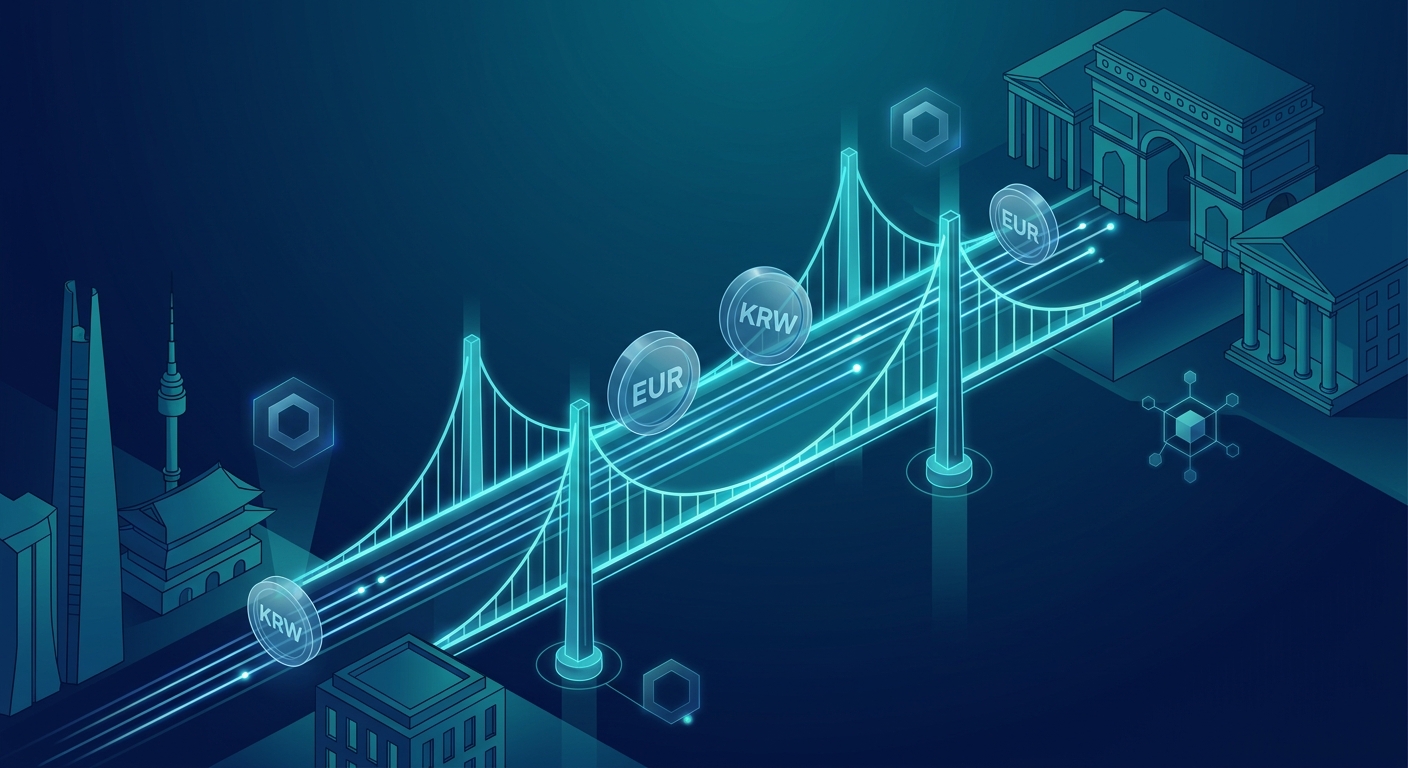
A Real-Time Meeting of the Euro and KRW: The Future of RWA Envisioned by Korean Banks with 'Project Pangea'
For a long time, virtual assets and traditional finance seemed to be walking on separate paths. However, the news from the 'Point Zero Forum 2026' recently held in Zurich, Switzerland, was a decisive moment showcasing how rapidly these two worlds are converging into one.
'UniKA' (Unified Korea Alliance)—a coalition of leading Korean banks including Shinhan Bank, Woori Bank, and K-Bank—along with the global oracle network Chainlink and the stablecoin consortium 'Qivalis' (comprising 37 European banks), have officially joined forces to launch 'Project Pangea'.
The future they envision is clear: transforming the cross-border remittance and foreign exchange settlement process—which traditionally takes at least two days—into a near-real-time 'T+0' settlement system using blockchain technology. This massive experiment, which directly connects the KRW (Korean Won) and EUR (Euro) stablecoins for the $150 billion annual trade corridor between Korea and Europe, will serve as a milestone demonstrating how RWA (Real-World Assets) can be integrated into our daily lives, going far beyond a simple technical test.
We have condensed the key points on how they intend to disrupt the financial landscape with innovative technology and why our community and the Web3 ecosystem should be paying close attention to this movement.
From T+2 to T+0: Real-Time Movement of Money Across Borders
What is the most frustrating part when we shop internationally, send money abroad, or when companies settle import/export payments? It is the 'time' and 'cost'.
The current global foreign exchange settlement system typically operates on a 'T+2' basis. Simply put, this means even if I send money today, it takes at least two business days for it to actually show up in the recipient's account. Furthermore, when sending Euros (EUR) from Korea, the KRW is not directly converted into EUR. It must pass through the US Dollar (USD) as a 'transit station'.
This process is similar to sending a package internationally with no direct route, forcing it to bounce between multiple logistics hubs while incurring transshipment fees and taking over two days to arrive. During those two days, exchange rates can fluctuate, and the user must bear the full risk of loss (FX risk).
'Project Pangea' emerged to completely break this inefficient structure. The core is 'T+0', or immediate real-time settlement.
This project is targeting the massive $150 billion (approx. 200 trillion KRW) annual trade corridor between Korea and Europe. It boldly skips the USD intermediary, instead using secure 'KRW stablecoins' and 'EUR stablecoins' issued within a regulatory framework to perform an immediate atomic swap on the blockchain.
A world is opening where large amounts of capital moving across borders can be settled in seconds, just like sending money via KakaoTalk or Toss. With the removal of complex intermediary banking networks, fees are drastically reduced, allowing businesses and individuals to send money safely and cheaply without the anxiety of exchange rate volatility.
How Does It Work? A Technical Structure Composed of 3 Layers
How can banks and blockchain safely meet? Instead of forcing new technology onto banks, 'Project Pangea' harmoniously connects existing infrastructure with trusted Web3 technology. The system operates through three innovative, securely interlocking layers.
Phase 1: The Banking Layer – Leveraging the SWIFT Network
The main reason banks are hesitant to adopt blockchain is the burden of replacing their core systems (mainframes) that were built at a massive cost. Project Pangea cleverly overcomes this barrier. Banks can communicate using the global standard messaging format they currently use for international remittances: SWIFT (ISO 20022). As a result, financial institutions can easily connect to the blockchain-based remittance network without replacing their internal systems entirely.
Phase 2: The Connectivity Layer – Chainlink as a Secure Bridge
Payment signals from banks entering through traditional financial networks are transmitted to the blockchain world via Chainlink’s CCIP (Cross-Chain Interoperability Protocol). This is combined with Chainlink Data Streams, which provide real-time FX market prices, to instantly reflect the accurate exchange rate between the Euro and the KRW on-chain.
Phase 3: The Consensus Layer – 'Pangea L1' Developed by FairSquareLab
The stage where Euro and KRW stablecoins are actually swapped and transactions are perfectly finalized is the 'Pangea L1' blockchain, a dedicated consensus layer operated by Korean blockchain technology firm FairSquareLab.
💡 Eliminating the Source of 'MEV'—Traditional Finance’s Biggest Fear
One of the reasons traditional finance fears large-scale transactions via public blockchains is the risk of MEV (Maximal Extractable Value) and front-running. On a blockchain, transactions often get hijacked by others who pay higher fees to be processed first. For banks handling tens of billions of won in foreign exchange, manipulated transaction sequences leading to unfavorable prices are an unacceptable financial risk.
To solve this, Pangea L1 forces the Chainlink oracle's price updates to be executed first in every block at the protocol level. Since the price information is fixed at the very beginning of the block, no subsequent transaction can distort the price or intercept the trade for profit. This provides a perfect shield, allowing financial institutions to process large-scale transactions instantly with peace of mind.
Proactive Moves by Korean Banks Ahead of Regulatory Changes (UniKA)
The leading force driving this grand financial innovation from the Korean side is 'UniKA' (Unified Korea Alliance), a coalition of major domestic banks and partners.
UniKA is not just a loose association in name only. It is backed by financial giants like Shinhan Bank, JB Bank, Woori Bank, and NongHyup Bank, as well as innovative internet and regional banks like K-Bank and iM Bank (formerly Daegu Bank). Additionally, FairSquareLab, a leading domestic blockchain firm, has joined as an operations partner and technical partner for Pangea L1, working closely with the banks.
So, why are these famously conservative Korean banks acting so aggressively now? The decisive trigger is the institutionalization of stablecoins in Korea, scheduled for the 'second half of 2026'.
The Korean financial sector is currently preparing for a massive turning point to handle digital assets within an institutional framework. Once regulatory guidelines become clear in the second half of 2026, the issuance and circulation of KRW-based stablecoins will surface in earnest. For domestic banks, realizing that waiting idly for regulations to be fully finalized would mean falling behind in global competition, this is a strategic move.
Ultimately, their strategy is to build practical experience with global partners like Qivalis within the safe enclosure of a regulatory sandbox before the laws are passed. They are warming up their engines so they can launch actual services the moment the law is passed. Rather than passively waiting for regulatory changes, UniKA's move to proactively secure a 'first mover' position is injecting great vitality into the entire domestic Web3 ecosystem.
The Next Key Points to Watch
Project Pangea will not stop at a 'technical experiment' or a one-time announcement; it plans to conduct live tests involving real capital movement within the next 12 months. The historic moment where the $150 billion (approx. 200 trillion KRW) annual trade corridor between Korea and Europe is settled in real-time on the blockchain is not far off.
We should pay special attention to this project because it is deeply intertwined with Korea's institutional changes. The scheduled legalization of stablecoins in Korea for the second half of 2026 and the proactive moves by UniKA banks are closely linked. Once the regulatory framework is established, Korean banks that have already verified global standard infrastructure (Chainlink CCIP, Pangea L1) will likely hold the lead in the market.
Key points to watch in the future are as follows:
- Success of actual live tests: Will the real-transaction tests in the sandbox environment over the next 12 months operate smoothly without interruption?
- Regulatory coordination and sandbox approval: Can they obtain regulatory approval without conflict with domestic foreign exchange laws and stablecoin guidelines?
- Expansion of the ecosystem: Following the join of K-Bank and iM Bank, how many more major financial institutions or European banks will join this network?
Until now, terms like 'RWA' or 'institutional blockchain' felt somewhat distant and abstract. However, Project Pangea will serve as the most realistic and powerful textbook on how stablecoins and traditional finance can perfectly converge within a regulatory framework. We look forward with excitement to the next synergy that Korean finance and global Web3 technology will create.