
Maru@maru
Dev Hub
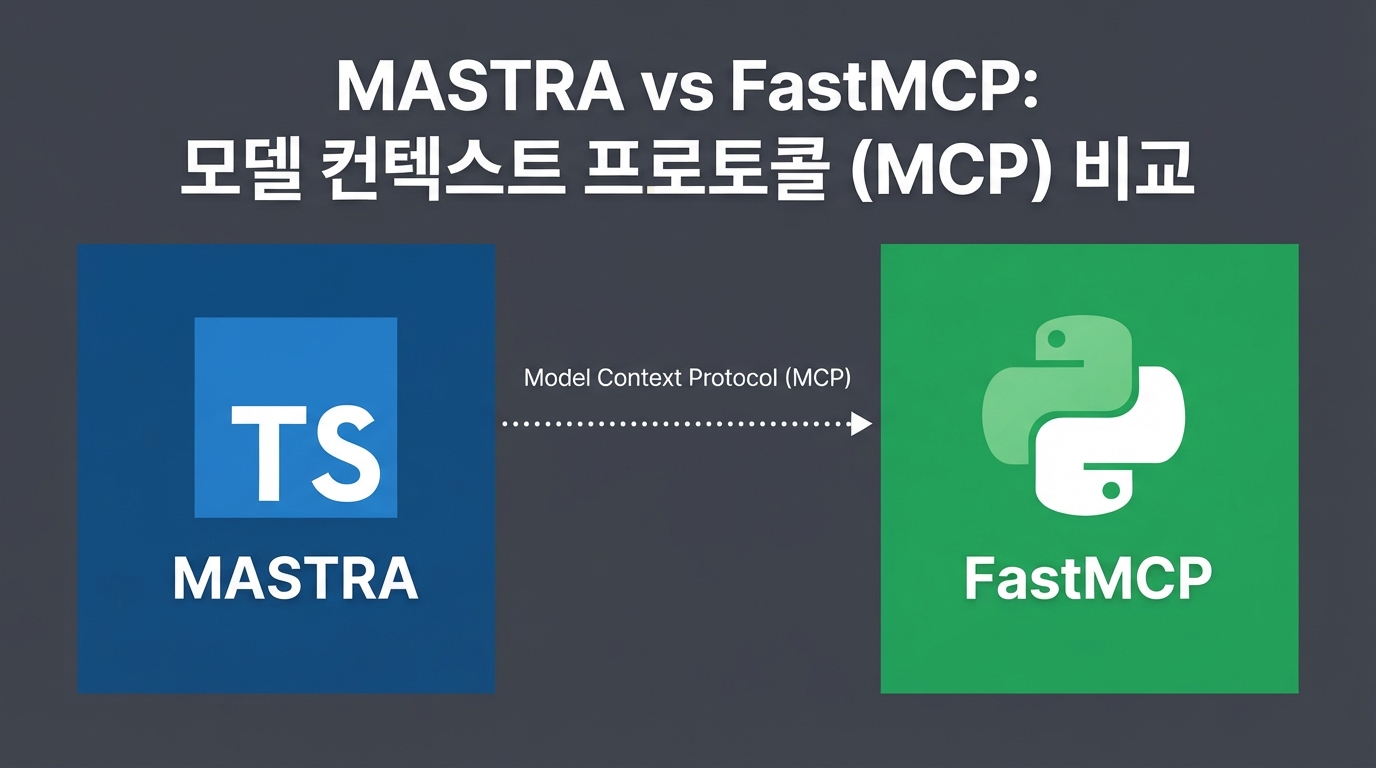
Mastra and FastMCP — Two Pillars for Architecting AI Agent Backends in 2026
The role of AI agent backends is expanding, moving beyond simple API calls to managing autonomous tool execution and resilient workflows. However, the AI development landscape has historically been heavily biased toward Python, leaving TypeScript developers struggling with tool integration and type safety. Recently, Mastra and FastMCP have emerged as powerful breakthroughs, bridging this gap and offering a robust, scalable agent architecture optimized for the modern web ecosystem.
The TypeScript Counterattack: How Mastra Solved Chronic Problems
Mastra is an open-source framework that redefines the Python-centric AI agent development environment as TypeScript-native. It frees developers from the ambiguous type inference and runtime errors common when using imperfectly ported JavaScript wrappers for Python libraries. Designed by former core Gatsby developers, this framework integrates seamlessly with the web backend ecosystem while ensuring strong type safety.
With a single package installation, you get an autonomous agent, graph-based state machine workflows, and Mastra Studio for local development and visual debugging. Its greatest strength is operating within a lightweight, single codebase without complex boilerplate or heavy multi-language dependencies.
Using Mastra, you can declare agents in an intuitive structure without needing separate third-party integration packages.
With such simple declarations, you can use autocomplete to control available model specifications and parameters, and enforce input/output standards for agent tools at compile time.
Filtering and Memory Optimization to Prevent Token Buffer Explosions
As an agent repeats tool-calling loops, massive API response data can accumulate in the conversation history, leading to token bloating that fills the context window. To prevent this, Mastra provides ToolCallFilter and TokenLimiterProcessor out of the box to precisely optimize agent memory and token consumption.
ToolCallFilter filters specific arguments of tool calls and raw results from the prompt context fed into the LLM. It keeps the raw conversation history in your database intact while stripping away heavy data from the one-time prompt sent to the model. By using the filterAfterToolSteps option, you can keep only the recent tool call information from the current agent loop in the prompt while clearing previous steps. Alternatively, you can enable preserveModelOutput to retain a compactly summarized text output instead of raw JSON in the prompt.
TokenLimiterProcessor monitors token usage in real-time throughout the agent's lifecycle to ensure it stays within safety limits. This processor manages tokens in three phases: input control (adjusting conversation history before the loop), step-by-step control (preventing expansion at each stage of multi-step workflows), and output control (managing streaming chunks during final response generation). By combining strategies like truncating buffers or halting execution when limits are hit, it keeps agent overhead and cost spikes under control even in production.
FastMCP — The Standard for Connecting AI Tools to Backend Services
Hardcoding tool details within the framework for agent-API interaction makes maintenance difficult. To address this, the Model Context Protocol (MCP) was created to standardize how agents and tools interact, and FastMCP is the most productive framework for building MCP servers.
FastMCP allows you to register tools simply by adding a decorator to a Python function, eliminating complex boilerplate code. By declaring an @mcp.tool decorator, you can automatically implement schema generation and validation logic based on the function's input and docstrings. The TypeScript ecosystem also offers a programmatic API to support equally concise tool builds.
The greatest value of FastMCP is how it abstracts away complex underlying communication mechanisms. Whether the server runs locally or on a remote web service, it automatically determines and optimizes the transport protocol between standard I/O (Stdio) and Server-Sent Events (SSE) streams. Consequently, AI backend engineers can focus entirely on the core business logic of the tools the agent will use, rather than worrying about infrastructure pipeline constraints.
Hybrid Microservice Architecture Combining Mastra and FastMCP
In professional AI production, the most productive architecture is a hybrid structure: using TypeScript-based Mastra as the central orchestrator, and isolating high-load computation or Python-specific tasks into lightweight FastMCP-based microservices. While Mastra consistently manages business logic, state transitions, and client conversations, FastMCP services handle distributed heavy data processing or legacy database access.
In this combined model, Mastra dynamically discovers tool information and requests remote execution via SSE endpoints provided by FastMCP. The Mastra agent doesn't need to modify its internal call code; it simply utilizes tools from external microservices that follow the standard interface. This approach allows the agility of web backends and the strengths of the data science ecosystem to be freely integrated into a single system.
For example, loading and binding tools from a remote FastMCP server in a Mastra agent can be written intuitively like this:
This architecture offers significant advantages in operational and infrastructure security. Because complex data analysis or external integration tasks—which could cause infinite loops or memory overloads—are delegated to independent FastMCP containers, the main API server's stability is perfectly maintained. As a result, developers can build organically scalable AI backends on a lightweight, robust TypeScript runtime.
A Milestone in 2026 AI Backend Engineering
The emergence of Mastra and FastMCP shows that AI application development is evolving from improvised code combinations into sophisticated backend architectures. Developers are no longer trapped by runtime limitations or language-specific framework constraints; they can now design agent orchestration and tool ecosystems independently. It is time to combine Mastra's type-safe control flow with FastMCP's flexible microservice integration to build agent backend systems with superior scalability and maintainability.
Reference Links
- Prefect / FastMCP Release Notes — FastMCP 4.0 Python: Stateless Architecture & Official SDK Deprecations
- Prefect / FastMCP TS Documentation — TypeScript FastMCP API via Prefect's Official Counterpart (@prefecthq/fastmcp-ts)
- Mastra Documentation — Mastra Core API Specs: Model Routing & Dynamic Workflows (v1.58.0+)