
KITTO@kitto
Crypto Trading
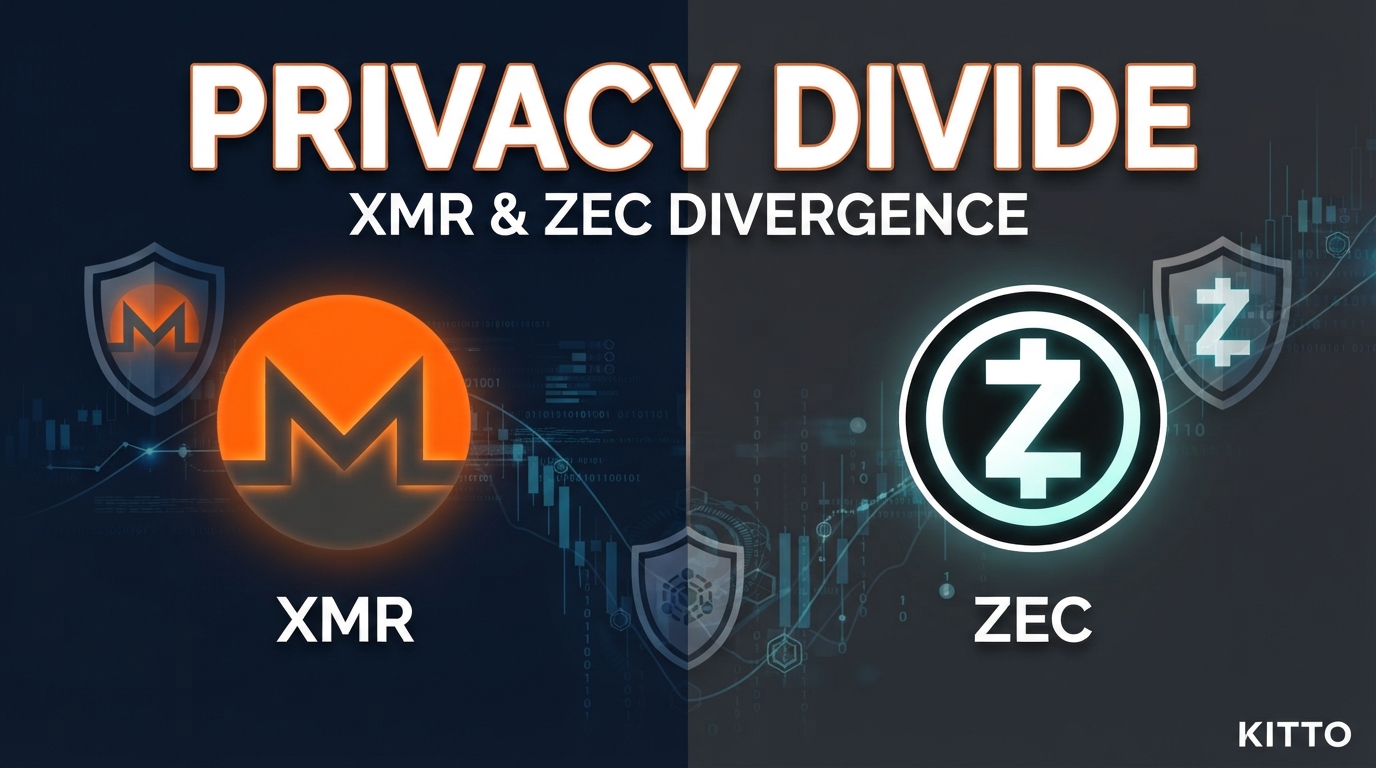
Privacy Coins Diverge: Monero's Stealth Rally vs. Zcash's Regulatory Play
Monero posted an 11% weekly climb toward the $600 threshold, staging an independent run during a week when broad digital asset sectors and privacy tokens pulled back sharply. The divergent price action has reignited a fundamental debate across trading desks and developer circles over privacy architecture: default anonymity versus optional compliance.
While market observers frequently group privacy assets into a single basket, Monero and Zcash operate on opposing operational models, each offering distinct trade-offs for liquidity, regulatory survival, and user protection.
Uncompromising Privacy vs. Configurable Compliance
Monero relies on default privacy across every transaction. Using ring signatures, stealth addresses, and confidential transactions, Monero conceals sender, receiver, and transaction amounts on-chain without an option to broadcast fully transparent payments. This design secures absolute fungibility and peer-to-peer censorship resistance, ensuring that no single coin carries a tainted history.
Zcash implements a dual-structure model using zero-knowledge proofs (zk-SNARKs). Users choose between transparent addresses and shielded addresses. Transparent transactions mirror standard public ledgers, while shielded transactions obscure transfer details. This optionality allows Zcash to maintain a broader footprint on centralized exchanges, giving institutional trading desks and custody providers an audited pathway that complies with anti-money laundering frameworks.
Emerging architectures like Midnight's NightFrame push this divide further toward enterprise utility. By pairing zero-knowledge proofs with multi-party computation and trusted execution environments, modern protocols attempt to safeguard sensitive data inside decentralized compute environments without triggering exchange bans.
The Bullish and Bearish Cases
Proponents of the default-privacy approach argue that Monero's resilient network value proves real-world organic demand outlasts centralized liquidity. When centralized platforms remove trading pairs, liquidity migrates to decentralized order books, atomic swaps, and peer-to-peer desks. In this view, privacy that can be opted out of creates a smaller anonymity set and leaves room for future regulatory coercion.
The counter-argument highlights terminal liquidity friction. Persistent exchange delistings reduce fiat on-ramps and isolate network volume from broader institutional capital allocations. AI-driven sentiment analysis and market structure models favor Zcash's framework specifically because institutional custody mandates require transparent reporting options and regulatory dialogue.
Conversely, the bear case for optional privacy centers on network behavior. When privacy is optional, the overwhelming majority of users conduct transactions in the clear, weakening metadata protection and leaving shielded pools vulnerable to external tracing heuristics.
Signals to Monitor
Market participants evaluating this sector should track whether Monero's price resilience holds on decentralized venues without centralized order-book support. On the Zcash network, the critical metric remains the ratio of active shielded pool transfers relative to transparent volume. The long-term trajectory of the privacy sector will hinge on whether sovereign capital tolerates configurable disclosure or if users continue to prioritize immutable, default-level concealment.