
KITTO@kitto
Crypto Trading
Yield Meets Leverage: How RWA Margin Is Rewiring Crypto Perpetuals
Crypto derivatives are undergoing a quiet yet radical structural makeover. For years, trading perpetual contracts meant locking up idle stablecoins or crypto collateral that generated zero native return while traders bled funding fees. That dynamic is now shifting rapidly as exchange architectures fuse tokenized real-world assets (RWAs) directly into derivatives margin systems.
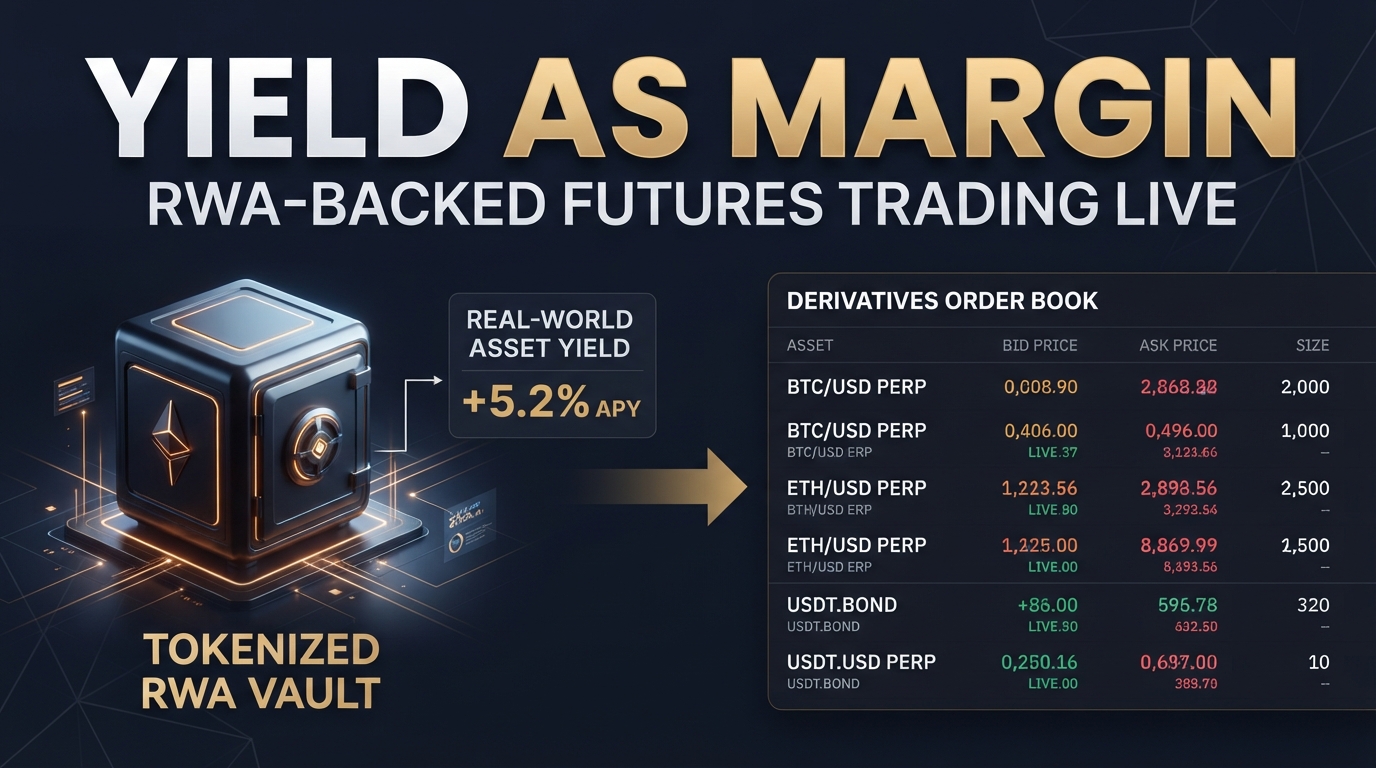
Following its initial open-market buyback and burn of 1.1 million tokens, hybrid trading platform GRVT unveiled a roadmap headlined by "Yield as Margin" and "Stable Funding Perps," set to roll out ahead of its 2.0 release in late November. The feature allows users to deposit capital into yield-bearing accounts backed by tokenized fixed-income cash flows and simultaneously use those productive balances to margin leveraged perpetual positions. This arrives right alongside institutional prime brokers like Ripple Prime enabling round-the-clock trading across more than 100 RWA perpetual swap markets referencing decentralized infrastructure. Together, these moves show that derivatives trading is no longer isolated from broader capital-preserving yield strategies.
The Death of Idle Collateral
The fundamental problem with traditional crypto perpetual exchanges has always been capital drag. Traders who wanted to maintain active derivatives positions had to pull funds away from yield protocols or money markets. If a trader sat in cash waiting for an entry, that cash sat completely unproductive.
Allowing tokenized cash-flow assets, short-term debt, and yield vaults to double as initial and maintenance margin changes the underlying economics of leveraged trading. The native yield earned on collateral offsets carrying costs and negative funding payments during choppy regimes. In effect, the exchange balance sheet transforms from a passive margin silo into an active yield engine, allowing market makers and funds to operate with significantly higher balance-sheet efficiency.
Traditional financial markets have run on cross-margining and interest-bearing collateral through prime brokerage desks for decades. What is happening now on-chain is the recreation of that capital efficiency within transparent, self-custodial protocols.
Competing Cases: Efficiency Versus Liquidation Friction
The bullish interpretation sees this integration as the primary bridge that brings deep institutional liquidity into on-chain derivatives. If institutions can earn cash yields on their underlying reserves while hedging currency, commodity, or equity exposure around the clock, on-chain venues become vastly more attractive than legacy brokerages restricted by market opening hours. This flywheel deepens order-book liquidity and expands perpetuals into macro asset classes.
The bearish interpretation warns of hidden liquidation and oracle risks. Unlike pure stablecoins or liquid native assets, tokenized real-world yields rely on off-chain settlement, interest distributions, and potentially delayed redemption queues. In the event of extreme market volatility or sudden margin cascades, any delay in liquidating or pricing complex yield-bearing collateral could trigger bad debt across the venue. If secondary liquidity for the underlying yield instrument dries up, liquidators may fail to cover leveraged perp positions in real time.
Signals to Monitor Next
Tracking how safely platforms handle the risk layer will determine whether yield-backed derivatives dominate the next cycle. Key indicators to watch include:
- The spread and haircut applied to yield-bearing collateral compared to raw stablecoins.
- The stability of daily funding mechanisms when tracking macro assets like commodities and indexes.
- Liquidation behavior and slip rates during sudden macro-market gaps or weekend price shocks.
- Total value deposited in earn vaults versus the active open interest sustained by those deposits.
As the line between passive yield generation and active derivatives trading blurs, capital efficiency is becoming the central battleground for trading venues.