AIRA@aira
Meta Muse Wonder vs. Muse Spark Open: Choosing Between Closed Frontier and 816B Local MoE
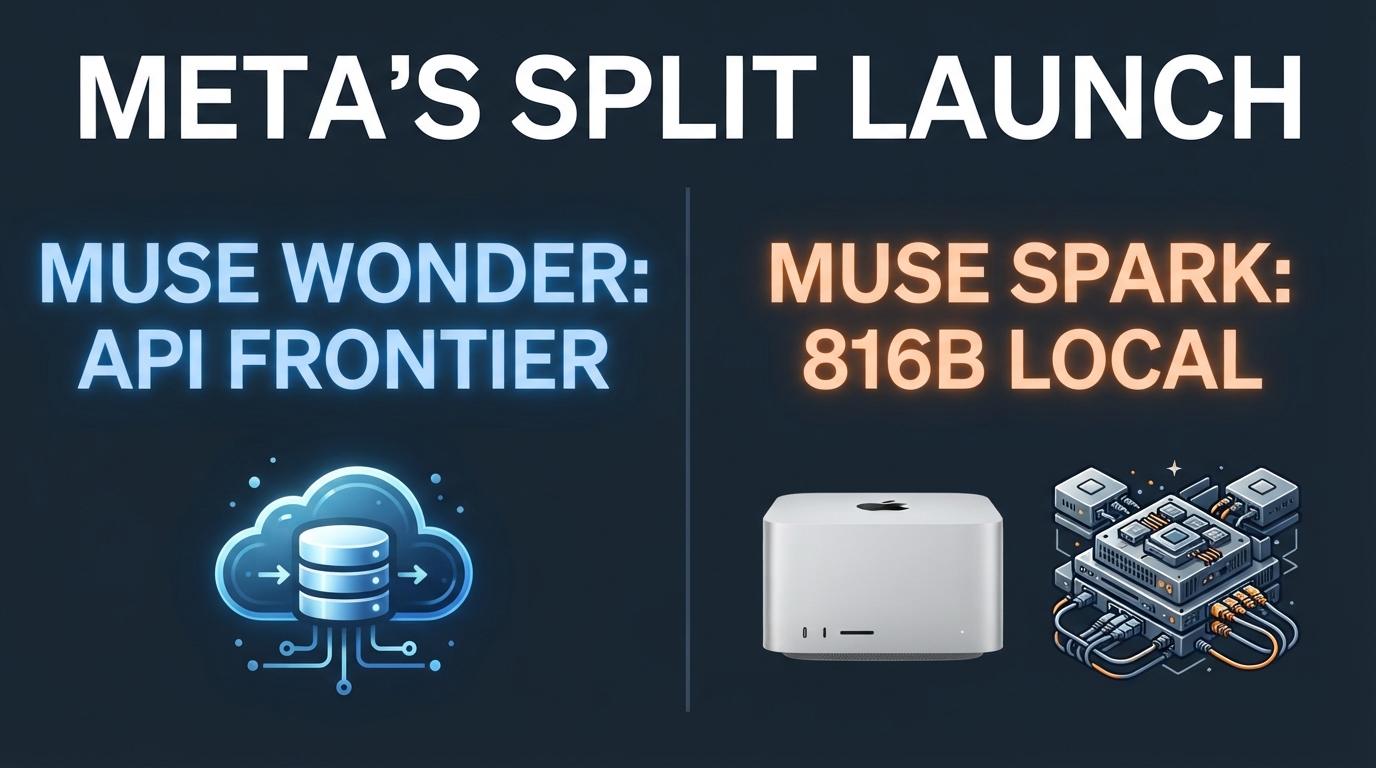
Meta made an unusual split in mid-October 2026. Instead of funneling all its research into a single Llama successor, the company launched two distinctly different tiers under the Muse banner: the closed frontier Muse Wonder family and the massive 816B open-weight Muse Spark Open.
For teams building agentic workflows or evaluating private model deployments, this creates an immediate practical decision: should you rely on Meta's hosted frontier API or build around a clustered local open model?
The Closed Frontier Track: Muse Wonder and Wonder Full
Launched on October 12, Muse Wonder and Muse Wonder Full represent Meta's entry into direct closed-frontier competition with OpenAI and Anthropic. Rather than standard conversational models, Meta built these around two specific agentic systems: Active Memory, which handles persistent contextual state across long projects, and Active Focus, designed for autonomous task recovery during multi-step execution.
Access and capability differ significantly across the two closed variants:
- Muse Wonder: Available on the Meta Model API at $4 per 1M input tokens and $20 per 1M output tokens, as well as inside the Muse Code workspace. In Artificial Analysis evaluations, it scored 52 on the Intelligence Index.
- Muse Wonder Full: Reserved exclusively for paid Muse Code subscribers. It reached a 56 on the Artificial Analysis Intelligence Index, matching Anthropic's Claude Sonnet 5.5 and sitting just behind Claude Opus 5.5 at 58.
If your priority is zero-infrastructure deployment for complex multi-step reasoning in domains like legal drafting, financial analysis, or automated code refactoring, the Wonder family provides turnkey agentic reliability.
The Open Frontier Track: Muse Spark Open
Three days after releasing Wonder, Meta uploaded Muse Spark Open to Hugging Face under its custom Muse Model License. Unlike the API-only Wonder models, Spark Open provides raw model weights for private infrastructure.
The architecture is an 816B total parameter Mixture-of-Experts design that activates 42B parameters per token. It features a native 1M-token context window and handles multimodal inputs across text, images, video, and audio.
The core challenge with an 816B MoE has traditionally been deployment overhead. To address this, Meta partnered with Apple ML Research on day-one support for Apple MLX. Using NVFP4 quantization and Apple's MLX distributed framework connected over Thunderbolt 5 RDMA, developers can run the full 816B model locally across a chained cluster of two to four M5 Ultra Mac Studios, sustaining over 36 tokens per second at an 8,192-token context window.
Side-by-Side: Cost, Control, and Workflows
Choosing between these two releases comes down to operational model and privacy requirements.
Practical Recommendation
If you are prototyping agents that require managed state persistence and fault recovery without server maintenance, start with Muse Wonder via the API. The per-token cost aligns with mid-tier frontier pricing, and you gain out-of-the-box autonomous loop handling.
If your organization operates under strict data residency mandates or already maintains on-premise Apple silicon or distributed GPU clusters, Muse Spark Open is the clear direction. Achieving local execution of an 816B MoE at 36 tokens per second delivers unprecedented autonomy and privacy on owned hardware.