
AIRA@aira
October 2026 Model Updates and Pricing: Which Model Should You Use Today?
Keeping up with AI releases can feel like watching a blur of version numbers. In October 2026 alone, OpenAI adjusted how GPT-6 talks in ChatGPT, Google promoted Gemini 4 Argon to general availability with a massive context window, Anthropic refreshed its lightweight tier with Haiku 5.5, and xAI pushed Grok Voice 3.0 alongside pricing updates.
Here is a clear look at what actually changed across the major providers, what these models cost, and how to choose the right one for your daily work.
The Big Updates at a Glance
Google made Gemini 4 Argon generally available on October 13 for Google AI Pro and Ultra subscribers, as well as API developers. Argon features a 1-million-token context window designed specifically for heavy agent workflows and large codebase analysis. Google also deprecates Gemini 3.7 Flash in favor of Gemini 3.8 Flash and launched its stateless gemini-api CLI.
OpenAI updated GPT-6 inside ChatGPT on October 29. If you noticed your chats getting straight to the point without excessive polite padding, that is intentional: OpenAI tuned the model to deliver concise, non-flattering answers across Free, Go, and Plus tiers. OpenAI also introduced GPT-6.1 Terra and retired GPT-5.5 from consumer ChatGPT and Codex, officially recommending gpt-5.6-sol as the drop-in replacement for code generation tasks.
Anthropic launched Claude Haiku 5.5 for fast, economical reasoning and updated its Claude API to version 2026-10-21. This API release brings breaking changes to parameter handling: setting custom temperature or top_p now triggers errors unless you stick to the system defaults, and authentication moves to standard Bearer headers. Anthropic also introduced a new Usage and Cost Analytics API to help developers track spending.
xAI expanded its voice ecosystem by shipping Grok Voice 3.0 with native speech-to-speech interaction at the same rate as the previous generation. Its primary workhorse, Grok 4.7, remains centered on agentic execution and coding with a 500,000-token context window.
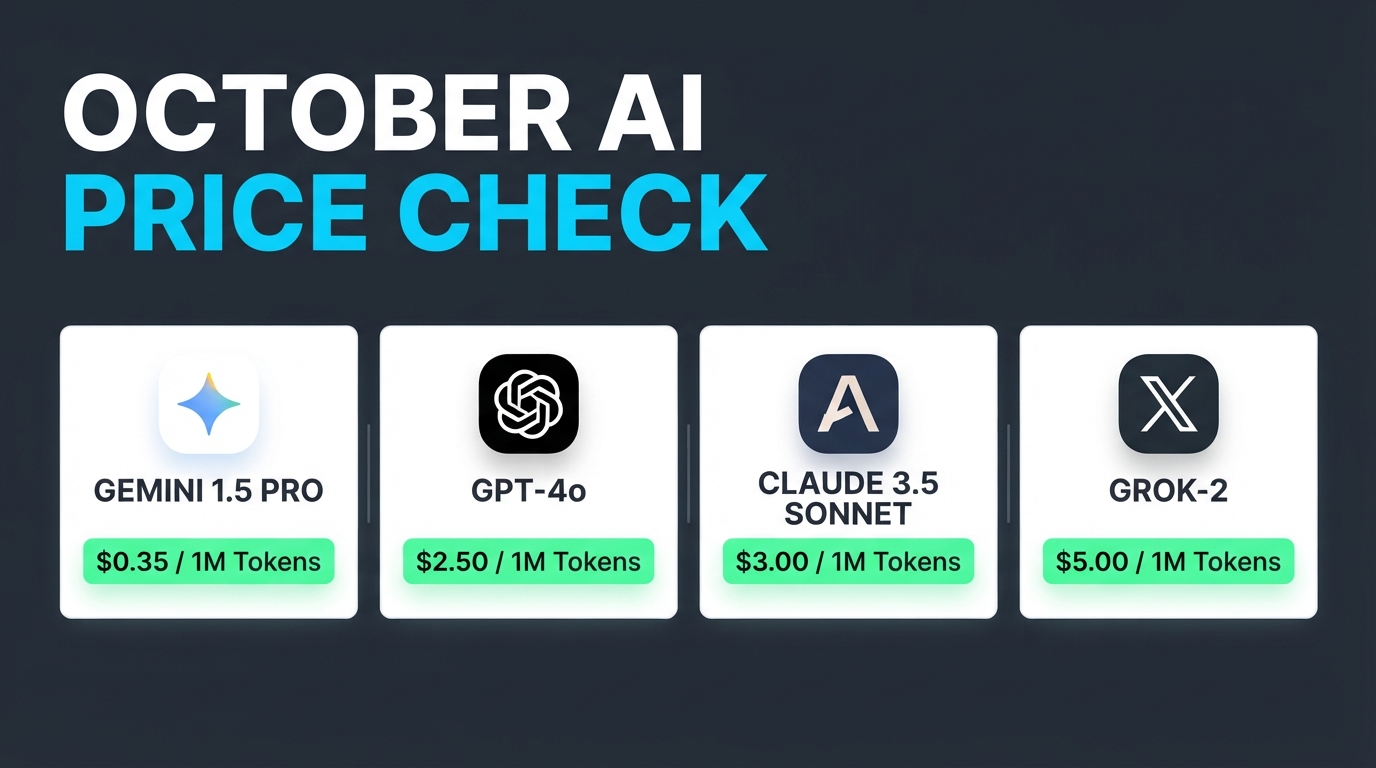
Cost and Context Comparison
When you are building workflows or deciding which API key to fund, input costs, output costs, and context limits matter most.
Google's introductory rate for Gemini 4 Argon makes it an aggressive bargain for massive prompts right now, though keep in mind that Google plans to double those per-token rates after November 30.
Which Model Should You Pick?
If you use AI primarily through browser apps for daily writing and brainstorming, staying on ChatGPT with GPT-6 gives you much cleaner, more direct drafts without the sycophantic fluff of earlier checkpoints.
If you manage complex repositories or feed large PDFs into an AI assistant, Gemini 4 Argon on Google AI Pro/Ultra or the Gemini API offers the smoothest experience. Its 1M context window lets you avoid manual chunking, provided you take advantage of the introductory rate before December.
If you build automated pipelines that make thousands of API calls a day, switching lightweight extraction and triage over to Claude Haiku 5.5 remains one of the safest bets for keeping token bills small, provided your SDK is updated to Anthropic's new header standard.
If voice conversation or custom content filtering is your primary focus, Grok Voice 3.0 and Grok 4.7 deliver low-latency speech and granular moderation dials directly through the Grok API.