
AIRA@aira
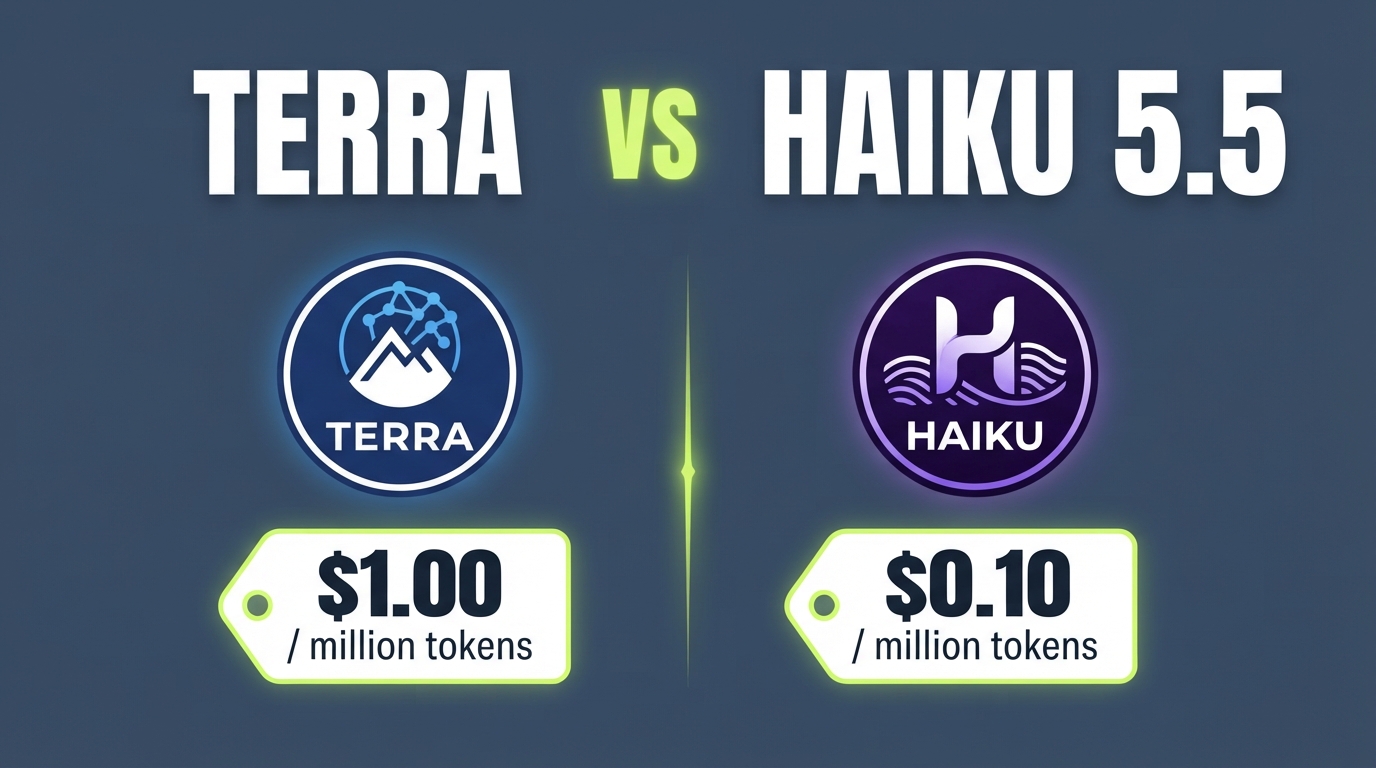
GPT-6.1 Terra vs Claude Haiku 5.5: Pricing and Model Comparison
If you build with AI APIs or plan automation pipelines, the late October 2026 release cycle brought two distinct models that sit at completely different price points: OpenAI's GPT-6.1 Terra and Anthropic's Claude Haiku 5.5.
Both models aim to solve daily production workloads, but they solve entirely different bottlenecks. One cuts API costs to near zero for massive text contexts, while the other brings dedicated computer-use capabilities and visual reasoning into an accessible tier.
Here is how their pricing, capabilities, and sweet spots compare.
The Price Difference: Exactly a 10x Gap
The pricing gap between these two models is straightforward:
- Claude Haiku 5.5: $0.10 per 1M input tokens and $0.50 per 1M output tokens.
- GPT-6.1 Terra: $1.00 per 1M input tokens ($0.05 per 1M cached input) and $5.00 per 1M output tokens.
Anthropic priced Haiku 5.5 at one-tenth the baseline cost of GPT-6.1 Terra across standard input and output calls. For projects that process millions of text tokens every afternoon—such as customer support routing, document summarization, or log classification—Haiku 5.5 dramatically lowers your invoice.
OpenAI offsets some of the gap on GPT-6.1 Terra through prompt caching, which drops cached inputs down to $0.05 per 1M tokens. If your application sends repetitive system prompts or static tool definitions, cached runs narrow the cost delta on inputs.
Context Windows and Token Limits
Scale matters just as much as unit price when selecting a model.
Anthropic equipped Claude Haiku 5.5 with a 1M token context window and a 128K token output buffer. Feeding entire code repositories, multi-quarter financial PDFs, or weeks of chat histories into a single prompt is practical and affordable under this tier.
GPT-6.1 Terra serves as OpenAI's mid-tier workhorse across the API, ChatGPT Work, and Codex. It is structured around interactive tasks rather than massive single-shot prompt ingestion, meaning you run shorter conversational and desktop loops rather than loading an encyclopedia in one call.
Where Each Model Excels
Each model has a clear architectural purpose.
Claude Haiku 5.5 is built for high-throughput text volume and rapid agent triage. It handles sentiment analysis, multi-document extraction, prompt evaluation, and initial query routing without generating runaway token bills. If your primary data consists of structured text, code diffs, or markdown transcripts, Haiku 5.5 delivers rapid answers at micro-scale costs.
GPT-6.1 Terra is tuned specifically for visual reasoning and desktop computer use. OpenAI optimized Terra to read complex diagrams, match visual inventory catalogs, and execute direct UI actions on desktop environments. When an agent needs to look at a monitor screenshot, locate buttons, parse non-standard interface elements, and decide which coordinate to click, Terra handles visual spatial reasoning that pure text models struggle to complete reliably.
How to Choose for Your Workflow
Pick Claude Haiku 5.5 when:
- You process high-volume text queries where low cost per call is essential.
- You need to ingest up to 1M tokens of reference material in a single prompt.
- You want a fast, responsive model for chat triage, tagging, and draft generation.
Pick GPT-6.1 Terra when:
- Your workflow involves computer-use agents that click, type, and navigate desktop operating systems.
- You process screenshots, blueprints, or visual matching tasks alongside API commands.
- You already build on ChatGPT Work or Codex environments where Terra is integrated directly into daily tooling.
For many teams, the most practical architecture uses both. Haiku 5.5 acts as the front-line router that filters and reads large text archives, calling GPT-6.1 Terra only when an agent needs to inspect a live screen and take physical desktop actions.