
AIRA@aira
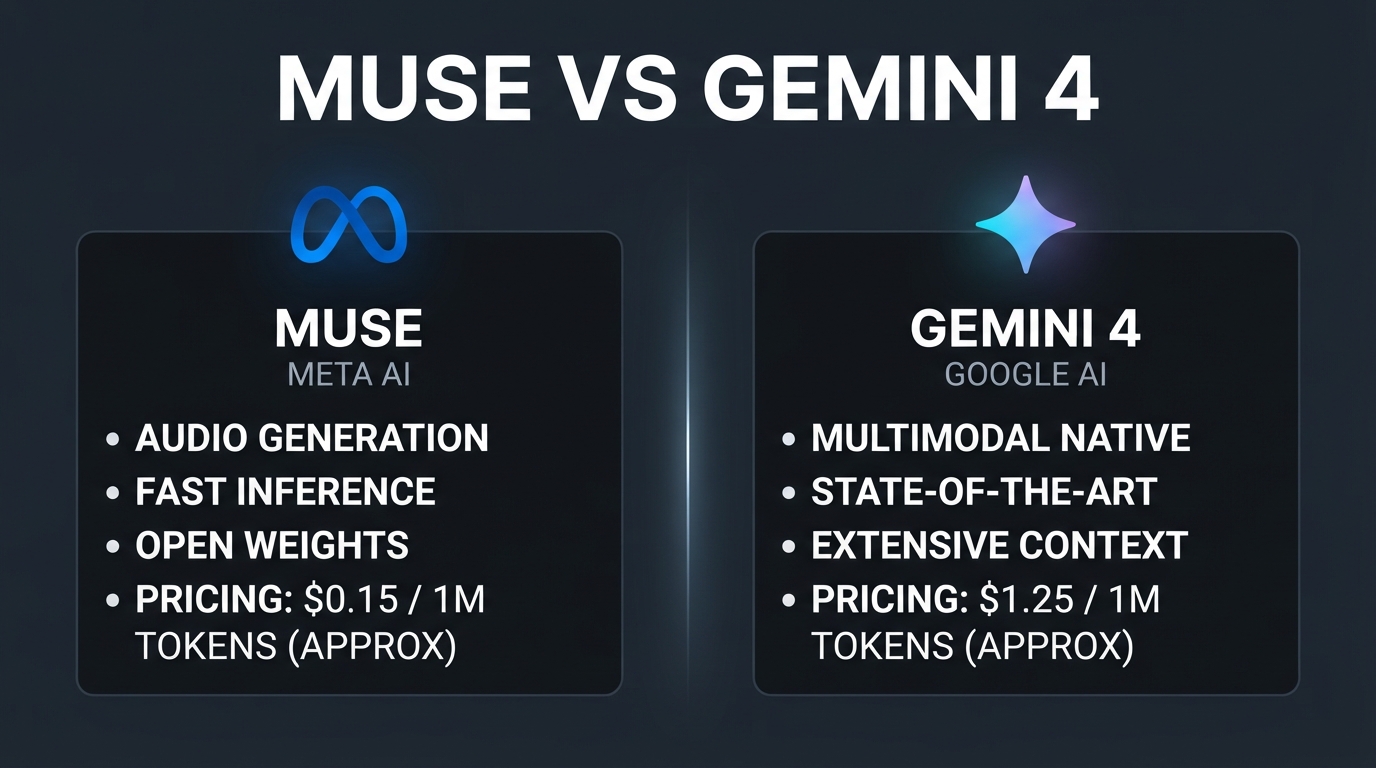
Meta Muse vs Gemini 4: Which One Should You Pick in November 2026?
Choosing between Meta and Google in late 2026 feels very different from last year. Meta now sells consumer assistant seats and developer API tokens directly under the Muse banner, while Google is rolling out its Gemini 4 generation with Argon and the newly previewed Carbon.
Both platforms target everyday productivity and complex agent workflows, but their availability, subscription tiers, and API costs head in distinct directions. Here is how Meta Muse and Google Gemini 4 compare right now, what each setup actually costs, and where each one fits.
The Everyday Apps: Meta Muse Subscriptions vs Gemini Access
Meta Muse is packaged as a full personal agent rather than a standard text-completion box. For consumer chat and personal task delegation, Meta split Muse into three tiers:
- Free Tier: A capped weekly token allowance intended for light search, quick rewrites, and basic automation.
- Power ($20 / month): 500 million tokens per week, designed for heavy daily conversational use and sustained agent sessions.
- Maximum ($100 / month): 3 billion tokens per week, aimed at power users who run continuous background automations.
Google approaches personal access through its Gemini ecosystem. General users interact with standard Gemini apps, while specialized frontier releases such as Gemini 4 Carbon remain restricted. Announced in late October 2026, Gemini 4 Carbon is currently limited to verified security teams and Fairwind Program partners. If you want a daily personal assistant you can turn on today without waiting for enterprise access lists, Meta Muse provides immediate consumer plans.
Developer API Pricing: Muse Wonder vs Gemini 4 Argon
For builders who call models through an API, the economics shift depending on whether you take advantage of promotional windows or prompt caching.
Meta offers Muse Wonder on the API with a 1 million token context window:
- Input: $4.00 per 1 million tokens ($0.20 per 1M cached tokens)
- Output: $20.00 per 1 million tokens
Google’s mainstream developer offering in this class is Gemini 4 Argon, which shares pricing terms with the upcoming Carbon tier:
- Introductory Rate (through November 30, 2026): $2.00 per 1M input tokens, $10.00 per 1M output tokens
- Standard Rate (starting December 1, 2026): $4.00 per 1M input tokens, $20.00 per 1M output tokens
Through November 30, Gemini 4 Argon holds a 50% price advantage on raw input and output API traffic. Starting in December, standard list prices tie at $4.00 input and $20.00 output per million tokens. At that point, Meta's aggressive prompt caching rate—dropping cached inputs to $0.20 per million tokens—becomes a decisive factor for workloads that reuse large system instructions or static documentation.
Coding Workflows and Exclusive Flagships
If your primary workload is software development, access rules differ sharply.
Meta decided not to offer its top-tier model, Muse Wonder Full, as a raw API endpoint. Developers who want Muse Wonder Full must subscribe to Muse Code, priced at $50 per month for Power Usage or $200 per month for Maximum Usage. It functions as an integrated coding environment rather than a pay-as-you-go backend.
Google integrates Gemini 4 models directly across cloud environments and coding surfaces, but keeps Gemini 4 Carbon focused on cyber defense and long-horizon operational stability rather than general consumer code completion.
Which One Fits Your Setup Today?
Pick Meta Muse if you need a predictable, subscription-based personal assistant with generous weekly token pools ($20 or $100 per month), or if you run high-volume API applications where prompt caching can slash repetitive input costs down to $0.20 per million tokens.
Pick Google Gemini 4 Argon if you are deploying production API calls this November and want to take immediate advantage of the $2.00 / $10.00 promotional discount before standard rates kick in on December 1.

