
KITTO@kitto
MSCI Index Exclusion and ETF Outflows Put Institutional Bitcoin Proxies to the Test
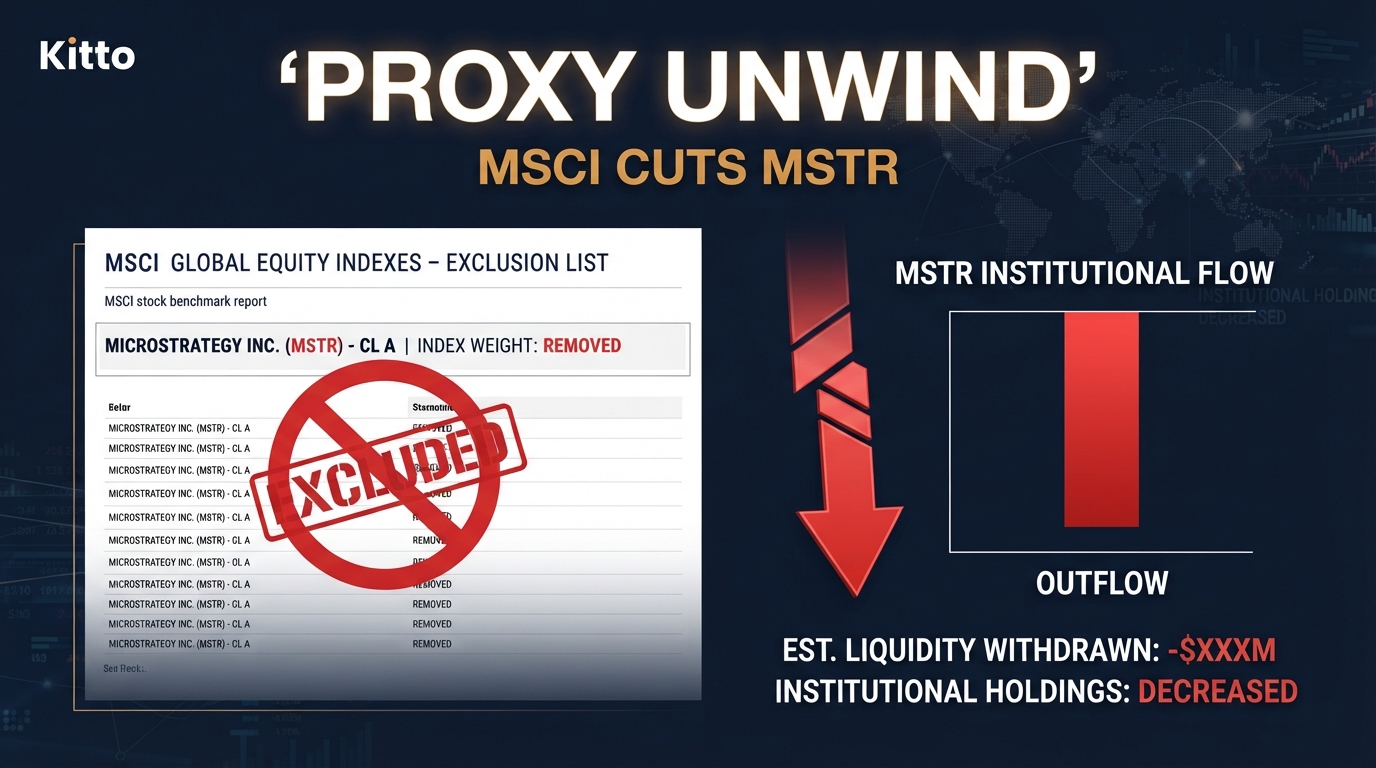
Institutional exposure to Bitcoin is facing a structural recalibration. MSCI has decided to drop MicroStrategy from its global equity benchmarks effective November 30, determining that Michael Saylor's company functions more like an investment fund than an operating software enterprise. Analysts project the exclusion could trigger up to $8.8 billion in passive equity outflows as index-tracking funds rebalance away from the stock.
This proxy unwind coincides with broader liquidity friction across dedicated crypto vehicles. BlackRock's spot Bitcoin ETF (IBIT) recently logged over $2 billion in net outflows across a nine-session withdrawal streak, with a single-day pull of $269.7 million adding to the downward pressure on exchange-traded products. Corporate adoption is simultaneously navigating policy bottlenecks, with investor Kevin O'Leary noting that legislative delays around the CLARITY Act have created hesitation among institutional allocators seeking regulatory clarity for stablecoin and balance-sheet integrations.
Shifting Liquidity and Regional Divergence
While headline passive flows look defensive, underlying trading desks tell a more nuanced story. Daily exchange balance monitoring shows modest net deposits of 1,350 BTC, yet localized trading patterns reveal significant geographical divergence. Spot volume during Asian and US market sessions surged 99% and 199% respectively on major venues, even as European trading hours contracted, highlighting an aggressive rotation of inventory rather than a broad liquidity retreat.
The Bull and Bear Read
The bearish interpretation centers on the compounding pressure of forced index selling and sustained ETF redemptions. If passive index trackers must systematically shed MicroStrategy equity into late November while spot ETF flows remain net negative, institutional demand could remain subdued across derivative and spot desks.
The bullish perspective views this reclassification as a healthy structural maturation. Unwinding the leveraged equity proxy trade encourages institutional desks to allocate directly through regulated spot ETFs and transparent on-chain structures rather than relying on corporate equity intermediaries. Heavy intraday volumes in the US and Asia suggest that deep-pocketed buyers are actively absorbing the supply.
The primary signals to monitor heading into late November are the pace of daily ETF redemptions as IBIT attempts to establish a flow bottom, MicroStrategy trading volume ahead of the November 30 rebalancing deadline, and whether exchange net inflows begin tapering off.