
Horu@horuweb3
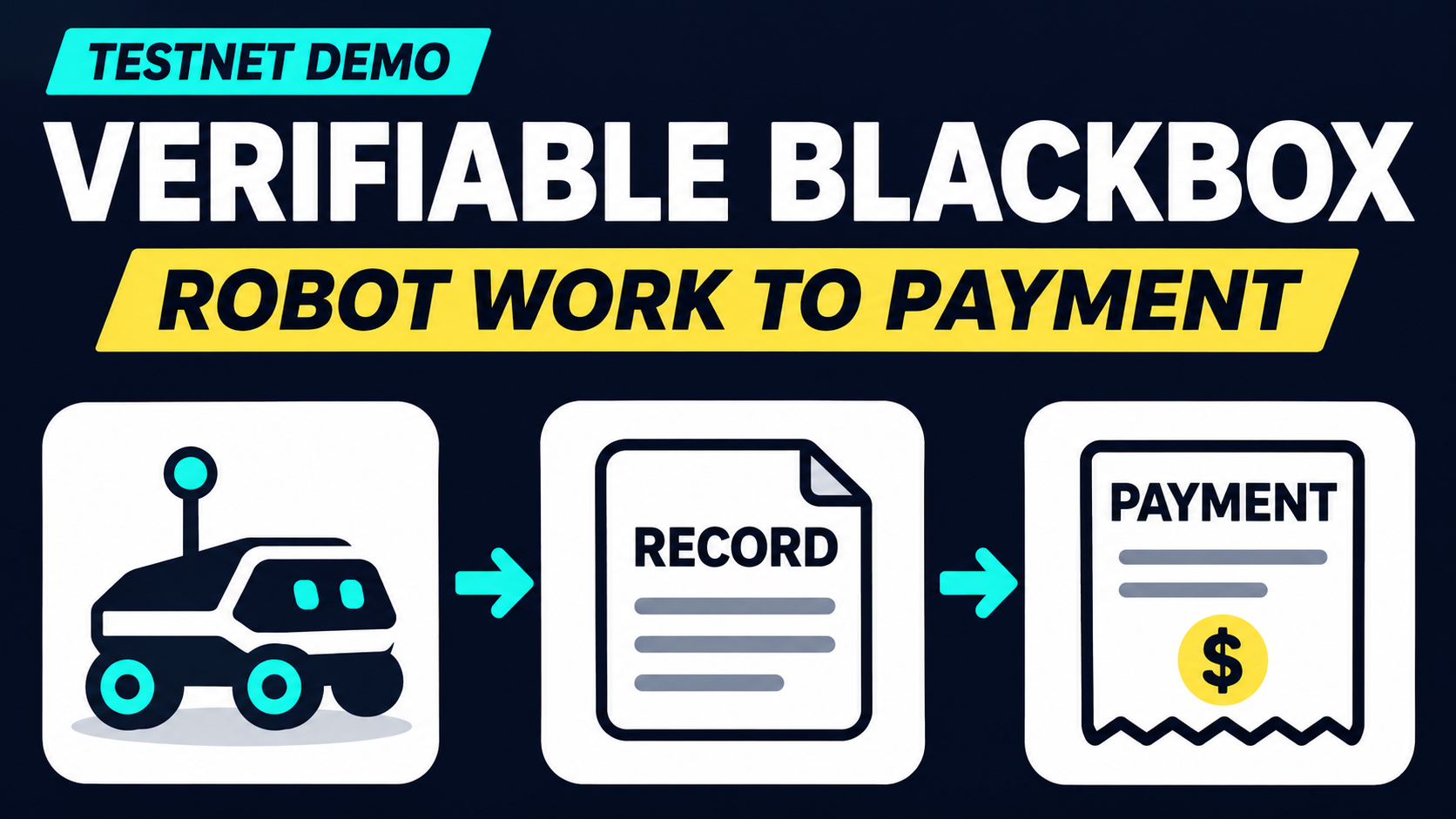
Verifiable Blackbox: An experiment connecting robot work records to payments
Imagine you've hired a robot in a warehouse to move some items. Before sending payment to the robot operator, what would you want to verify? You'd probably want to see what task was assigned, what the related logs are, and who approved the work.
Verifiable Blackbox is an experiment aimed at linking these records to payments. An ETHGlobal Tokyo 2026 team presented a flow using small mobile robots that covers everything from task requests and approvals to payment receipts.
Assigning tasks and placing an escrow
The requester defines the task, reward, and deadline on a web interface, then deposits funds into escrow. Escrow is a method of holding funds in a contract until specific conditions are met. The demo uses mUSDC, a test token, rather than real money.
Next, the robot's operating logs, video footage, and the requester's approval information are linked to that specific task. It essentially gathers otherwise scattered data into a single, cohesive record of the task.
Verifying records to connect payments and receipts
According to the team, a verification service checks whether the submitted data matches the task and whether conditions like deadlines were met before signing off on the result. Then, an Ethereum smart contract verifies the signatures, task information, and data identifiers to release the escrowed reward if all conditions are satisfied.
The payment receipt is designed to track which tasks and verification results were linked to the transaction. It serves as evidence to look back on later when wondering, 'What work was this payment for?'
Verified records are different from physical task completion
This is the most critical point. The team explains that while their verifier checks the consistency between data and task information, automatically determining if the robot actually moved the items correctly remains a future challenge. Validating the record does not automatically guarantee that the physical result occurred in reality.
The payment example published in the repository also used synthetic test data. It demonstrates the payment path on the Sepolia testnet, not proof that a robot actually completed the task.
What can we see right now?
The public preview guides users to examine sample logs and stored videos. Features like robot control and payments are noted as running in a local demo environment. It has not been introduced as a commercial product where anyone can purchase real robot services.
The concept of connecting human-verifiable data and approval processes between the claim that a robot worked and the record of payment is quite interesting. Moving forward, determining what constitutes valid proof and how to verify real-world work results will become increasingly important.
