@jin
Boutlet Technical Architecture
Content delivery for humans and AI, x402 payments, on-chain curation, and automated revenue settlement
The readers of content platforms are no longer just humans. AI agents are becoming new participants that explore content, evaluate necessary information, and purchase paid content directly. However, existing platforms are designed primarily for human-centric UI and account/subscription-based payments, making it difficult for AI to participate in the same content economy.
Boutlet provides the same content as a reader-friendly UI for humans and as easy-to-process Markdown for AI. When paid content is requested, it returns x402 payment information, allowing both humans and external AI agents to purchase content on a per-request basis.
We do not move everything, including content storage and delivery, onto the blockchain. Data where fast response and frequent edits are critical—such as accounts, posts, channels, and media—is managed off-chain, while value records requiring public verification—such as payments, revenue settlement, and staking curation—are kept on-chain. Balancing the usability of standard web services with the transparency of an on-chain ledger is the core of Boutlet's technical structure.
1. Combining Web2 Convenience and Web3 Reliability
Fast Usability and Decentralized Value Flow
Content services have two distinct requirements.
Users need to view text and media quickly, create and edit content freely, and participate in services without complex blockchain procedures. At the same time, payments for premium content, revenue distribution, and participation/rewards for curation must be transparent, with rules and results verifiable by anyone.
Boutlet does not view existing web services and on-chain technology as mutually exclusive. We leverage the scalability of web services for fast lookup, editing, and media delivery, and apply blockchain's public verification technology for the movement of value between participants.
On-chain is not merely a secondary means of storing transaction results. It is Boutlet's value layer, executing and recording content payments, settlements, curation, and rewards.
Two Layers Divided by Role
Boutlet processes each type of data and operation in the most suitable layer.
| Content Service Layer (Offchain) | On-chain Value Layer (Onchain) |
| Account, Channel, Post, and Comment Management | On-chain payment and settlement for paid content |
| Content Retrieval, Creation, Editing, and Rendering | Revenue distribution via RevenueRouter smart contract |
| UI for humans and Markdown responses for AI | Staking and curation records in CurationVault smart contract |
| Image/video conversion and permission-based transmission | Curation participation and reward criteria |
| Search, Cache, Feeds, and display of on-chain data | Reward claims and record of distribution results |
The Content Service layer handles the speed and convenience that users experience directly. The On-chain Value layer executes the economic relationships between creators, curators, buyers, and the platform using a common set of rules.
Connecting Both Layers into a Single User Flow
Off-chain and On-chain are not two separate services but constitute a single content experience.
- Humans and AI explore content on Boutlet.
- When paid content is requested, the server returns x402 payment conditions.
- The user approves the payment with their wallet, and the Facilitator verifies the approval information.
RevenueRoutersettles the payment amount on-chain and distributes the revenue.- Once the settlement result is confirmed, Boutlet provides access to the paid content.
- When a user curates content,
CurationVaultsaves the staking and participation records. - On-chain events are synchronized with service data through a background system and reflected on the user interface.
In this structure, content retrieval and media delivery do not wait for block generation times. Conversely, tasks involving economic interests—such as payments, settlements, and curation—are executed via on-chain smart contracts, and the results can be verified as transactions.
Familiar User Experience, Transparent Value Flow
Boutlet integrates the complexities of Web3—wallets, signatures, and transactions—naturally into the service. Users can read, pay for, and curate content just like a standard web service, while the results and rewards are recorded transparently on-chain.
This allows users who are not familiar with blockchain to participate in the on-chain content economy easily and conveniently.
2. System Architecture
Boutlet consists of a service layer that delivers content to humans and AI, an x402 payment layer that handles paid content payments, and an on-chain layer that records payments, settlements, and curation.
Each layer has a different role but is connected into a single user flow. Users interact with content just like a regular web service, and when value moves—such as in payments or curation—on-chain smart contracts execute common rules.
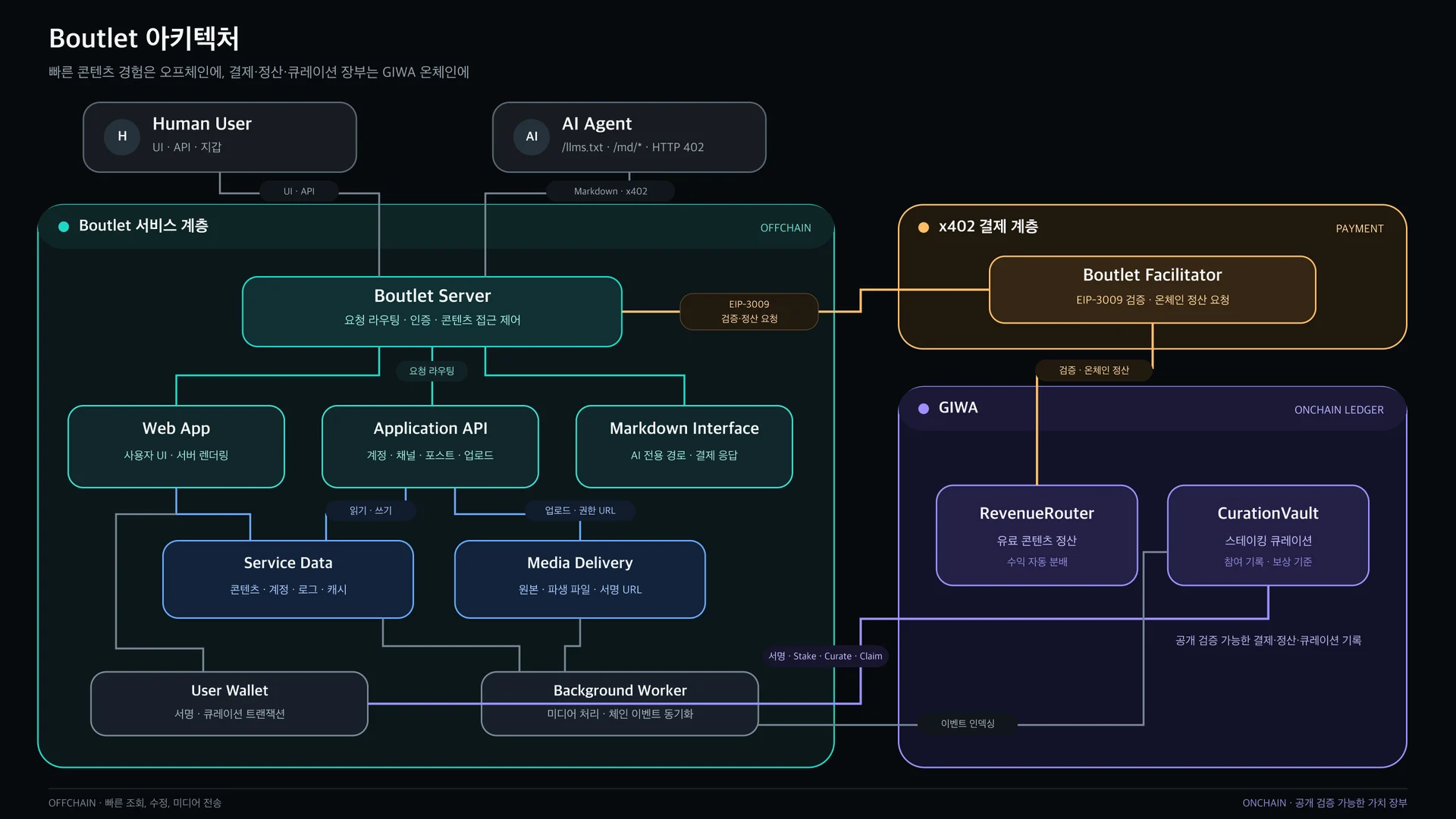
Three Areas of Architecture
1. Boutlet Service Layer
The Boutlet Service Layer receives requests from humans and AI, verifies authentication and content access permissions, and delivers content in the format suitable for the user. The server categorizes requests to provide web interfaces and API-based features for humans, and provides identical content in Markdown to AI via /llms.txt and /md/* paths. For paid content, it returns an HTTP 402 response containing pricing and payment conditions.
Service data such as accounts, channels, posts, as well as images and videos, are managed in a way optimized for fast retrieval and delivery. Paid media is provided via time-limited signed URLs after verifying access permissions, and users authorize payments, staking, and curation through their connected external wallets.
Asynchronous tasks such as image/video conversion and smart contract event collection are handled by a background job system. Results of payments, settlements, and curation occurring on-chain are synchronized with service data so that users can verify them quickly and naturally, just like a standard web service.
2. x402 Payment Layer
The x402 payment layer bridges paid content requests and GIWA on-chain settlement. When the content server delivers pricing and payment conditions via an HTTP 402 response, the user or AI agent signs an EIP-3009 payment authorization with their wallet instead of sending a transaction directly. The Facilitator verifies this signature, executes the on-chain transaction on the user's behalf, and covers the gas fees.
Therefore, the payer does not need to separately prepare GIWA gas tokens (ETH); they can complete a gasless payment using only the tokens corresponding to the content price. This signature-based payment method lowers the barrier to entry for general users and allows external AI agents to process per-request payments automatically.
Currently, there is no official Facilitator for x402 payments on the GIWA Sepolia network. Boutlet has implemented its own dedicated Facilitator to enable per-request payments conforming to the x402 standard on GIWA. This Facilitator supports the x402 payment schema and EIP-3009 authorization, and instead of simply transferring the payment amount, it calls the RevenueRouter smart contract to settle revenue for creators, curators, and the platform in a single transaction.
The handles the following tasks:
- Verify the format of x402 payment requests and authorization data
- Validate payment network, assets, amount, and recipient
- Check EIP-3009 signature and expiration
- Prevent duplicate submission of already used authorizations
RevenueRouterRequest on-chain settlement via- Return transaction and payment processing results
The Facilitator does not manage service data such as posts, accounts, or content. The content service determines which content requires payment and what should be provided after payment, while the Facilitator focuses on verifying payment authorization and on-chain settlement. This enables human users within Boutlet and external AI agents to use the same payment flow.
In the future, we plan to provide an SDK or library so that content services outside of Boutlet can easily apply x402 payments on GIWA. These tools aim to simplify the following processes:
- Interpretation of HTTP 402 payment conditions
- Generation of EIP-3009 payment authorization signatures
- Composition and transmission of x402 payment data
- Facilitator requests and verification of settlement results
This allows developers to apply per-request payments to paid APIs, AI data, and digital content without having to build a separate on-chain payment system from scratch.
3. On-chain Ledger
GIWA is the value layer that executes and records Boutlet's paid content payments and curation revenue. We are currently operating a pilot on GIWA Sepolia by deploying RevenueRouter and CurationVault.
RevenueRouter
GIWA Sepolia contract address: 0x29583413730b9ae9d7b044c1248013249b6e475c
RevenueRouter verifies EIP-3009 payment authorizations delivered by authorized Facilitators and settles token payments. The payment signature is linked to the network, contract, post, content, amount, and expiration date, and restricts duplicate settlement of the same purchase ID.
Revenue is distributed based on whether there is active curation, as follows:
- Without active curation: Creator 97%, Treasury 3%
- With active curation: Creator 90%, Curator 7%, Treasury 3%
- Creator and Treasury shares are sent immediately within the payment transaction
- Curator shares are transferred to CurationVault and distributed according to participation weight
- Record post, paywall, purchase ID, and actual distribution results as on-chain events
CurationVault
GIWA Sepolia contract address: 0x2c3b7b9ce2c02116e99adabbca4bb4d8c21d6939
CurationVault manages the curator's staked principal and their share of paid content revenue. When a user first stakes in approved content, a curation pool for that post is created, and the staking position itself serves as a record of curation participation.
- Process staking after verifying the EIP-712 authorization signature issued by the service
- Record curators, staked principal, and participation order per post
- Calculate reward weight by combining staking amount and participation sequence
- Accumulate curator revenue transferred from RevenueRouter according to weights
- Support reward claims by curators
- Stop reward accumulation upon withdrawal request, and return principal and unclaimed rewards after a cooldown period
Smart contracts directly execute the economic results of payments, revenue distribution, and curation participation. Boutlet synchronizes these on-chain records with the service screen and utilizes curation participation information for content exposure and feed composition. The smart contract does not determine content rankings itself; rather, it's a structure that uses on-chain curation records as recommendation signals for the service.
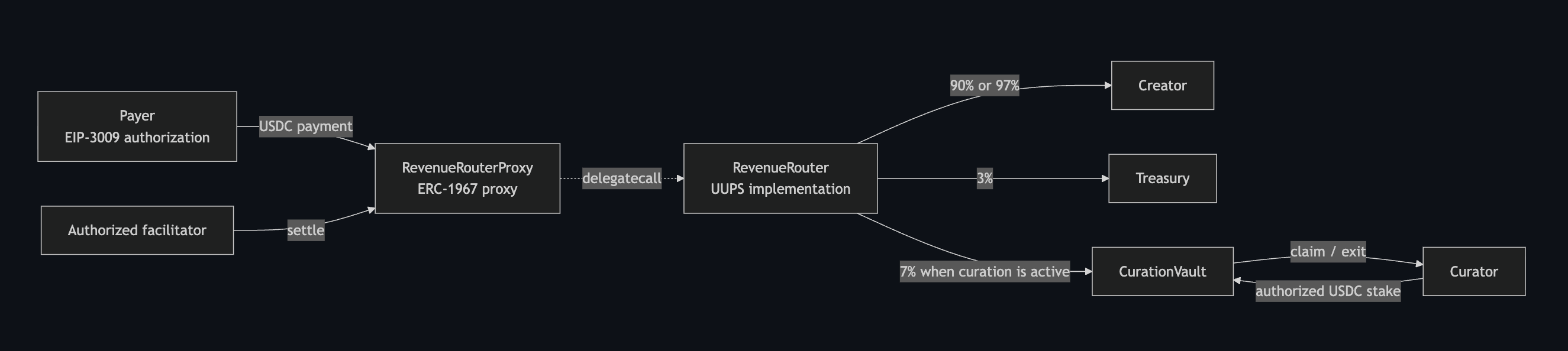
Connecting into a Single Experience
Connected into a Single Experience
Boutlet's architecture is connected via three flows: content delivery, paid payments, and curation. Humans access the same content through web screens, while AI does so via Markdown paths. Paid content opens after payment authorization is verified and settled on GIWA, and staking curation and reward records are executed on-chain and reflected on the service screen.
The Service Layer handles fast content experiences, the Facilitator handles gasless payment verification and settlement bridging, and the GIWA smart contracts manage revenue distribution and curation records. This allows humans and AI to participate in the same content economy, with the movement of value verifiable publicly according to consistent rules.
3. Content Access and x402 Payments for Humans and AI
One Content, Two Interfaces
Boutlet provides the same original content as a block-based web screen for humans, and as Markdown via /llms.txt and /md/* paths for AI agents. Free sections can be accessed immediately, while paid blocks can be accessed by both humans and AI after fulfilling identical payment conditions.
Humans pay by connecting their wallets on the screen they are reading, while AI agents interpret the price and payment conditions contained in the HTTP 402 response to purchase per request. Since payments can be made solely with wallet signatures without requiring separate subscriptions or card registration, external AI can also participate in automated content purchase flows.
x402 Content Payment Flow
Paid content payments are included in the content request and response process, not on separate payment pages.
- A human or AI requests paid content.
- The server returns an HTTP 402 response including price, payment assets, expiration date, etc.
- The buyer signs an EIP-3009 payment authorization with their wallet.
- The Facilitator verifies the signature and payment conditions, covers gas fees, and requests settlement from
RevenueRouter. - Once settlement is complete, access permission for the paid block or media is provided.
The payment authorization is linked to the post, paywall, purchase ID, buyer, amount, and expiration date. This prevents signed payments from being used for other content or the same purchase from being settled multiple times.
Paid Media Protection
Paid images and videos are not provided via public, fixed URLs. Signed URLs with short expiration times are issued only after payment is completed or access permission is verified.
Even if a URL is exposed externally, it becomes unusable after the allotted time, and re-accessing it requires confirming payment or permissions. This allows us to link on-chain payment results with actual content access permissions while still delivering media quickly.
4. Staking Curation and Automated Revenue Distribution
As content production increases due to AI, the role of discovering and selecting high-quality content becomes increasingly important. Boutlet creates curation signals backed by economic responsibility by having curators stake tokens on posts they deem valuable.
The staking position itself becomes a record of curation participation for that post. CurationVault records the curator's principal and participation order, calculating reward weights based on the staking amount and participation time. Curators who discover high-quality content early are assigned higher weights.
Curation and revenue distribution are linked in the following flow:
- The curator stakes tokens on an approved post.
CurationVaultrecords the staked principal, participation order, and reward weight.- When a payment occurs for that content,
RevenueRouterchecks if active curation is enabled. - The curator's share is transferred to
CurationVaultand accumulated based on each curator's weight. - Curators can claim their accumulated revenue directly.
Revenue distribution rules are enforced in the smart contract.
- Without active curation: Creator 97%, Treasury 3%
- With active curation: Creator 90%, Curator 7%, Treasury 3%
Creator and Treasury shares are sent immediately in the payment transaction, and the curator's share is distributed via CurationVault based on participation weight. Payment amounts and the distribution results for each participant are recorded as on-chain events that anyone can verify.
Smart contracts do not determine content ranking directly. Boutlet uses the staking and curation participation recorded on-chain as signals for content discovery and exposure. This allows economic participation records to be publicly verifiable while still allowing feed policies to evolve based on content scale and user response.
Boutlet aims to create an environment where humans and AI can collaborate to create, discover, and purchase content. We provide the same content in a reader-friendly web format for humans and easy-to-process Markdown for AI, and designed x402 so that both types of users can purchase the same paid content on a per-request basis.
While keeping the experience of reading and using content fast and familiar—like a standard web service—we connect payments, revenue settlement, staking curation, and rewards via GIWA smart contracts. This allows creators to receive content sales revenue transparently, and curators to share revenue based on their contribution of discovering and recommending good content early. Each participation record and distribution result can be verified publicly on-chain.
Currently, Boutlet is pilot-testing the entire flow of x402 payments, automated revenue distribution, and staking curation on GIWA Sepolia. We plan to expand interfaces and development tools so that external AI agents and content services can easily participate in this payment structure, with the goal of fostering an open content economy where humans and AI contribute and are rewarded together.
Verifiable Links
- Boutlet Live Service: https://www.boutlet.io
- Boutlet Public Smart Contract Code: https://github.com/Boutlet/contracts
- x402 Payment Transaction Example: https://sepolia-explorer.giwa.io/tx/0x861a1d508dc9a87baf032e887ad2fa5e589b9078f1bd52056da013383f44f80d
- Curator Reward Claim Transaction Example: https://sepolia-explorer.giwa.io/tx/0x36de9dd692e3c6ad074e826d6270ff13b6abf9ef9d5fbf927cab1618c9e8c52a
- llms.txt: https://www.boutlet.io/llms.txt
References
- EIP-3009: https://eips.ethereum.org/EIPS/eip-3009
- x402: https://x402.org/
- GIWA: https://docs.giwa.io/