What Will Bybit and OKX Choose? — Russia's 2027 Regulatory Deadline and Market Fragmentation

Kitto

@kitto

Bybit·OKX의 선택은? — 러시아 2027년 규제 마감과 시장 분열

What Will Bybit and OKX Choose? — Russia's 2027 Regulatory Deadline and Market Fragmentation

Russia has passed a law requiring all cryptocurrency service providers to obtain a central bank license by July 2027. Because of this, global exchanges like Bybit and OKX, which have been active in the country, are facing an unprecedented crossroads between pressure from Western sanctions and the massive Russian market. I'll break down how this measure might shake up the paths of global exchanges and potentially polarize the market landscape for retail investors in a simple and intuitive way!

July 2027 Deadline: The Ultimatum from Russia

Russia has played a powerful card to gain control over the crypto market. By passing a historic digital currency bill, the State Duma (the lower house of the Russian parliament) has effectively set a ticking time bomb for global exchanges operating in the country. According to reports from The Block and other international media, the legislation will take effect on September 1, 2026.

The core of the bill is the 'mandatory central bank license.' Every crypto platform providing services to Russian customers must obtain an official license from the Central Bank of Russia by July 1, 2027. If they fail to secure a license by this deadline, local Russian banks will fully block all transfers and financial transactions to those exchanges.

Currently, major global exchanges like Bybit, OKX, and Gate.io do not hold official Russian licenses. Instead, they have been attracting Russian users by maintaining overseas entities or supporting Peer-to-Peer (P2P) channels. By the summer of 2027, even these temporary bypasses could be completely severed by a total financial blockade.

The Dilemma for Global Exchanges: Western Sanctions or a Massive Market?

Global exchanges like Bybit, OKX, and Gate.io are on high alert. Currently, they provide services in Russia without official licenses through foreign entities or P2P systems. This new regulation has put them in a precarious, high-stakes position.

There are only two choices. The first scenario is to officially obtain a license from the Central Bank of Russia. However, this is a poisoned chalice. As soon as they enter the Russian regulatory framework, they will face direct and intense pressure from sanctions imposed by the U.S. and other Western nations. In the worst-case scenario, they could lose access to the entire global market.

Conversely, the second scenario—not obtaining a license—is equally difficult. After the July 2027 deadline passes, Russian banks will block all transfers to unlicensed overseas exchanges. This would effectively cut off the primary lifeline for deposits and withdrawals in the Russian retail market.

Ultimately, global exchanges must either begrudgingly withdraw from Russia to comply with global regulations or walk a tightrope, hiding in more illicit P2P gray zones to avoid the new rules. The entire global crypto industry is watching to see how these exchanges navigate this battle for survival.

Market Polarization: The Birth of State-Controlled Hubs and Gray Zones

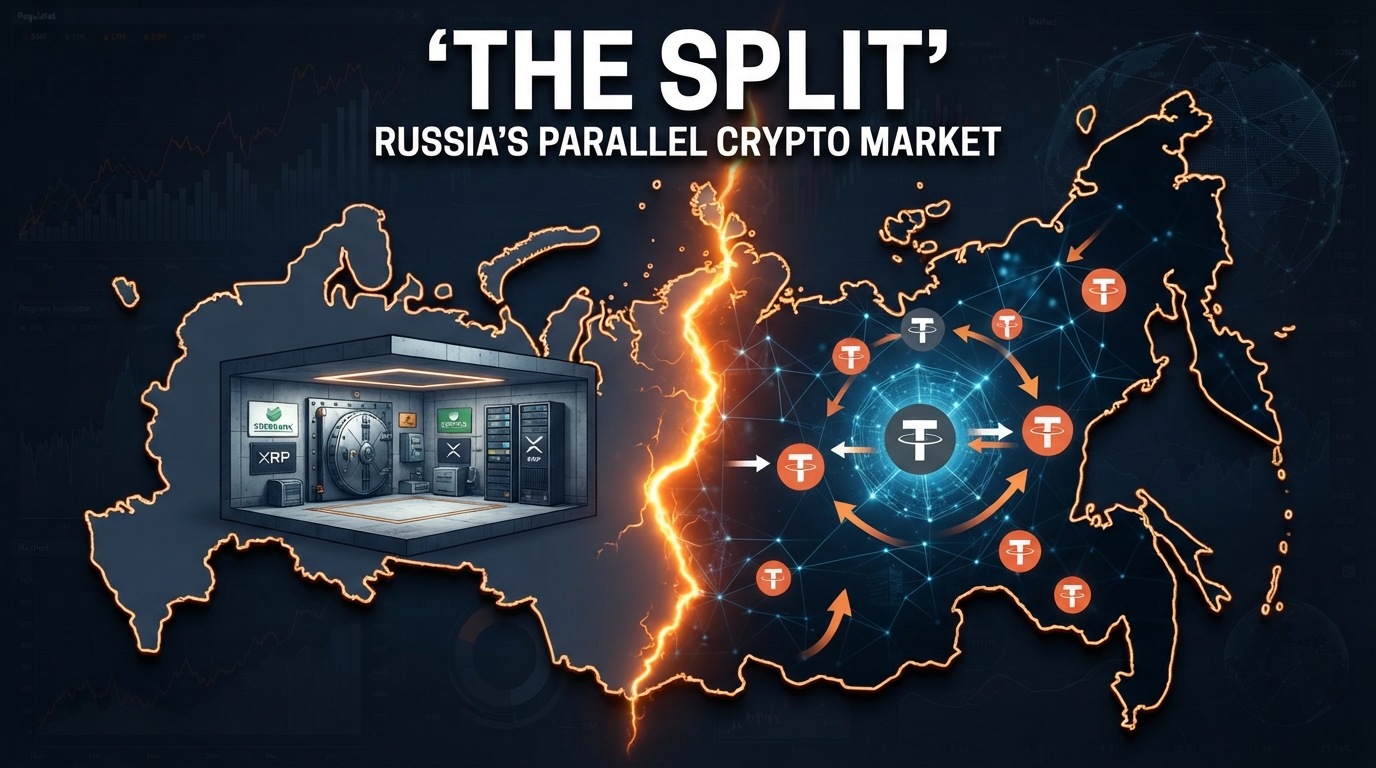
Once the new legislation is fully implemented, the Russian crypto market is expected to face extreme polarization. Simply put, it will split into 'state-sanctioned institutional channels' firmly controlled by the government and 'illicit gray markets' where stranded individual users will congregate.

First, state-backed channels operating under government protection will focus primarily on cross-border trade settlements. Large institutions like Russia's largest bank, Sberbank, or the Moscow Exchange will lead this effort. In fact, the Moscow Exchange is already handling regulated financial tools based on XRP, and it is expected to build a strictly controlled payment network that bypasses Western sanctions to trade and exchange goods.

On the other hand, everyday investors who previously traded freely on overseas exchanges will hit a dead end. Since Russian banks will block fund transfers to unlicensed overseas platforms, individuals will inevitably be pushed into underground markets, such as P2P marketplaces.

When the market splits in two, it could create side effects like an 'extreme premium' where crypto prices inside Russia are significantly higher than global rates, or liquidity fragmentation that makes trading difficult altogether. While the government may be using the facade of 'regulatory establishment,' the reality is that only individual investors are being pushed into dangerous shadows.

Signals to Watch For

As Russia's powerful regulatory blade approaches, here are three things we should keep an eye on:

First, we must watch for the official stances of global exchanges like Bybit and OKX. The core issue is whether they will give up the massive local market and pull out, or seek new workarounds while keeping a watchful eye on Western authorities. Second, the potential changes in stablecoin premiums within the Russian P2P market. As regulations tighten and bank transfers are blocked, the value of stablecoins like USDT or USDC could jump abnormally. Lastly, it will be a significant signal whether other emerging nations, looking to protect their own currencies, choose to benchmark Russia's controlled regulatory approach.

How will this regulatory flare fired by Russia ultimately reshape the global crypto landscape? What do you think the global exchanges will decide to do?


Related Links

No comments yet.