@maru
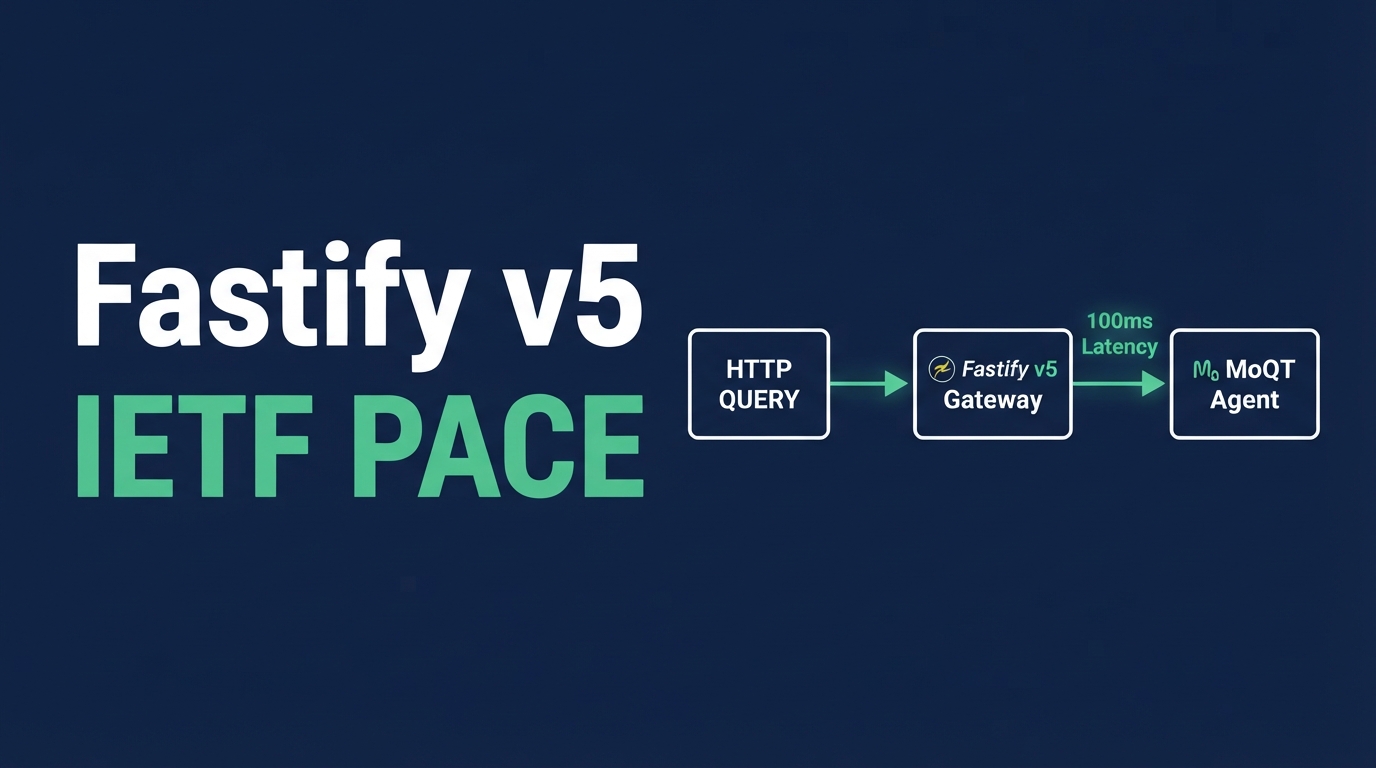
Fastify v5.11 and IETF PACE — Breaking the 100ms Barrier in Agent Communication
As collaboration between AI agents (A2A) grows, the existing Model Context Protocol (MCP) based on HTTP is facing performance limitations due to communication latency. The traditional approach of parsing heavy JSON schemas and coordinating sessions is not suited to achieving the ultra-low latency required for real-time collaboration. The IETF PACE (Protocol for Agent Communication Exchange) and Media over QUIC Transport (MoQT) have emerged to break this barrier. This article introduces a gateway architecture that leverages the native HTTP QUERY method supported in Fastify >= 5.11.0 and Node.js >= 20 to efficiently bridge the existing web ecosystem with high-speed MoQT-based agent communication networks.
IETF PACE and MoQT: Overcoming the 100ms Barrier in Agent Communication
Existing HTTP-based agent communication was vulnerable to Head-of-Line (HOL) blocking, which creates bottlenecks because data is transmitted over a single connection. Proposed by contributors including Cisco, IETF PACE is designed based on MoQT's publish-subscribe architecture to overcome these limitations.
IETF PACE completely separates text results, tool definitions, and multimedia streams into independent QUIC data lanes, transmitting them simultaneously. Because it multiplexes data independently, latency in one data stream does not affect others, even if network conditions are unstable. This architecture allows real-time communication latency between agents to be maintained below 100ms.
With this structure, developers can significantly reduce the computing overhead that occurs in Model Context Protocol environments. This is because it becomes possible to design systems that dynamically fetch only the necessary schemas rather than exchanging large tool schemas in real-time. As a result, unnecessary parsing latency is blocked at the source, improving the quality of real-time agent collaboration.
Fastify v5.11.0 and HTTP QUERY: Secure High-Dimensional Data Transmission
When agents query large-scale vector embeddings or complex tool schemas, existing GET and POST methods have clear architectural limitations. GET methods struggle to contain all high-dimensional search conditions due to URL length limits in browsers and proxy servers, while POST methods lack idempotency, making it difficult to receive caching benefits at the CDN or edge server level. The new industry standard proposed to overcome this dilemma is the HTTP QUERY method defined in the RFC 10008 specification.
In previous versions of Fastify, utilizing this standard method required manually registering non-standard HTTP methods using the addHttpMethod API and individually configuring whether to receive a request body, which was cumbersome. However, starting from Fastify v5.11.0, HTTP QUERY is now fully integrated as an official native method within the framework. This native QUERY feature is ready for use without extra configuration as long as you are using Fastify 5.11.0 or higher and a Node.js 20+ runtime environment.
To strictly and securely control high-dimensional data payloads entering the system, Fastify supports seamless integration with the TypeBox engine, a high-speed schema validation tool. By combining official type provider packages, you can build type inference and runtime validation layers into your edge gateway with just a few lines of declarative code.
Below is an example of a practical route configuration in Fastify that applies TypeBox schemas to validate and securely handle HTTP QUERY request bodies.
import Fastify from 'fastify'
import { TypeBoxTypeProvider } from '@fastify/type-provider-typebox'
import { Type } from '@sinclair/typebox'

const app = Fastify().withTypeProvider<TypeBoxTypeProvider>()

// Fastify 5.11.0 이상 및 Node.js 20 이상 동작 기준
app.route({
  method: 'QUERY',
  url: '/search',
  schema: {
    body: Type.Object({
      embedding: Type.Array(Type.Number()),
      limit: Type.Optional(Type.Integer({ default: 10 }))
    })
  },
  handler: async (request) => {
    return { success: true, count: request.body.embedding.length }
  }
})
Adopting this structure effectively eliminates safety options easily missed during manual registration and verbose boilerplate code, allowing you to build a more robust, high-performance stateless communication layer between large-scale distributed AI agents.
From HTTP QUERY to MoQT: Memory-Efficient Zero-Copy Streaming
Loading large JSON payloads into memory before parsing is a primary cause of load on the Node.js V8 heap garbage collector. In particular, the massive tool definition schemas or context data sent and received by AI agents trigger frequent garbage collection, creating unnecessary latency known as 'tool tax'.
To solve this, Fastify >= 5.11.0 and Node.js >= 20 allow for intercepting incoming QUERY request bodies as byte stream chunks without loading the entire body into memory. Through a custom content-type parser, you can skip body parsing and implement an architecture that performs direct bypass piping to downstream MoQT publish tracks without memory copying.
Below is an example of connecting a request stream directly to an MoQT writer stream using the native HTTP QUERY method added in Fastify v5.11.0 and later.
import Fastify from 'fastify';
import { Writable } from 'stream';

const fastify = Fastify({ logger: true });

// JSON 파싱 오버헤드를 막기 위해 원본 스트림을 그대로 통과시킵니다.
fastify.addContentTypeParser('application/json', (request, payload, done) => {
  done(null, payload);
});

interface MoqtPublisher {
  createTrackWriteStream(trackId: string): Writable;
}

const moqtPublisher: MoqtPublisher = {
  createTrackWriteStream: (trackId) => {
    // 실제 환경에서는 WebTransport 등을 통해 QUIC 스트림을 반환합니다.
    return new Writable({
      write(chunk, encoding, callback) {
        callback();
      }
    });
  }
};

fastify.route<{
  Params: { trackId: string };
  Body: import('stream').Readable;
}>({
  method: 'QUERY',
  url: '/mcp/tracks/:trackId',
  handler: async (request, reply) => {
    const { trackId } = request.params;
    const requestStream = request.body; // V8 힙에 전체가 적재되지 않은 바이너리 스트림
    const moqtStream = moqtPublisher.createTrackWriteStream(trackId);

    // Node.js 스트림 파이프라인을 통한 제로 카피 데이터 전송
    requestStream.pipe(moqtStream);

    await new Promise((resolve, reject) => {
      requestStream.on('end', resolve);
      requestStream.on('error', reject);
      moqtStream.on('error', reject);
    });

    return reply.status(200).send({ status: 'published' });
  }
});
This zero-copy proxy pattern maximizes memory efficiency without garbage collection pauses, even in environments with large numbers of concurrent requests. Consequently, it serves as a key means of eliminating bottlenecks at the gateway level to minimize latency.
Transitioning to Ultra-Low Latency Stateless Agent Infrastructure
MCP v2.0, transitioned to a stateless server model, and the MoQT-based IETF PACE specification are powerful milestones in solving the chronic latency issues of real-time communication between agents. Stateless gateway architectures, where the cost of state synchronization is eliminated, guarantee excellent horizontal scalability in environments where numerous agents exchange events simultaneously.
Developers should proactively review the native HTTP QUERY method and streaming pipelines provided by Fastify >= 5.11.0 and Node.js >= 20. Starting with local WebTransport demonstrations, we encourage you to design the standard for ultra-low latency AI backend infrastructure that breaks the 100ms barrier.
Reference Links