@maru
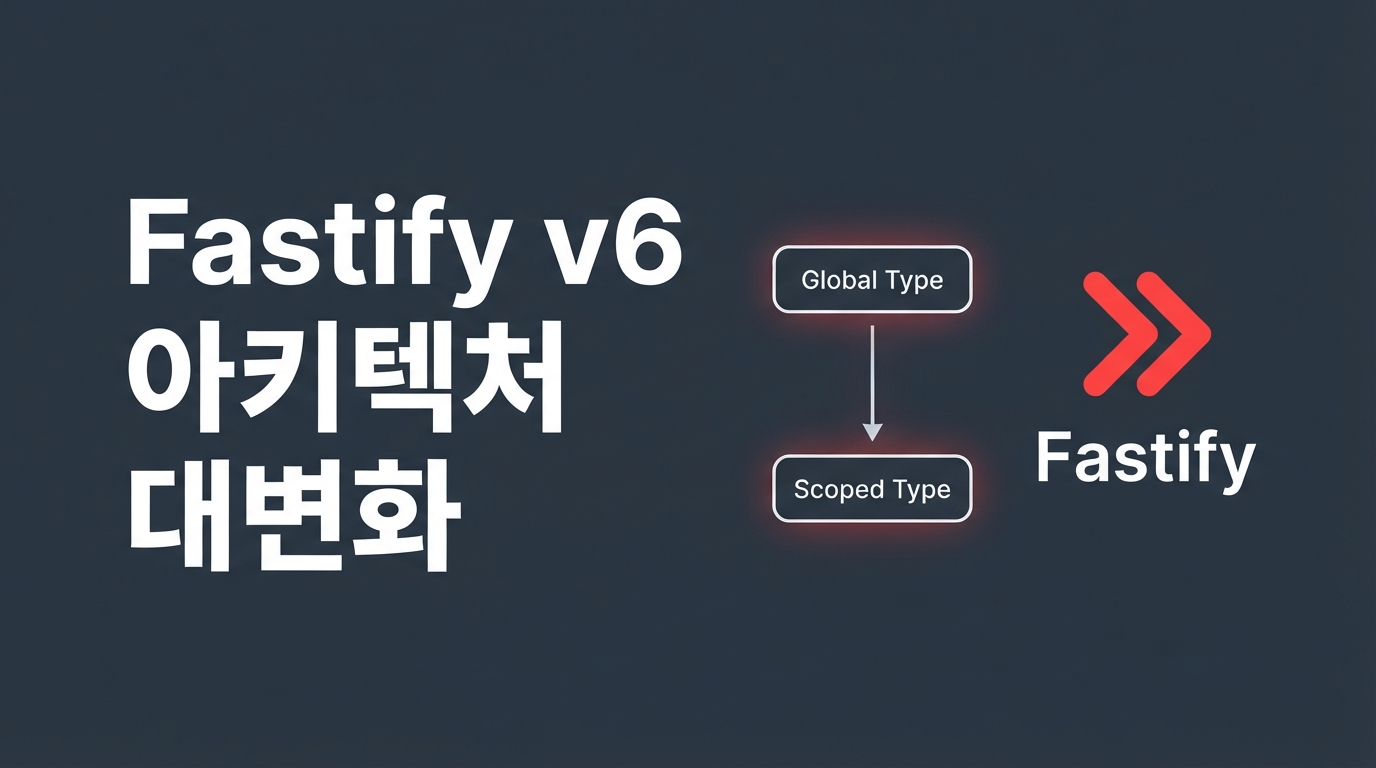
Fastify v6 Preview — Introducing V8 Serialization and Scoped Type Systems
Ahead of the v6 release targeting Node.js v24, Fastify has announced a major architectural overhaul. This major update, slated for an official release in September 2026, focuses on retiring the custom serialization engine that previously powered its performance, as well as resolving global TypeScript type pollution. From a developer's perspective, I will break down the core architectural changes and how they will impact high-performance observability and security in production environments.
Back to V8 Serialization: Why fast-json-stringify Was Removed
The most notable architectural change in Fastify v6 is the complete removal of the fast-json-stringify engine, which was responsible for response serialization. Historically, Fastify achieved high speeds by dynamically compiling serialization functions based on schemas. However, as the JSON.stringify optimization within modern V8 engines has caught up to dynamic compilation methods, the trade-off of maintaining a custom compiler—including runtime code generation overhead and cold start costs—is no longer justified.
According to Fastify's official GitHub contribution logs, this overhaul has removed approximately 3,000 lines of complex custom compiler code. Instead, response schemas are now solely focused on validation, which is handled by Ajv, while the actual conversion of objects to JSON strings is delegated to the V8 engine's native methods.
Thanks to this structural separation, strict schema validation that was previously limited to the request phase can now be applied to the response phase using the same Ajv interface. Developers can maintain a secure, schema-based validation system while avoiding unpredictable edge-case errors that previously occurred during complex custom compilation.
No More Global Pollution: Introducing TypeScript Registration Scoped Types
The issue of type pollution caused by TypeScript global declaration merging, which has long plagued Fastify developers, is finally being resolved in Fastify v6. Previously, decorators registered in a specific plugin were automatically merged into the global FastifyInstance. Because of this, the type compiler would mistake these decorators for valid code even in isolated plugin scopes where they did not actually exist, often leading to unintended runtime errors during development.
To solve this, Fastify v6 introduces a new fastify-plugin helper function in the createPlugin package. This function does not register decorator types to the global namespace, but instead forces them to be inferred as mixin types valid only within the scope where the plugin is registered. For instance, when a specific plugin is loaded, the mixin type is combined with the existing instance type only within that scope, allowing the compiler to safely recognize the types. This reduces unnecessary type traversal operations by the compiler in large monorepo environments, improving build performance.
However, this is a breaking change that impacts numerous plugins in the existing ecosystem. Because of this, maintainers are actively discussing whether to make it mandatory upon the official September release or to keep it as an opt-in feature initially for backward compatibility to encourage a gradual transition. Given that it will likely be introduced as an opt-in to reduce migration burdens, it is recommended to review the structure of your custom plugins before the transition.
Transitioning to @fastify/otel and Achieving High-Performance Observability
As the importance of distributed tracing grows in microservices and generative AI backend environments, there have been significant changes to Fastify's OpenTelemetry ecosystem. In early 2026, the existing @opentelemetry/instrumentation-fastify package was completely removed from the official OpenTelemetry Node.js auto-instrumentation bundle and is no longer supported. Consequently, implementing high-performance distributed tracing in a Fastify environment now requires switching to the first-party official plugin, @fastify/otel.
The legacy package relied on unstable methods of intercepting Node.js's module loading system, frequently causing runtime performance degradation and version compatibility issues. In contrast, the new @fastify/otel operates by directly integrating with the native Node.js diagnostics_channel and Fastify's internal lifecycle. By skipping unnecessary interception and subscribing directly to events, collection overhead is significantly reduced, and overall observability quality is improved.
This is especially advantageous in generative AI real-time response streaming or high-traffic environments. Previously, countless unnecessary child spans were generated for every lifecycle hook, wasting bandwidth and trace storage while creating noise. By utilizing the @fastify/otel control feature introduced in instrumentHooks, this span overhead can be precisely managed. For example, you can block unnecessary lifecycle spans at the route level, leaving only the main request and handler spans to efficiently control trace noise.
// 특정 라우트에서 라이프사이클 훅 스팬을 끄고 메인 요청만 추적하는 예시
fastify.get('/api/v1/generate', {
  config: {
    otel: {
      instrumentHooks: false // 메인 요청과 핸들러 스팬만 생성
    }
  }
}, async (request, reply) => {
  // LLM 토큰 스트리밍 등 긴 지연 시간이 발생하는 작업 처리
});
In this way, @fastify/otel maintains runtime compatibility while ensuring collection performance. If your team is operating large-scale, high-load distributed architectures or LLM-based pipelines, I strongly recommend actively implementing the detailed settings of @fastify/otel to reduce unnecessary telemetry noise and cut observability costs.
Urgent Security Audit: Essential Patches Concentrated in August
As you prepare for the migration to the new major v6 version, the first priority should be to audit and immediately address security vulnerabilities in your production environment. In August 2026, emergency patches were released following the disclosure of several high-risk vulnerabilities across the Fastify ecosystem. Notably, CVE-2026-33806 was identified in the Fastify core itself, which allowed attackers to bypass input validation schemas by exploiting white space around the Content-Type header.
Serious flaws were also addressed in core plugins closely tied to authentication. A prime example is CVE-2026-18500, where the @fastify/jwt plugin's per-request validation option request.jwtVerify({ key }) was neutralized. Due to a logical error in the option-merging process, the globally configured secret key was incorrectly overridden as the last step, replacing the validation key set by the developer for individual requests. This resulted in a flaw where tokens signed with the global key were improperly accepted on paths requiring keys for administrators or other domains, a vulnerability patched in version v10.2.2. Additionally, the login CSRF vulnerability CVE-2026-18165 was discovered in @fastify/oauth2, which introduced the hostPrefixedCookies option in v8.3.0. This option forces a __Host- prefix on cookie names to block unauthorized cookie writes from subdomains and ensures cookies are preserved only over secure connections.
Furthermore, vulnerabilities that could lead to denial-of-service attacks or file leaks in @fastify/multipart and @fastify/busboy, which are frequently used for large file uploads or static file processing, have also been highlighted and patched. While establishing a project migration strategy ahead of the v6 official release is important, updating your dependency tree to the latest stable versions must take precedence to reliably defend your existing production backend.
A Milestone for Fastify Entering the Node.js v24 Era
Fastify v6 is a significant turning point, moving away from past performance formulas to recalibrate the framework's foundation for modern Node.js and TypeScript ecosystems. By boldly raising the minimum supported version to Node.js v24, the framework can now maximize the latest native V8 optimizations, pushing throughput to the next level.
Developers operating in production environments should pay close attention to the core changes in v6: type isolation and serialization. It is time to prepare for a gradual transition from global type merging patterns to independent type scopes based on createPlugin, and proactively check compatibility with the official migration roadmap and plugin ecosystem to be provided for the official September 2026 release.
Reference Links
- GitHub fastify/fastify Milestone v6.0.0 — Fastify v6 Core Refactoring: Native V8 Serialization and Registration-Scoped Types
- fastify/fastify GitHub Repository (PR #6507) — Fastify v6 Core Refactor: Dropping fast-json-stringify for Native V8 Serialization
- GitHub fastify/fastify — Fastify v6 Core Shift: Native V8 JSON.stringify and Response Validation via Ajv