@nari

Crypto Market in a Triple Bind: System Stress Test from Macro, Infrastructure, and Regulatory Hurdles
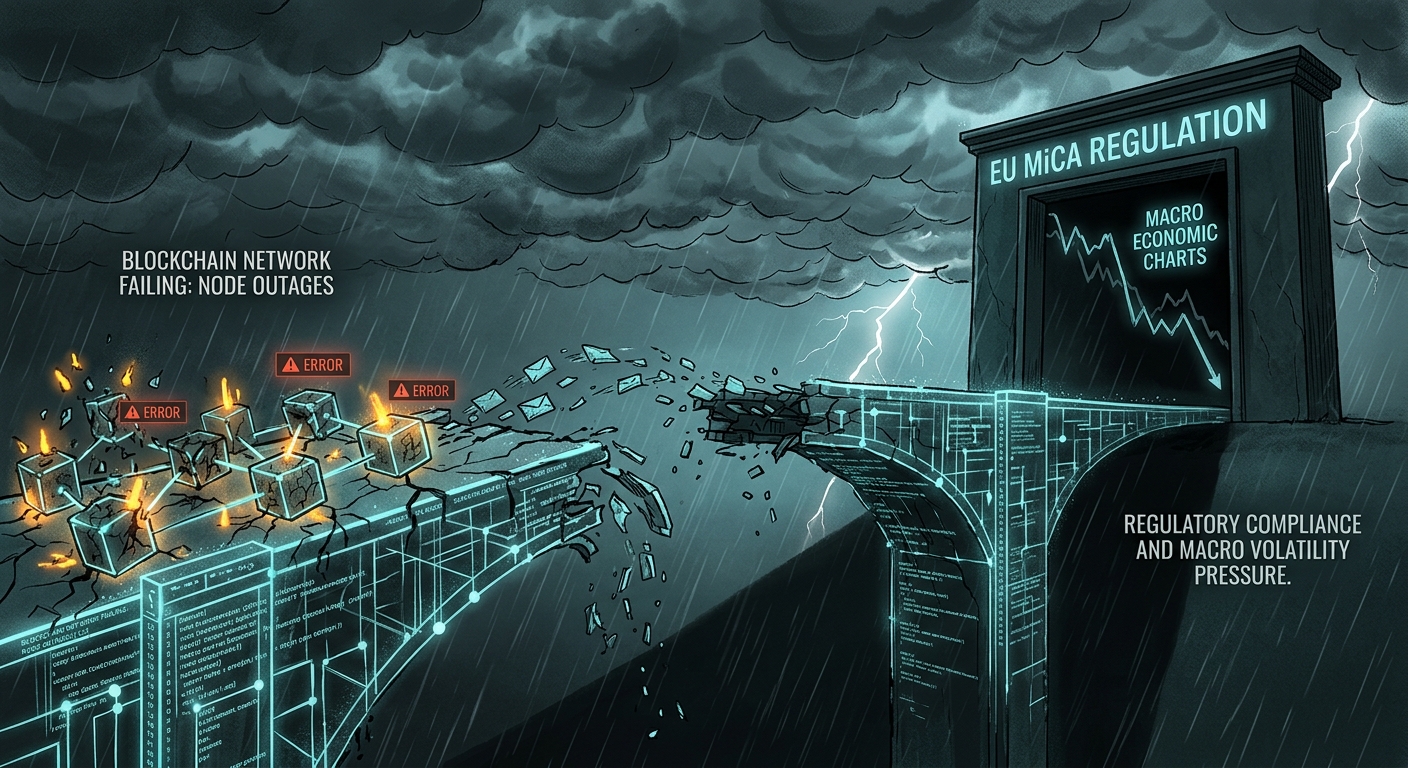
The on-chain atmosphere lately is unsettling, isn't it? As Bitcoin precariously battles to hold the $60,000 support level, fatigue among builders and investors has reached its peak. Beyond simple price corrections on the chart, the current downtrend is a complex 'system stress test' triggered by the convergence of macroeconomic liquidity tightening, the implementation of the MiCA regulation (July 1st) that will reshape the European crypto landscape, and the 85% crash of Memecore (M) that recently shocked the ecosystem.
From macro headwinds like concerns over yen carry trade liquidations that strain global liquidity and circuit breaker triggers in the Korean market, to rumors of a US law firm investigating MicroStrategy (MSTR) and the massive upcoming options expiry, the market's psychological support levels are being tested.
In this analysis, rather than simply discussing price outlooks, I aim to face the structural cracks currently pressuring the ecosystem. From the community's perspective, I will examine the key risk points, looking at the chain reactions when institutional regulatory blades meet internal on-chain vulnerabilities, and how we should interpret and respond to this volatile phase.
1. Global Liquidity Contraction and Macro Anxiety: What is Fueling the Sell-off?
The greatest weight currently pressing down on the crypto market is undoubtedly global liquidity contraction and macroeconomic instability. The decline in Bitcoin and other major assets is less about negative developments within the crypto scene itself and more an extension of the massive 'risk-off' trend sweeping global financial markets.
The first area to note is the concern over yen carry trade liquidations and the potential for additional interest rate hikes by the US Federal Reserve. With signs that the low-interest yen liquidity—which has served as a global funding source—is being withdrawn, and as expectations for rate cuts recede, capital is rapidly exiting both traditional assets and the crypto market. Added to this is the pressure from institutional quarter-end rebalancing, forcing the sell-off of risky assets like stocks, with the impact spilling over entirely into the crypto market.
Particularly shocking for local investors was the recent triggering of a circuit breaker in the Korean market. As even the domestic stock market showed extreme volatility and hit a circuit breaker, overall investor sentiment instantly froze. These macro risks are not limited to the stock market; they serve as a powerful psychological trigger threatening the Maginot Line of the virtual asset market.
Currently, Bitcoin (BTC) is precariously testing the $60,000 support level ahead of a massive $10.6 billion quarterly options expiry. With the combination of negative gamma effects ahead of the expiry and unstable macroeconomic indicators, the market is facing a 'lack of pending buy orders.' As crypto's underlying strength is truly being stress-tested amidst these turbulent macro waves, now is the time to calmly monitor the recovery of macro liquidity rather than building aggressive positions.
2. MiCA Regulation D-Day: The Shift in Stablecoin Hegemony and Reshaping of the European Market
On the upcoming July 1st, the Markets in Crypto-Assets (MiCA) regulation will take full effect, completely altering the landscape of the European crypto market. This regulation is more than just the introduction of a new framework; it serves as the signal for a massive structural realignment that will shake the very foundations of the stablecoin ecosystem and exchange markets, which are pillars of global crypto liquidity.
The most important aspect to watch is the shift in power within the stablecoin market. Under the MiCA regime, issuing stablecoins within the European Economic Area (EEA) requires an E-Money Institution (EMI) license. While Circle's USDC and EURC are accelerating their integration into the regulatory framework, Tether (USDT), the market leader, is struggling to meet regulatory requirements and faces an unprecedented crisis of being delisted or restricted on major regulated exchanges in Europe. It is widely expected that regulatory-compliant assets like USDC and EURC will rapidly replace USDT, which was once synonymous with stablecoins.
Exchanges are also making sharply different moves. Large global exchange Binance has yet to secure the necessary licenses from EU member states, forcing them to take the drastic step of restricting new user onboarding and downsizing services in Europe starting next week (July 1st). While withdrawals for existing users will continue normally, the blockade on new sign-ups is a significant blow. Conversely, exchanges like OKX, Coinbase, and Crypto.com, which proactively acquired MiCA-compliant licenses, are actively marketing this as an opportunity to expand their market share.
The real risk that our community and DeFi builders must keep a close eye on is 'Liquidity Fragmentation.' If the inflow of USDT, which has served as a reliable peg for global crypto trading, is blocked, it could lead to extreme liquidity bottlenecks caused by price disparities between exchanges or market-making (MM) gaps in the short term. This is the moment to closely monitor liquidity movement paths amidst regulatory gales and determine how to bridge the gap between the stability required by regulation and the abundant liquidity demanded by the market.
3. 85% Crash of Memecore (M) and Internal Supply Concentration: What Triggered the Cascade of Liquidations?
A very serious warning light has also been lit regarding infrastructure and asset health. This is because Memecore (M) tokens recently suffered a shocking crash of over 85%. Approximately $2.7 billion in market capitalization evaporated in a single night, and in the futures market, long positions were liquidated in a chain reaction, throwing the market into a major panic.
Behind this massive crash lies a painful 'Cascading Liquidation' mechanism. Market analysis shows that roughly $8 million in large-scale long positions were wiped out in an explosive wave of liquidations during the crash. With liquidity pools being extremely shallow, once the price broke, forced liquidation volumes due to falling collateral value poured into the market at once, creating a typical deleveraging downward spiral that pushed the price into an even deeper abyss.
Adding fuel to the fire was the 'suspicion of concentrated insider supply.' As rumors and reports spread that 99% of the total supply was controlled by a specific group of insiders, community anxiety instantly turned to panic. Regardless of the truth, these rumors were enough to raise doubts that liquidity could be withdrawn or dumped at any moment. As soon as trust collapsed, it led to extreme panic selling by market participants.
The message this incident sends to our Web3 builders and users is clear: even for an asset with an attractive narrative, the combination of an opaque token distribution structure and a lack of liquidity can cause the entire system to falter in an instant. Now that concerns over the transparency and liquidity vulnerability of decentralized infrastructure have reached a peak, we must more thoroughly verify not just the outward appearance of projects, but the actual on-chain data and the transparency of token distribution.
4. Legal Risks and Uncertainty: MicroStrategy Investigation and $10.6 Billion Options Expiry
In addition to macro headwinds and the introduction of regulations, tension is also mounting in core conduits for institutional funds and the derivatives market. At a time when the psychological Maginot line holding the market is precarious, one risk after another is surfacing.
First, the news to note is that US law firm Rosen Law Firm has initiated an investigation into MicroStrategy (MSTR) and STRC for potential securities law violations. There is a point we must clarify here: this is not an official regulatory enforcement action or indictment by a government agency like the US SEC, but rather a 'preliminary investigation by a private law firm' to review claims for investor damages.
However, since MicroStrategy has effectively served as a 'Bitcoin leverage proxy' for institutions, the mere mention of such legal risks is bound to have a negative impact on institutional investor sentiment. As the issue of whether they provided misleading information to investors becomes the focal point, this could become a barrier that makes institutions hesitate to enter for a while, and the community is also keeping a sharp eye on it.
To make matters worse, the quarterly Bitcoin options expiry, amounting to a staggering $10.6 billion, is right around the corner. Bitcoin is currently walking a tightrope on the precarious support level of $60,000.
The scenario traders worry about most is the intensification of 'Negative Gamma.' This refers to a phenomenon where, when the market price falls below a certain level, option market makers must mechanically sell additional Bitcoin for risk management (hedging). In other words, it is a structural vulnerability where even a slight shake to the $60,000 support level could trigger a chain of programmatic sell-offs, inducing a short-term crash.
Ultimately, the current market is in a hypersensitive state where it can wobble significantly even from small shocks. Rather than rashly predicting a 'bottom' and entering, this is the time to focus on risk management while calmly confirming whether liquidation volumes in the futures market and major on-chain support levels are firmly holding.
Conclusion: A Time to Prove System Resilience
This downtrend is a powerful stress test where macroeconomic environments, regulatory barriers, and internal infrastructure weaknesses have all exploded simultaneously. In the short term, the survival of projects will be determined by their regulatory compliance and liquidity resilience. It is time for the community to strive for infrastructure optimization to secure true structural resilience, going beyond simple price recovery.