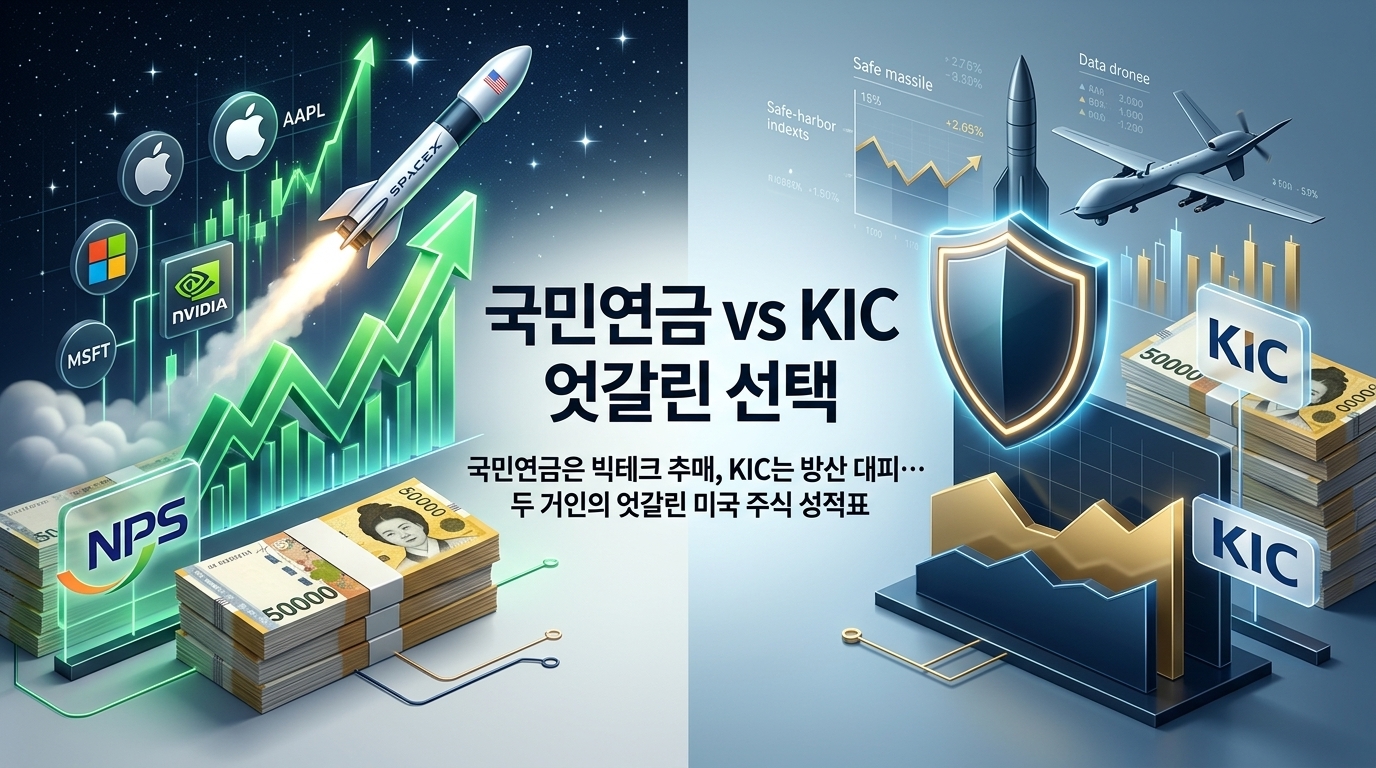
NPS Buys More Big Tech, KIC Seeks Refuge in Defense: The Diverging U.S. Stock Scorecards of Two Giants

지금왜

@whynow

국민연금은 빅테크 추매, KIC는 방산 대피… 두 거인의 엇갈린 미국 주식 성적표

NPS Buys More Big Tech, KIC Seeks Refuge in Defense: The Diverging U.S. Stock Scorecards of Two Giants

The National Pension Service (NPS) and the Korea Investment Corporation (KIC), the two giants of South Korea's capital market, have released intriguing investment report cards via their Q2 13F filings submitted to the U.S. Securities and Exchange Commission on August 12 and 13, 2026. While both institutions moved quickly to secure stakes in SpaceX, the space company long considered a major off-market target, they took completely opposite paths in their approach to Big Tech. While one chose a direct approach by aggressively sweeping up tech stocks during the downturn, the other opted to reduce its exposure, pivoting toward U.S. defense stocks and broad market indices to build a solid defensive wall.

Joining the Off-Market 'SpaceX' Giant for the First Time: How Did They Perform?

The most eye-catching detail in the Q2 13F reports submitted by the two giants to the U.S. SEC on August 12 and 13, 2026, is undoubtedly the inclusion of Elon Musk’s space company, SpaceX, in their portfolios. After watching it as a major off-market target for some time, both institutions participated in SpaceX's historic IPO on June 12, finally boarding the space industry train in earnest.

As of June 30, the end of the second quarter, the NPS had secured 3.5 million shares of SpaceX. This accounts for 0.39% of the NPS's total direct investment portfolio, equivalent to approximately $598 million (roughly 850 billion KRW). The KIC also joined the journey to space by adding 802,182 shares to its portfolio, securing a stake worth approximately $137.06 million.

Both institutions likely rejoiced in the early days of the listing, having entered at an initial offering price of $135 per share. SpaceX's stock price soared to a high of $225.64 immediately after listing, providing substantial unrealized paper gains. However, the harsh initiation of a public stock soon followed. The share price experienced extreme volatility, dipping as low as $104.83 in early August and falling below the IPO price. While it has recently recovered to the $141.29 range to catch its breath, it is experiencing the rough waves typical of public stocks, a far cry from the steady upward trend observed in the off-market.

Diverging Views on M7 Big Tech: NPS 'Buys More' vs. KIC 'Exits'

According to the Q2 13F reports submitted to the U.S. SEC on August 12 and 13, 2026, the NPS and KIC showed completely different approaches to existing Big Tech stocks. Looking at their portfolios as of June 30, the end of the second quarter, while the two giants were in sync regarding SpaceX—which made a spectacular debut on June 12 at an IPO price of $135—their stances on the core tech stocks known as the 'Magnificent 7' were completely split.

The NPS took the direct approach, treating the recent stock price correction as an opportunity to increase its weightings. Aside from a minor 0.86% adjustment to its largest holding, NVIDIA, it added 1.61% to its Apple stake, 2.16% to Microsoft, and 2.58% to Amazon. Along with these, it increased holdings in most major tech stocks such as Alphabet, Meta, and Tesla, placing its weight behind continued market growth and a rebound.

On the other hand, the sovereign wealth fund KIC’s choice was one of thorough 'defense and realization.' The KIC reduced its NVIDIA holdings by a whopping 9.3% and its Alphabet stake by 5.8%, undertaking a major reduction in weightings across large-cap tech stocks. As seen in the case of SpaceX—which rose as high as $225.64 after listing, fell to a low of $104.83 in early August, and is now experiencing severe volatility in the $141.29 range—it prioritized smart profit-taking and risk management over trying to overcome market-wide warnings of peaks and valuation burdens.

However, these contrasting moves by the two national financial giants are the results of each institution's medium- to long-term asset allocation adjustments and portfolio strategies. Therefore, it is advisable to view them as indicators for observing macroeconomic asset flows from a long-term perspective rather than as short-term investment recommendations or buy/sell advice for specific stocks.

KIC’s Defensive Strategy: Sheltering in Defense Stocks and Broad Indices

The refuge chosen by the Korea Investment Corporation (KIC) after offloading a significant amount of Big Tech was two-fold: index-tracking products that follow market averages and the U.S. defense industry, which serves as a shield amidst geopolitical tensions.

According to the Q2 13F report submitted by the KIC to the U.S. SEC on August 12, 2026, they increased their holdings of IVV, a representative S&P 500 ETF, by 7.9% compared to the previous quarter as of June 30. This is a strategic decision to secure stable average returns by following the overall U.S. stock market trend rather than being directly exposed to the volatility of individual tech stocks.

Simultaneously, the KIC heavily added representative U.S. defense stocks to its portfolio. It surged its stake in unmanned aerial vehicle manufacturer AeroVironment by a massive 196.9%, while increasing its L3Harris Technologies stake by 85.9% and Northrop Grumman by 45.5%. In essence, it has solidified the downside of its portfolio in response to unstable global situations and geopolitical risks.

The additional acquisition of a stake in Circle, the issuer of the stablecoin USDC, also stands out. This can be interpreted as a detour to indirectly ride the growth of the blockchain ecosystem while avoiding the volatility of direct investment in virtual assets. The KIC’s move to reduce exposure to Big Tech, where concerns about a peak were raised, and pivot to thorough diversification and defense, stands in clear contrast to the NPS, which continued aggressive additional purchases. However, this portfolio adjustment is a historical record as of the end of the second quarter and is reference information showing the asset allocation flow of institutional investors, not an investment recommendation for specific stocks or products.

NPS Portfolio Grows by 33 Trillion KRW: Was It a 'Real Buy'?

The valuation of the NPS's direct U.S. stock investments reached $155.08 billion as of June 30, 2026, the end of the second quarter. Compared to the previous quarter, this is a massive increase of approximately 33.2 trillion KRW—an 17.8% jump—in just three months. At first glance, it may seem like the NPS swept the market with aggressive additional purchases, but looking at the reality, it is closer to a pleasant optical illusion created by a sharp market rise.

According to the Q2 13F report submitted by the NPS to the U.S. SEC on August 13, the actual quantity of shares held by the NPS only increased by 2.1% during this period. This means that rather than injecting new large-scale funds, a much larger portion was driven by the value of the stocks already held, which naturally increased in price amid the market climate. Compared to the KIC, which quickly reorganized its portfolio when submitting its report on August 12, the NPS's strategy of fully enjoying the benefits of value appreciation in existing holdings stands out.

In fact, the global stock market, which hit a low in March, drew a steep upward curve in the second quarter. In particular, Micron Technology, which was already in the NPS portfolio, performed impressively, soaring over 241% during this quarter alone. As the value of quality tech stocks held previously expanded in this way, they played a reliable role as a driving force in pushing the total valuation up by tens of trillions of KRW.

The paths of the NPS, which must safely manage the public's retirement funds over the long term, and the KIC, a sovereign wealth fund that pursues the preservation of national assets and absolute returns, diverged as much as the inherent nature of the two institutions. The Q2 13F reports submitted to the U.S. SEC on August 12 and 13 clearly show how their investment philosophies were misaligned as of June 30. The success or failure of the NPS’s direct approach, which trusted in growth even during tech stock corrections, and the KIC’s defensive strategy, which quickly retreated into defense stocks and index-tracking products, will be determined by the direction of global interest rate trends and macroeconomic indicators in the second half of the year.

Here, the trend of SpaceX, which both giants boarded together, is also a key variable that cannot be ignored. SpaceX, which made a spectacular listing on June 12 with an IPO price of $135, has since faced a harsh initiation, surging to a high of $225.64 before dropping as low as $104.83 in early August. It has now recovered to the $141.29 range to catch its breath, but the high volatility typical of its first year of listing is expected to continue to affect the portfolio valuations of the two institutions that declared long-term investments.

The market is watching with interest to see who will be laughing in the year-end scorecard among the choices of these two national asset management agencies, which have completely divided into offense and defense. However, it should be noted that their efforts to diversify portfolios and their detailed asset allocation methods are just part of long-term strategies tailored to institutional characteristics, and are not recommendations to buy or sell specific stocks or products.

두 거인의 엇갈린 포트폴리오 선택, 하반기 수익률을 가를 변수

1

tUSDC

국민연금의 M7 빅테크 매수와 KIC의 미국 방산주 피난 전략이 마주할 매크로 변수를 짚어봅니다. 금리 결정과 스페이스X의 변동성 속에서 관찰해야 할 핵심 신호를 분석합니다.


Related Links

No comments yet.