@whynow

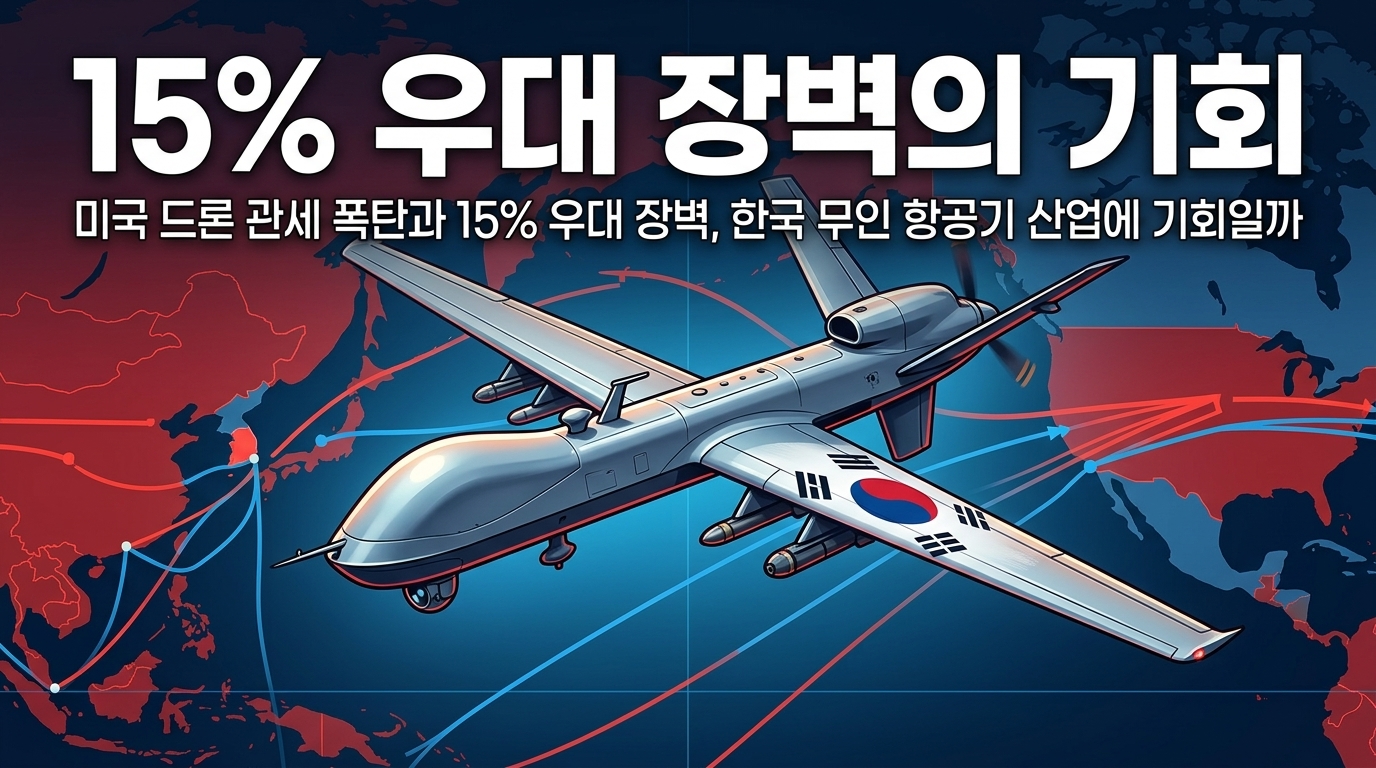
US Drone Tariff Bomb and 15% Preferential Barrier: An Opportunity for the Korean UAV Industry?
Today, August 17th, the term 'unmanned aerial vehicle' (UAV) is dominating internet search trends. Drones, once considered simple hobby gadgets or photography tools, have overnight become both the new focal point of a global trade war and a key weapon determining national security. With the US Trump administration invoking Section 232 of the Trade Expansion Act to threaten tariffs of up to 100% on imported drones, the Korean industry is buzzing following news that South Korea has secured a 15% preferential tariff rate.
The Ulchi Freedom Shield (UFS) joint US-ROK military exercise, which kicked off today, has also heightened tensions on the front lines by fully integrating combat scenarios involving UAVs, which are essential to modern warfare. We take a closer look at the reality behind the UAV trend that has become a front-line keyword in both tech and security.
The US's 100% Tariff Bomb: Aimed at China, but Why It Shook South Korea
On August 13th (local time), an announcement from the White House sent shockwaves through the global drone industry. US President Donald Trump signed an executive proclamation under Section 232 of the Trade Expansion Act, authorizing tariffs of up to 100% on imported drones that pose a national security threat. The measure is set to take effect on September 3rd, just around the corner.
The targets of this tariff bomb are clear: large drones with a maximum takeoff weight exceeding 25kg, drones equipped with thermal cameras for surveillance or reconnaissance, and key equipment like dedicated docking stations. It is effectively a declaration of war aimed at completely ousting Chinese products, which currently dominate the US civil and public drone markets.
As this massive wall was erected, the Korean drone industry began to move quickly. While the US is closing its doors to China, it has promised to apply a relatively low 15% preferential tariff rate to key allies, including South Korea. However, hidden behind this expectation are cold and demanding conditions. To enjoy the 15% benefit, companies must prove that every single key component inside their drones is not of Chinese origin. The US's aggressive move against China has essentially presented our companies with a monumental test to overhaul their supply chains from the root up.
The 15% Preferential Barrier We Gained: The Real Condition is the 'Nationality of Components'
While Chinese drones are effectively blocked from the US market, key US allies such as South Korea, Japan, Taiwan, Switzerland, and the EU have been granted a relatively favorable 15% tariff ceiling. Compared to Chinese products that will lose price competitiveness under the 100% tariff bomb, this is clearly a golden opportunity for our drone companies to quickly penetrate the vast gaps in the US public and commercial markets.
However, this sweet benefit comes with a cold, strict prerequisite: the 'nationality' of the key components and software used in the drones must be perfectly verified. To qualify for the 15% preferential rate, it must be proven that not only the finished drone but also its core components like sensors and motors, as well as the operating software, are not Chinese and were produced in South Korea, the US, or other approved allied nations.
Given the overwhelming dominance of Chinese components in the global drone supply chain, this is by no means an easy task. This is why South Korea's Ministry of Trade, Industry and Energy is acting swiftly ahead of the US tariff implementation scheduled for September 3, 2026. The government is urgently assessing the domestic supply chain status while planning to work with US authorities to refine strict guidelines for country-of-origin verification. Ultimately, only companies that secure this certificate of a 'clean supply chain' will be able to enter the door of opportunity opened by the US.
UFS Joint Exercise Day One: UAV Scenarios Deployed in Practice
This intense economic tension surrounding drones is not limited to the trade front. At the Ulchi Freedom Shield (UFS) joint military exercise, which began today, August 17th, UAVs are the hottest topic. This exercise was designed to actively project the devastating firepower that drones have demonstrated in modern warfare into actual combat scenarios.
In fact, just last weekend, August 15th and 16th, the Ukrainian military launched an unprecedented offensive using a massive swarm of 822 drones to strike areas near Moscow, Russia. As military experts note, the sight of inexpensive drones disrupting a nation's core infrastructure serves as a vivid example that drones are no longer just auxiliary tools, but essential asymmetric assets on the battlefield.
In line with this trend, the ROK-US combined forces began operating advanced UAV warfare scenarios from the very first day of the UFS exercise. Beyond simply deploying drones for reconnaissance, the exercises involve tactical engagement using drones, electronic warfare countermeasures to neutralize drones, and cyber interference operations to prevent loss of network control.
Ultimately, the site of this joint exercise clearly demonstrates why localizing drone technology and key components is a matter of survival in terms of national security. As the world closes its doors on drone industries and tries to prevent technology leaks, securing an independent UAV supply chain has become a front-line battleground that determines not only military defense capabilities but national competitiveness.
Opportunities for Territory Expansion and Challenges for Domestic Drone Tech Companies
Markets and investors are already bustling. As the September 3, 2026 date for the full implementation of US measures approaches, domestic UAV manufacturers and control software developers that exclude China from their supply chains are receiving intense market attention. This is because the US market for large drones and thermal surveillance drones—which was virtually monopolized by price-competitive Chinese firms—has overnight turned into a huge land of opportunity for our companies.
However, there is a high hurdle to overcome to open this door of opportunity. To fully enjoy the 15% preferential tariff benefit, the nationality of key components must be clearly proven. While domestic drones currently show excellent technical prowess in fields like flight control software, it is an undeniable reality that a significant portion of core hardware components, such as motors and sensors, still rely on Chinese imports.
Ultimately, the true outcome of this trade policy depends on how quickly and precisely supply chains can be diversified. Since the Ministry of Trade, Industry and Energy has announced it will refine precise verification criteria in cooperation with US authorities, the moment companies pass the US's strict verification hurdles and prove a 'clean supply chain' will be the turning point for capturing leadership in the global UAV market.
The Future of Domestic Drones Flying Over Protectionist Barriers
The massive tariff barrier set up by the US is raising concerns about a contraction in global free trade, but for the domestic UAV industry, it is a decisive opportunity to level up quickly. Amid the tariff bomb of up to 100% aimed at China, the 15% preferential tariff ceiling secured by South Korea is a powerful weapon to penetrate the wide gaps in the US market.
However, this 15% figure is not a freebie. When the full tariff application begins on September 3, 2026, the US government will impose very strict supply chain verification standards. If even a tiny component or piece of software in a drone fails to meet the exclusion requirements for Chinese parts, the preferential benefit will vanish instantly. Essentially, a brutal testing ground is opening where only companies that can perfectly prove a transparent supply chain will survive.
The key to watch moving forward is the specific content and standards of the detailed verification guidelines that the Ministry of Trade, Industry and Energy will release in coordination with US authorities. What our companies need right now, rather than vague optimism, is to clearly organize the nationality of their supply chains and push the completeness of their proprietary drone technology to the limit. The real countdown has begun to see whether Korean drones can ride the winds of protectionism and capture the US skies.
미국 드론 관세 폭탄과 15 우대 장벽 한국 무인 이후, 다음 흐름을 가를 신호
1
tUSDC
미국 드론 관세 폭탄과 15 우대 장벽 한국 무인 의 관심이 이어질지 판단하기 위해 후속 공식 움직임과 반응 지속성에서 무엇을 먼저 확인할지 짚습니다.
Related Links