People searching for 'livelihood recovery vouchers'... Local government Chuseok subsidies of 500,000 KRW and the controversy over regional gaps

지금왜

@whynow

민생회복 소비쿠폰 찾는 이들…지자체 추석 지원금 50만 원 지급과 지역 격차 논란

People searching for 'livelihood recovery vouchers'... Local government Chuseok subsidies of 500,000 KRW and the controversy over regional gaps

Ahead of Chuseok, many are busy typing 'livelihood recovery voucher' and 'livelihood subsidy' into search engines. Rumors that the government is distributing a lump-sum holiday subsidy to all citizens have fueled anticipation, with many asking, "Can I get 500,000 KRW too?" To put it bluntly: there is no integrated consumption voucher or nationwide subsidy program from the central government for all citizens.

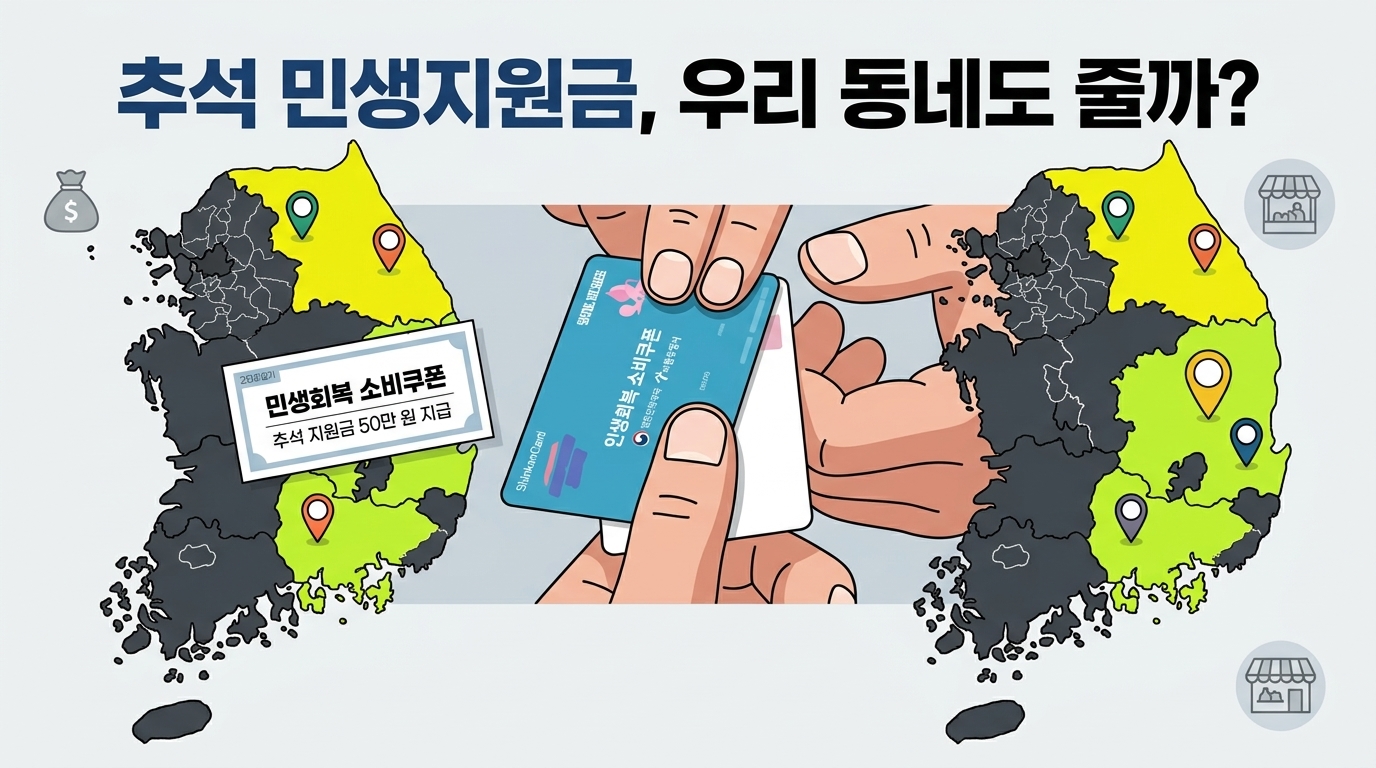
The actual protagonists of this search craze are not the central government, but certain local governments. When municipalities like Uiryeong-gun in Gyeongnam and Hampyeong-gun in Jeonnam decided to use their own budgets to provide up to 500,000 KRW per resident, confusion arose as people mixed rumors with the question of whether their own area was eligible. Because this is a 'go-it-alone' type of support based on individual local government resources, it has created a strange imbalance where some people in neighboring towns receive hundreds of thousands of won, while residents in large urban areas like Seoul or Gyeonggi receive nothing, fueling controversy over fairness.

Neighboring towns give 500,000 KRW, so why do Seoul and Gyeonggi get 0 KRW?

Neighboring towns give 500,000 KRW, so why do Seoul and Gyeonggi get 0 KRW?

Ahead of the holiday, online communities are buzzing with complaints about why some people get money while others don't. A sense of relative deprivation is spreading among residents of large cities regarding the news of these Chuseok subsidies. While some rural areas are generously giving 500,000 KRW per person, residents in densely populated capital areas like Seoul and Gyeonggi receive no benefits at all. Why does this gap exist when we pay the same taxes?

The reason lies in the funding. These Chuseok subsidies are not a central government initiative funded by the national budget. They are individual projects funded entirely by local governments from their own coffers. Consequently, whether or not these subsidies are paid—and the amount—varies wildly depending on the fiscal conditions and the intent of local leaders.

In reality, most major metropolitan governments and large urban areas, including Seoul, Gyeonggi, Incheon, Busan, and Daegu, have decided not to provide independent cash subsidies this time. Conversely, some counties facing population decline and the threat of local extinction have proposed generous support amounts—in some cases hundreds of thousands of won per resident, rather than per household.

This disparity has sparked a heated debate online about reverse discrimination. Residents of large cities complain, "Residents in big cities pay more taxes, so why do only residents of certain areas get to enjoy the holiday subsidy benefits?" Ultimately, the bitter reality that differences in local government fiscal independence translate directly into welfare gaps felt by residents has been laid bare ahead of the holiday.

Up to 500,000 KRW per person: What are the eligibility conditions and schedules in my area?

Among the local governments providing subsidies before this Chuseok, the ones opening their wallets the widest are Uiryeong-gun in Gyeongnam and Hampyeong-gun in Jeonnam. Both are offering 500,000 KRW per resident. Uiryeong-gun began accepting applications on August 10 and will continue through September 11. Hampyeong-gun, with a total population of about 29,000, plans to issue the subsidy in the form of prepaid cards starting September 7.

Some regions are providing subsidies in the 300,000 KRW range. Tongyeong-si in Gyeongnam decided to pay 350,000 KRW per person starting August 31. Hadong-gun in Gyeongnam is providing 300,000 KRW per person. Eligibility in Hadong-gun is limited to residents registered as of August 7, including permanent residents and marriage immigrants. The application period runs from August 24 to October 2; residents should visit their local township or district office. During the first week, a five-day rotation system based on the last digit of the birth year will be used to prevent congestion. The Hadong-gun subsidy is provided as paper Hadong Love Gift Certificates, which can also be used at large stores like local Nonghyup Hanaro Marts.

In addition, Wanju-gun, Gochang-gun, and Buan-gun in Jeonbuk, Yeongdong-gun in Chungbuk, and Uljin-gun in Gyeongbuk are providing 300,000 KRW in livelihood subsidies per resident. Since each local government has slightly different criteria, application periods, and payment methods, it is best to check the specific details on your local government's website or via your local community center before visiting.

The truth behind the '500,000 KRW for everyone' rumor and the confusion over government vouchers

'Can I get 500,000 KRW too?' Behind the surge in searches that got so many people's hopes up is a mix of sweet misunderstandings and provocative distortion of information. News of Chuseok subsidies being provided by certain local governments using their own budgets has snowballed as it spread online.

Some YouTube channels and social media accounts have cleverly repurposed terms like 'livelihood recovery subsidy' or 'consumption voucher' that were once discussed in political circles. They packaged it as if the government were distributing a '4th disaster relief fund' or a '500,000 KRW Chuseok coupon' to all citizens just to drive up views.

To be clear, there is absolutely no plan from the central government for a lump-sum Chuseok subsidy or an integrated consumption voucher worth 500,000 KRW for all citizens. This subsidy is a local benefit available only to residents registered in certain municipalities, funded within their own budgets. Don't waste your time applying for a 'nationwide voucher' that doesn't exist due to fake news.

Populism or a lifeline for local businesses? The remaining challenge

Local governments hope that these subsidies will act as a primer to bring warmth to the stagnant local economy ahead of the Chuseok holiday. Like the Hadong Love Gift Certificates, which Hadong-gun is issuing for applications submitted between August 24 and October 2, 2026, many local governments have chosen to provide subsidies in the form of local gift certificates or prepaid cards to encourage spending within their jurisdictions. Uiryeong-gun, which began accepting applications on August 10, 2026, also moved quickly to breathe life into the local economy by making the bold decision to provide 500,000 KRW per resident.

However, there is also significant concern over a structure that exhausts precious local government budgets on one-time cash support. Critics point out that budget funds meant for long-term regional development are evaporating in temporary, populistic pre-holiday policies. Furthermore, as the welfare gap grows every year—where a resident in one town receives 500,000 KRW while a neighbor receives nothing, depending on the municipality's coffers—more residents are expressing a sense of relative deprivation. Between the positive view of it as a spark to revive local commerce and criticism regarding budget waste and inequality, establishing rational standards that respect the autonomy of local governments while balancing regional disparities remains a difficult task to resolve.

민생회복 소비쿠폰 찾는 이들 지자체 추석 지원금 5 이후, 다음 흐름을 가를 신호

1

tUSDC

민생회복 소비쿠폰 찾는 이들 지자체 추석 지원금 5의 관심이 이어질지 판단하기 위해 후속 공식 움직임과 반응 지속성에서 무엇을 먼저 확인할지 짚습니다.


Related links

No comments yet.