@whynow

A 'Dollar Shopping' Spree Erupts as Exchange Rate Plummets by 125 Won: The Story Behind Hitting $100 Billion for the First Time
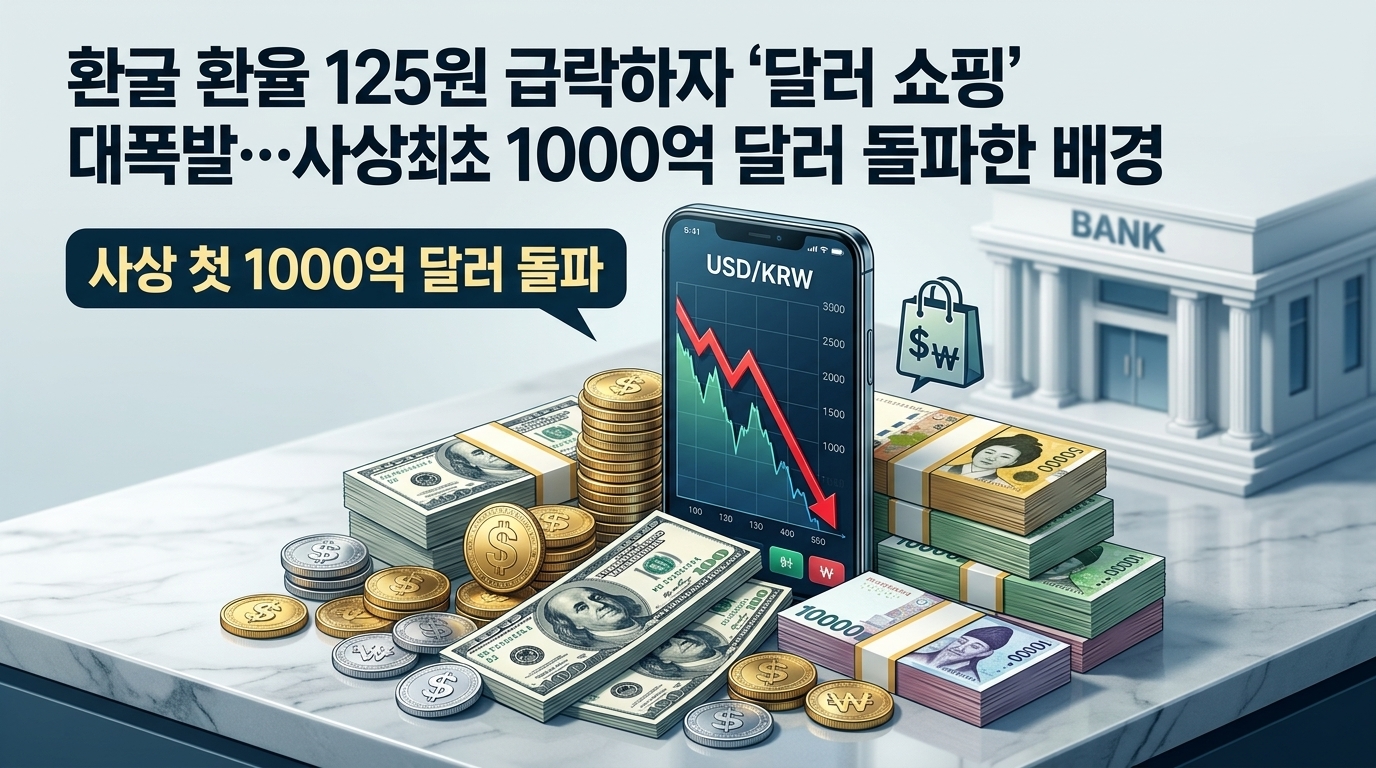
The eyes of those recently searching for 'exchange rate' look quite different than usual. It's not just a routine interest in saving on overseas travel expenses or buying cheaper direct-import goods; it's because of the news that, for the first time in South Korean history, 'dollar deposits' alone have exceeded $100 billion in foreign currency accounts. According to the Bank of Korea, foreign currency deposits by residents reached a record high of $128.34 billion at the end of July. Of this, dollar deposits alone hit $108.92 billion, crossing the $100 billion mark for the first time. The reason behind this massive $15 billion inflow in just one month is a combination of swift dollar buying following the sharp drop in the exchange rate and huge capital inflows from large corporations.
From the 1500s to the 1400s: The 'Dollar Shopping' Craze Triggered by a 125-Won Plunge
Paradoxically, the secret to dollar deposits hitting the $100 billion mark for the first time lies in the steep drop in the exchange rate. Usually, one might think people turn their eyes to the dollar when the exchange rate soars, but the actual market movement was the exact opposite.
At the end of June, the won/dollar exchange rate soared to 1,549.4 won, heightening market tension. However, the situation changed abruptly in the month of July. In just one month, it plummeted by a whopping 125.4 won, falling to 1,424.0 won by the end of July.
As the exchange rate dropped sharply in such a short period, a mindset took hold among both corporate and individual investors that this was the best opportunity to buy dollars at a low price. Preemptive buying demand surged as people sought to fill their dollar balances in anticipation of a future rebound, and these funds flowed directly into dollar deposit accounts at commercial banks. It is the result of a perfect intersection between the real-world demand of large corporations aiming to secure funds for import payments and the investment goals of individuals trying to accumulate dollars while they are relatively cheap.
The Decisive Difference: Strong Exports and SK Hynix’s $26.5 Billion Inflow
It is difficult to explain the unprecedented $100 billion milestone solely by the investment mindset of individuals thinking, 'The exchange rate is low, so let's buy dollars.' The core driving force behind this surge was a structural and massive inflow of dollars led by domestic large corporations.
The solid foundation was robust export performance. As export proceeds earned overseas by semiconductors and large IT firms continuously flowed into the country, corporate dollar balances were naturally replenished. On top of this, capital raised by domestic securities firms through foreign currency bond issuances added to the dollar supply in the market.
However, one event put a definitive finishing touch on this. It was SK Hynix's massive overseas capital raise. On July 10, SK Hynix raised approximately $26.5 billion by listing a large-scale American Depositary Receipt (ADR) on the US NASDAQ. As this enormous amount of foreign currency flowed directly into domestic bank accounts, it served as the definitive spark that pushed the total volume of dollar deposits to unprecedented levels. By adding this large, one-off capital-raising success to the general flow of corporate export proceeds, a critical difference was made in filling the market balance.
Companies Sweep Up $13.5 Billion While Individuals Buy $1.4 Billion: A Tale of Two Dollar Shopping Sprees
Looking at the figures released by the Bank of Korea, you can read the subtle difference in temperature between the economic actors behind the hands buying up dollars. Of the total $15.01 billion increase in resident foreign currency deposits during the month of July, the share held by corporations was overwhelming. Corporate foreign currency deposits swelled by a staggering $13.57 billion in just one month, recording a total balance of $112.56 billion. In contrast, deposits by individual investors increased by only $1.44 billion, showing a total balance of $15.77 billion.
Given the size disparity, the underlying reasons for stuffing dollars into vaults also differed. Corporations, including large conglomerates, chose to securely lock away their dollar balances for management purposes, such as defending against payment requirements in trade transactions or raising large-scale overseas funds. On the other hand, individual investors had a strong motive to buy when the won/dollar rate fell to potentially profit from a future rebound, and they were busy buying dollars as standby capital meant for future overseas stock investments.
Although the size of their wallets and the specific purposes for the funds were completely different, their direction—'Let's stock up while dollars are cheap'—was perfectly aligned. As the won/dollar exchange rate plummeted by 125.4 won from 1,549.4 won at the end of June to 1,424.0 won at the end of July, both sides captured this fleeting moment as a smart opportunity for preemptive buying.
A Historic High Driven by a Falling Exchange Rate: What to Watch Moving Forward
This dollar-buying spree, which began as the won/dollar exchange rate plunged by 125.4 won in a single month from 1,549.4 won at the end of June to 1,424.0 won at the end of July, has left an interesting milestone in the foreign exchange market. With dollar deposits exceeding the $100 billion mark for the first time in history, a massive buffer has been created to defend against exchange rate fluctuations.
The remaining question is when this massive amount of dollars piled up in the vaults of companies and individuals will be released back into the market. If the exchange rate returns to an upward trend, the surge in corporate demand to exchange dollars for won at a higher value could act as a natural protective shield that helps suppress a spike in the exchange rate.
Conversely, if the downward trend in the exchange rate persists, the calculations of those holding dollars will become even more complex. It is time to carefully observe the intense maneuvering of these holders to see at what timing the record-high dollar balances, fueled by strong exports and large-scale capital raising, will flow back into the market depending on future exchange rate movements.
Related Links