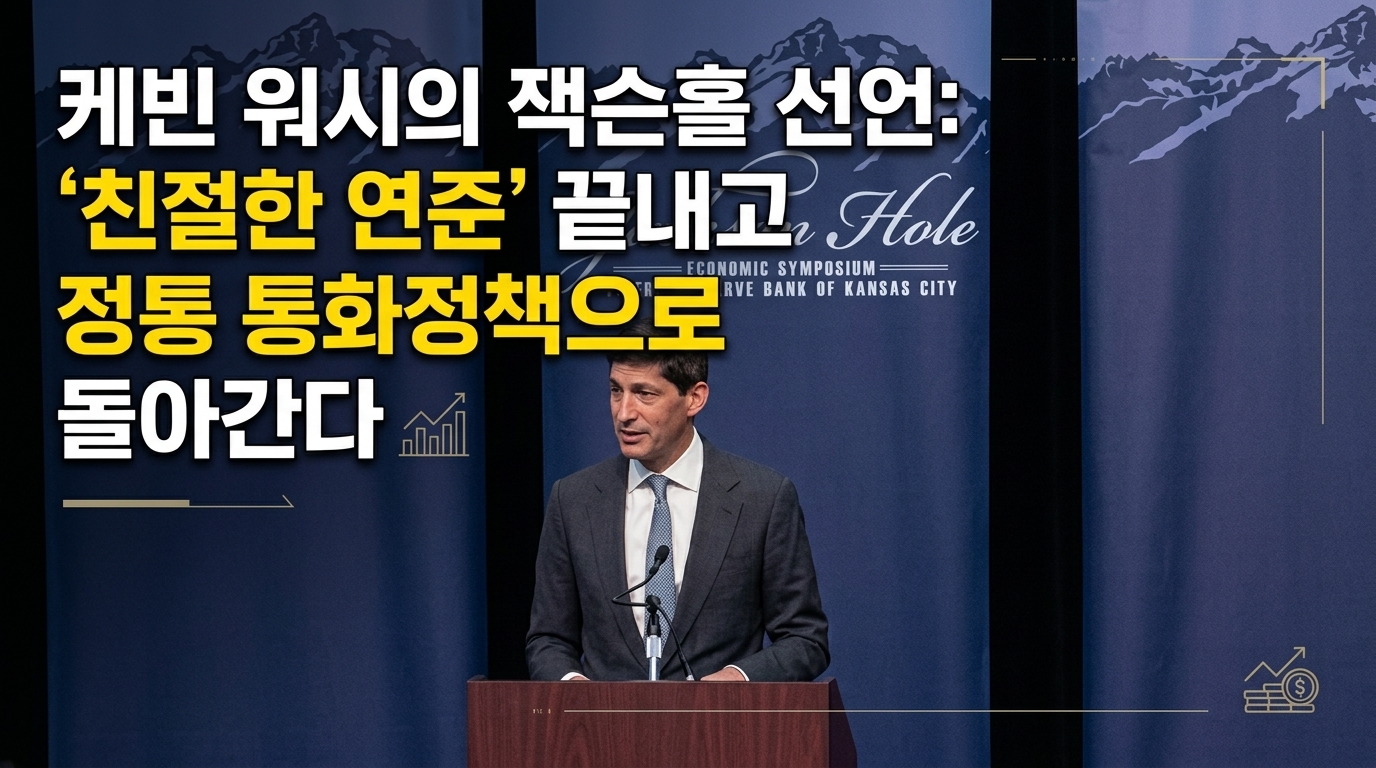
Kevin Warsh's Jackson Hole Declaration: Ending the 'Friendly Fed' for a Return to Orthodox Monetary Policy

지금왜

@whynow

케빈 워시의 잭슨홀 선언: '친절한 연준' 끝내고 정통 통화정책으로 돌아간다

Kevin Warsh's Jackson Hole Declaration: Ending the 'Friendly Fed' for a Return to Orthodox Monetary Policy

In his debut appearance as the new Chair of the Federal Reserve, Kevin Warsh delivered a strong warning to global financial markets. During his keynote address at the Jackson Hole Economic Symposium on August 28, 2026, he announced the end of forward guidance—the preemptive communication policy that had previously guided the market by the hand. His hawkish declaration that the war on inflation is not yet over and that the Fed still has significant work to do sent a chill through global financial markets instantly.

The Era of 'Friendly Hints' Shaking the Market Is Over

For some time, global financial markets had become accustomed to the 'friendly hints' provided by the Fed. This was thanks to forward guidance, a preemptive policy that forecasted future interest rate moves. Markets moved using these guidelines as milestones, and the Fed took on the role of a careful overseer, always aiming to spare the market from sudden shocks.

However, the message delivered by the new Chair, Kevin Warsh, was firm. It was essentially a notice that this 'friendly accompaniment' would be coming to an end. Warsh pointed out that the style of communication where the Fed holds the market's hand and provides gentle guidance actually distorts financial markets. He argued that a cycle where Fed forecasts create market expectations, which in turn trap the Fed in its own reactions, creates a 'hall of mirrors' effect that distorts reality.

Moving forward, the Fed plans to reduce unnecessary dialogue with the market and move more quietly. Instead of gentle communication involving constant hints, the Fed intends to focus solely on the essence of monetary policy by obsessively analyzing real-time data. Markets are on high alert following his declaration to abandon the practice of gauging market sentiment and instead act coolly, based strictly on real-time trends.

Return to Orthodoxy: The 7 Policy Principles Declared by Chair Warsh

In short, the new Fed guidelines announced by Chair Warsh are a call to 'get back to basics.' The core of his seven principles is to move away from unconventional emergency measures like quantitative easing and return to orthodox tools: adjusting short-term interest rates and managing the money supply. It reflects an attitude of focusing on the Fed’s inherent role rather than intervening in market trends at every turn.

The most firm point among them is the establishment of the 2% Personal Consumption Expenditures (PCE) inflation target as a non-negotiable, fixed line. This includes the principle that price stability is the top priority, data will be scrutinized more rigorously, and Fed messaging will be extremely restrained. It represents a clear break from the era of constant hints and word-heavy management.

To demonstrate this strict commitment, Chair Warsh quoted the legendary American pilot Chuck Yeager: 'In the moment of truth, there are no excuses, only results.' This highlights the Fed's newfound resolve to stop relying on lengthy explanations and excuses used to soothe the market, and instead be judged solely on the cold results of whether they managed to control inflation.

Persistently High Inflation and the Tension of Upcoming September Tightening

The scenario the market feared most is becoming reality. Behind Chair Kevin Warsh's ability to boldly announce the end of forward guidance lies the strength of U.S. economic indicators. Currently, the U.S. PCE inflation rate sits at 3.7%, significantly higher than the Fed’s long-term 2% target. Conversely, the unemployment rate is at 4.1%, indicating a robust labor market nearing full employment. With no need to worry about an economic recession, the Fed can now focus its full firepower on curbing inflation.

In his speech, Chair Warsh warned that inflation trends have not improved sufficiently and that if inflation does not subside, the Fed still has work to do. While he avoided confirming immediate interest rate hikes, he sent a clear hawkish signal that the Fed is ready to tighten its grip and increase pressure at any time. The sweet illusion of interest rate cuts that the market had been hoping for crumbled at this single warning.

Financial market calculations began to shift rapidly in response to the Fed's firmer-than-expected stance. The probability of an additional rate hike in September, which had been hovering around 35% before the speech, surged to approximately 60% according to the CME FedWatch Tool. This is a clear signal that tension is rising in a market that had been breathlessly weighing whether the Fed would actually pull the trigger on further rate hikes.

A Jolted Bond Market and the Challenges Facing the Korean Economy

Global bond markets reacted instantly to Chair Warsh's cold warning. The U.S. 2-year Treasury yield, which is most sensitive to changes in monetary policy, jumped 6.6 basis points immediately after the speech to reach 4.29%. This is a one-month high, providing clear evidence that the market has abandoned hopes for interest rate cuts and is rapidly pricing in the possibility of further tightening.

Indeed, according to the CME FedWatch Tool, the probability of a September interest rate hike surged from 35% before the speech to nearly 60% immediately after. With the 'friendly Fed' that once gently led the market gone, investors have immediately shifted to survival mode in preparation for prolonged tightening.

This U.S. tightening stance poses a significant burden on the Bank of Korea. For the Bank of Korea, which must balance domestic economic conditions amidst interest rate differentials and exchange rate volatility, the options for monetary policy have narrowed even further. The risk of a sell-off in U.S. bond markets spilling over into the Korean financial market has also intensified.

The first test for Chair Warsh—who declared he would look only at data without friendly guidelines—is the upcoming September monetary policy decision. Faced with the quiet yet heavy changes presented by the Fed, global financial markets, including Korea's, are watching the September Federal Open Market Committee meeting with bated breath to see how they will adapt to this new era of orthodox monetary policy.


Related Links

No comments yet.