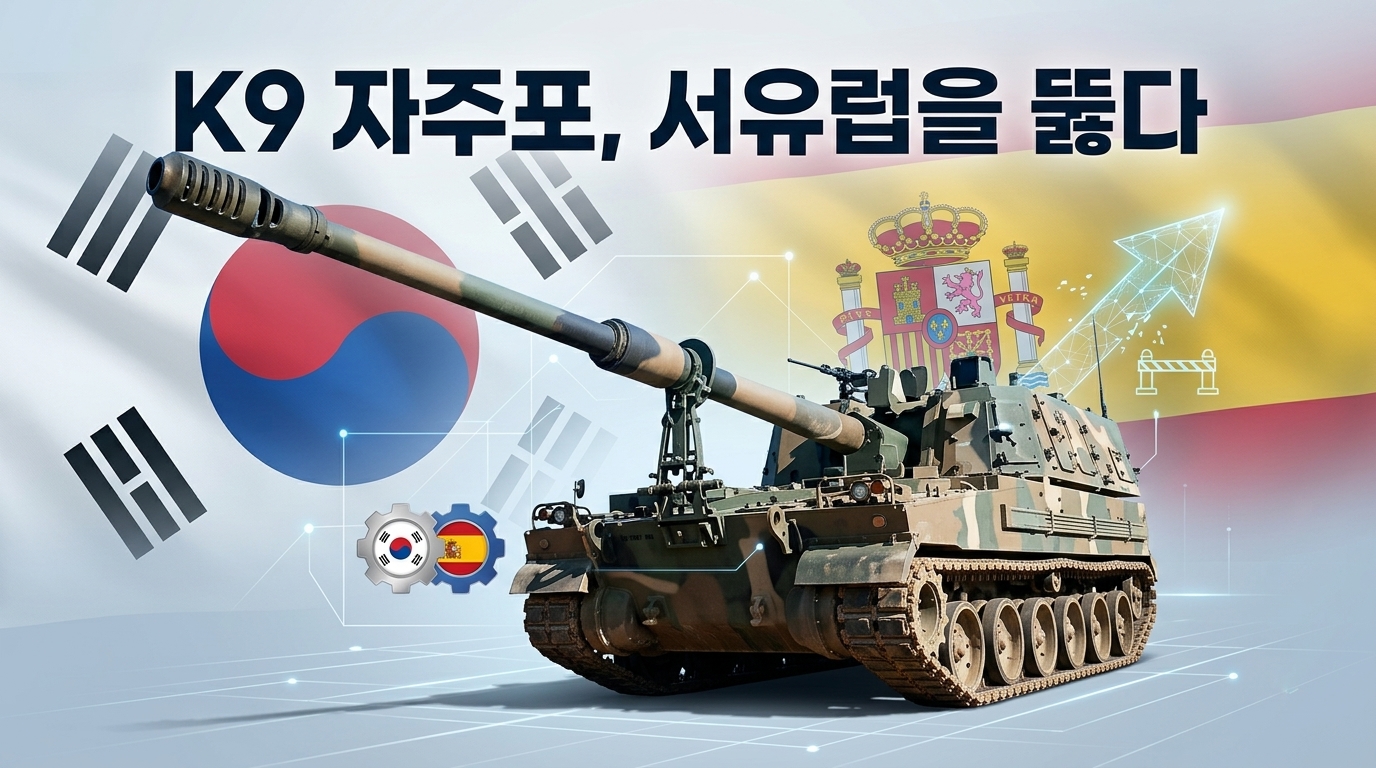
K9 Thunder Self-Propelled Howitzer Breaks Into Spain: The Secret to 'Local Co-Production' That Overcame Legal Hurdles

지금왜

@whynow

K9 자주포, 스페인도 뚫었다… 소송 장벽 넘어선 '현지 공동 생산'의 비밀

K9 Thunder Self-Propelled Howitzer Breaks Into Spain: The Secret to 'Local Co-Production' That Overcame Legal Hurdles

The K9 Thunder, a leader in South Korea's defense industry, has finally unlocked the tightly guarded Western European NATO market. With Hanwha Aerospace's announcement of an export implementation contract with the Spanish state-owned defense company Indra Sistemas on August 31, 2026, Spain has become the 11th nation to adopt the K9 and its first entry into Western Europe. We look into the backstory of how this achievement was realized, going beyond simple finished-product exports to overcome demanding local regulations and persistent legal challenges from competitors.

How an 11 Trillion Won Project Tied Up in Litigation Was Resolved

The path to planting the flag of the K9 Thunder on Spanish soil was anything but smooth. Until the moment the final contract was signed, a heated legal battle and intense litigation between multinational defense firms—some of the most intense in Spanish defense history—were playing out behind the scenes.

The conflict began in January 2026. Santa Bárbara Sistemas, a Spanish subsidiary of the U.S.-based defense contractor General Dynamics European Land Systems (GDELS), filed a massive lawsuit against the Spanish government. They sought an injunction to halt the tender process, contesting the selection of the Indra Sistemas consortium as the preferred bidder for the Spanish Army's artillery modernization program. The project, championed by the Spanish government, is a mega-project with a total scale reaching between 4.55 billion euros (approximately 7.7 trillion to 11 trillion KRW).

At the heart of this fierce legal opposition lies a core institutional concept championed by the EU and NATO: 'Strategic Autonomy.' The policy dictates that countries must not merely import weapons but also secure domestic production foundations and core technologies. The Spanish government sought to adopt South Korea’s superior K9 platform hardware while integrating local technical capabilities—such as Indra Sistemas' fire control systems—to manufacture the units domestically. However, Santa Bárbara Sistemas, which had traditionally handled most of Spain’s defense projects, viewed this as a threat to their market dominance and fought back with aggressive litigation.

The legal risks that held Hanwha Aerospace back for months hit a turning point in June and July 2026, when Spanish courts dismissed the appeals filed by Santa Bárbara Sistemas one after another. Having secured legal legitimacy, the Spanish government and Indra Sistemas reached a dramatic compromise by bringing in the litigating competitor, Santa Bárbara Sistemas, as a partner in a joint industrial framework. With the primary obstacle to Hanwha Aerospace's entry into Spain cleared, the historic export operation was finally given the green light.

Beyond 'Simple Sales': Why 'Technology Transfer' and Local Co-Production Were Chosen

The most interesting aspect of this contract is that Hanwha Aerospace completely moved away from the conventional model of exporting finished weapon systems. Instead, they opted for 'technology transfer and local co-production,' enabling Spain to manufacture the weapons domestically. Why choose such a complex and demanding workaround?

It is because of the 'Strategic Autonomy' regulations strongly pushed by the European Union (EU) and NATO. Strategic autonomy is a key European security doctrine aimed at strengthening regional defense capabilities to reduce external dependency and maintain independent weapon production and maintenance systems, even during crises. Simple import models that rely solely on foreign-made finished products cannot satisfy these rigorous standards. To break down the impenetrable walls of the European market, Hanwha Aerospace presented a tailored solution based on a thorough localization strategy.

Under the framework of the basic agreement signed in March, Hanwha Aerospace provides core K9 platform technology via a long-term license. In return, the local partner, Indra Sistemas, gains design authority to integrate its own proprietary fire control systems and command-and-control software. Production of the howitzer chassis and final assembly will also take place at Indra's production facilities in Gijón, northern Spain, utilizing local labor and components.

Due to confidentiality clauses, the specific volume and value of this final implementation contract have not been officially disclosed. However, the industry estimates the scale based on the 128 howitzers and 120 K10 ammunition resupply vehicles outlined in the March basic agreement. The shrewd compromise—generously sharing core technology while handing over production leadership—became the decisive weapon that captured the Spanish government's trust despite fierce legal opposition from competitors.

A Milestone That Penetrated the Elite Western European Defense Market

Entry into the Spanish market goes beyond the simple fact that a contract was signed. It marks the first time that the K9 Thunder, the flagship weapon of South Korea's defense industry, has officially set foot on Western European territory. Previously, the K9 has primarily expanded across Northern and Eastern Europe, including Poland, Finland, Estonia, and Norway. This is the first time a core Western European NATO member—countries known for high entry barriers to defense procurement and conservative stances on foreign weapons due to robust domestic industries—has chosen the K9.

The true value of this contract lies in proving that the K9’s performance and compatibility meet the strict standards of Western Europe. It demonstrates that the customized card of technology transfer successfully resonated with Western European nations that prioritize self-sufficiency in defense manufacturing. By using Spain as a deployment site, the K9 has shown that it can naturally interface with NATO’s sophisticated command-and-control systems.

The defense industry views this Spanish export as a powerful lever that will incentivize other Western European countries currently considering artillery modernization. It establishes a precedent that Hanwha Aerospace provides not only cost-effectiveness and performance but also tailored responses to demanding European regulations. This achievement, having broken through the invisible barrier of the Western European market, is a milestone confirming that the K9 Thunder has firmly established itself as a true mainstream player in the European defense market.

Contract Execution and Remaining Tasks to Watch

Now, the market's focus shifts beyond the signed contract to the actual implementation process and remaining tasks. Hanwha Aerospace will receive a 20% down payment immediately upon signing and an additional 5% by the end of 2026. While the specific scale and quantity remain undisclosed due to commercial confidentiality, analysis based on the public disclosure requirement (which mandates reporting for contracts worth at least 2.5% of the previous fiscal year's revenue) suggests this is a major deal worth at least 667.5 billion KRW.

The real key to this project is the successful establishment of the local production line in Gijón, northern Spain. As the process goes beyond simple component assembly to include the transfer of core technology—with Indra integrating its own control software and systems to manufacture the chassis locally—the core challenge lies in managing operational variables that may arise during the initial construction phase of the production process.

Maintaining the quality of locally produced howitzers to the same level as the original Korean-made units is another task that cannot be overlooked. The success of this local co-production model in Spain will serve as a significant test case for Hanwha Aerospace to secure yet another powerful card—'technology transfer-based licensing exports'—in the global defense market.


Related Links

No comments yet.