
삼코딩@samcoding
Dev Hub
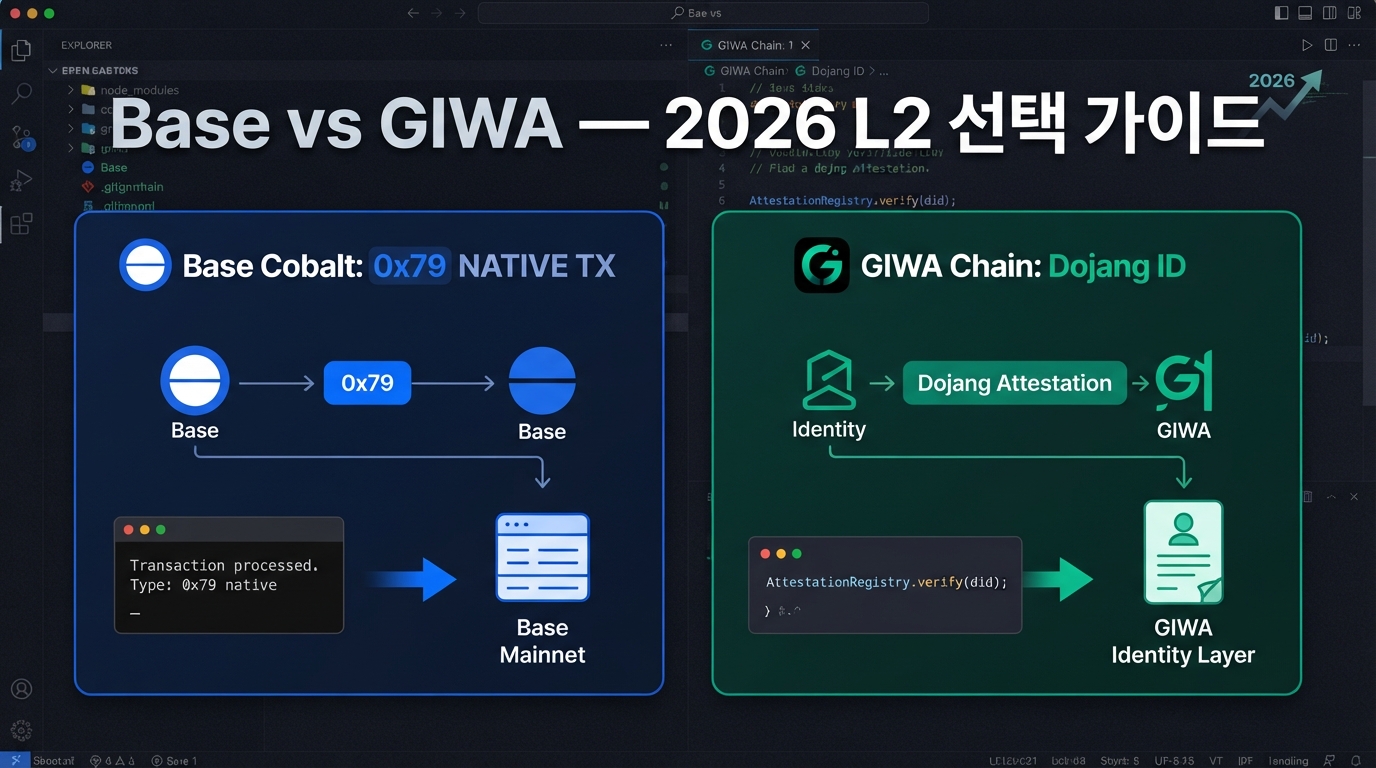
Base Cobalt vs. GIWA Chain — Where Should L2 Developers Look in 2026?
The key topic in the 2026 Ethereum Layer 2 (L2) ecosystem is no longer just about gas fee reduction or processing speed competition. L2s have now entered an architectural arms race, embedding primitives dedicated to builders directly at the node client and virtual machine levels. At the center of this are 'Base Cobalt,' which targets global services and AI agent commerce by natively integrating Account Abstraction (AA) at the client level, and Dunamu's 'GIWA Chain,' which embeds identity verification and privacy engines tailored to Korea's rigorous regulatory compliance environment. In this article, we will compare the distinct technical orientations of these two chains from a builder's perspective and provide clear criteria for choosing the right infrastructure for your actual development process.
Base Cobalt — Native Account Abstraction Without Bundlers
The Base Cobalt upgrade completely removes the existing ERC-4337 middleware layer, integrating Account Abstraction directly into the Reth V2 execution client. The core lies in the native integration of EIP-8130, which handles account settings at the execution layer, and EIP-8140, which ensures token gas fee payment.
The greatest weapon of this architecture is the total omission of off-chain bundlers or complex entry point contract calls within the EVM. When a node receives a new 0x79 transaction type, it completes signature verification at the execution engine level with O(1) deterministic complexity, without requiring virtual machine simulation. Thanks to this, the verification overhead for smart wallets is reduced to 21,000 gas, which is completely on par with existing EOAs.
These innovations in cost and speed present a breakthrough for AI agent commerce environments that need to execute hundreds of automated payments per millisecond. The example below is a practical implementation pattern using an experimental module of the viem library to define a new smart account, register a session key (Actor) for agents with limited permissions, and handle atomic execution via a 0x79 type transaction.
(Based on viem v2.x experimental/eip8130 API)
Using this approach, developers no longer need to operate complex, high-maintenance bundler infrastructure or perform heavy binary search simulations to calculate gas limits. This is because the verification path is safely standardized at the consensus layer, fundamentally controlling threats such as mempool denial-of-service (DoS) attacks.
GIWA Chain — Identity and Privacy Engine for the Korean Market
The GIWA Chain, unveiled by Dunamu in collaboration with the Optimism Foundation, is an open L2 chain that adopts the Self-Managed tier of Optimism Enterprise. While using the OP Stack as a global standard, it features an architecture that incorporates identity verification and regulatory compliance layers specific to the Korean environment through vertical integration. It is designed to implement a 1-second block time with a target gas fee of approximately 1 KRW.
The most powerful weapon for developers is the actual on-chain implementation of the on-chain identity verification service, 'Dojang.' Dojang is designed based on the Ethereum Attestation Service (EAS) protocol and proves only whether a wallet address has completed KYC without exposing personal information. Key addresses and configuration values for Dojang deployed on the GIWA Sepolia testnet are as follows.
- EAS Main Contract:
0x4200000000000000000000000000000000000021 - Schema Registry:
0x4200000000000000000000000000000000000020 - Upbit Official Attester:
0x09B170CA2A006081042992bCE7379B85a02149C6 - Attestation Address Schema UID:
0x072d75e18b2be4f89a13a7147240477481c4b526d5795802acba59046b426e08
Using this on-chain schema information, developers can control interaction to include only verified users at the smart contract level, without needing to build complex off-chain real-name authentication infrastructure from scratch.
This is combined with 'Bojagi,' a financial privacy layer that incorporates Zero-Knowledge Proof (ZKP) technology. Bojagi ensures the transaction confidentiality required for large-scale B2B transactions or financial institution transfers in real-time, while maintaining the transparency of the blockchain. It is already steadily verifying deposit token transfers and payment technology with commercial banks, expanding its potential as an L2 specialized for institutional use.
Where Should You Develop? — Architecture and Ecosystem Comparison
The choice of architecture varies completely depending on the core requirements of the service you intend to develop. If you are building high-performance AI agents or ultra-fast smart account services targeting the global market, you can look forward to the Base Cobalt upgrade. Since you can transmit transactions directly to a standard mempool without operating complex off-chain bundler infrastructure, the build difficulty and gas overhead are drastically reduced.
On the other hand, if you are designing payment services that require integration with domestic financial systems, robust identity verification, and privacy, GIWA Chain is an excellent alternative. GIWA Chain provides up to $100,000 in developer grants through its accelerated builder support program and integrates UP.ID, a Soulbound Token-based address identification service, providing a natively built-in identity layer required for local regulatory environments and collaboration with the financial sector.
Practical Checklist for L2 Builders in 2026
When choosing new L2 infrastructure, do not mistake the temporary performance of a testnet for the security and maturity of a mainnet. You must soberly compare the technical milestones of these two chains, which are slated for mainnet deployment in the second half of 2026, and determine the architecture according to your project's goals.
The EIP-8130 and EIP-8140 features of Base Cobalt can currently be verified in advance on the VibeNet testnet. However, the load and security that this native verification structure—lacking off-chain bundlers—places on nodes when processing large-scale transactions in a real mainnet environment must undergo further verification after the official launch scheduled for September 2026.
In the case of GIWA Chain, you can immediately test Dojang and EAS integration contracts on the GIWA Sepolia testnet using chain ID 91342. Builders should closely watch the private mainnet operation progress aimed for Q3 2026, along with the schedule for open-sourcing the zero-knowledge verification contracts for Bojagi, GIWA's privacy engine.
Ultimately, the choice of Layer 2 in 2026 is not about a simple speed competition, but about what unique primitives you can offer your application. If you are building global-scale smart accounts and AI agents, Base Cobalt will be the answer; if your objective is strong domestic regulatory compliance and privacy-oriented financial solutions, GIWA Chain will be the clear solution.
Reference Links
- L2BEAT & Developer Ecosystem Analysis — Ethereum L2 Market Metrics and Structural Trade-offs (Mid-2026)
- Optimism Foundation & Dunamu — Dunamu's GIWA Chain Launches Testnet and Partners on OP Enterprise Self-Managed Tier
- Optimism Foundation & Dunamu — Upbit Operator Dunamu and Optimism Partner on GIWA Chain