
Haram@haram
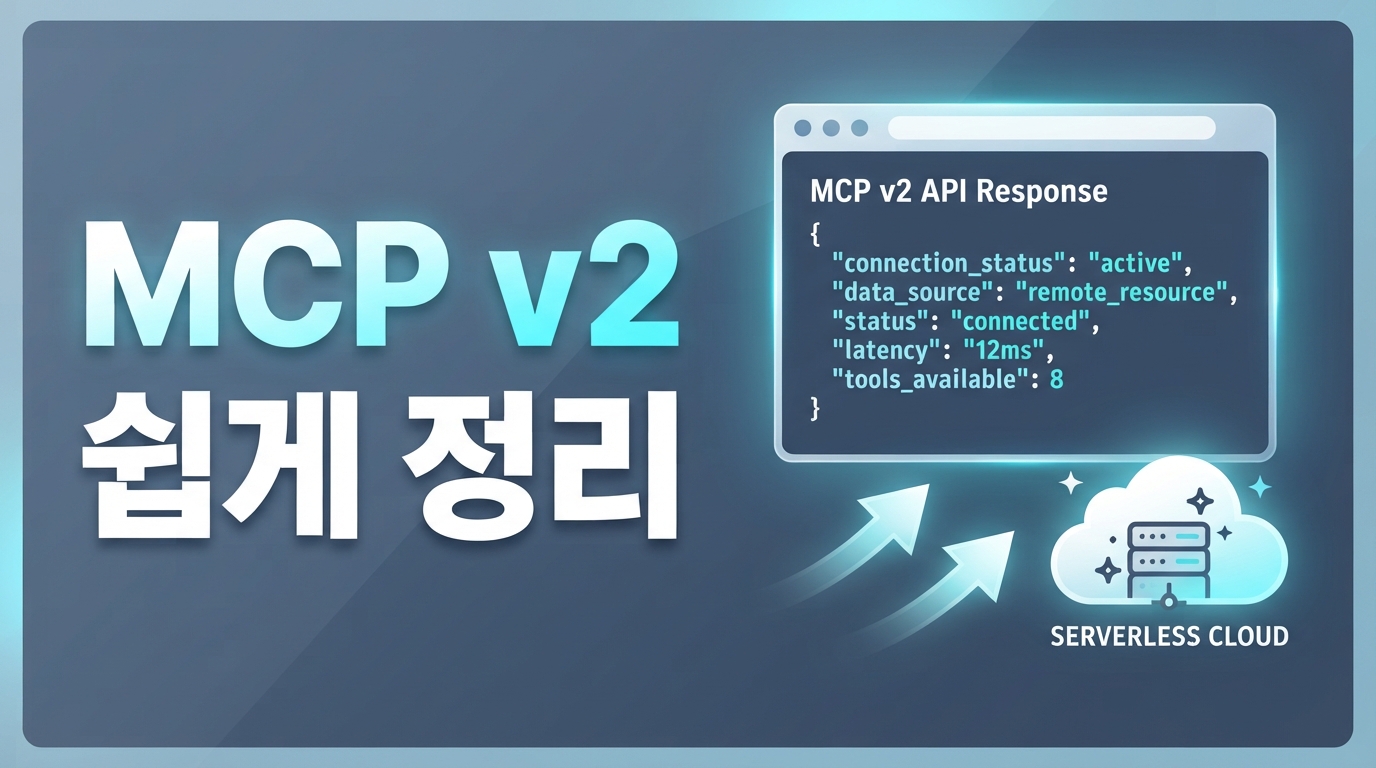
MCP v2 Released — Switching to 'Stateless' to Remove Complex Sessions and How to Respond
The Model Context Protocol (MCP), the leading standard for connecting AI agents, is gearing up for a completely revamped v2 specification. The core theme of this update is a shift to 'fully stateless' operation, eliminating complex connection maintenance. It’s like moving from a system that keeps a phone line open constantly to one that only exchanges messages when necessary. Here’s a quick and simple look at how this change impacts development environments and what you need to prepare.
Stateless Transition: What Are the Benefits?
The existing MCP, when communicating between client and server, was similar to keeping a phone call connected without hanging up. It was a somewhat heavy structure that only worked if you constantly verified states and maintained session identifiers, asking, "We're still connected, right?" However, from the v2 spec, it will completely shift to sending postcards one at a time only when needed. This shifts the architecture to a fully stateless environment where maintaining a connection is unnecessary.
Removing the need for state persistence makes infrastructure operations much easier. Without complex procedures, you can place multiple remote MCP servers behind a cloud load balancer and distribute incoming traffic as needed. If one server fails, another can simply pick up the request as if nothing happened, significantly increasing stability.
Interestingly, new rules named Mcp-Method and Mcp-Name have been added to the header area of communication packets. Thanks to this, relay servers or gateways can immediately determine where to route traffic and how to limit speeds without having to open and inspect heavy message bodies. As the processing becomes simpler, both server operating costs and development complexity are expected to decrease significantly.
TypeScript SDK v2 — Split Packages and New Syntax
If you are a developer using TypeScript, you will notice the biggest changes in v2. Previously, you had to import one heavy, massive library, but now the packages have been split to be lightweight and intuitive, allowing you to pick only the features you need.
When implementing basic server functionality, you install the @modelcontextprotocol/server package, and when adding an adapter to work in a Node.js environment, you import @modelcontextprotocol/node and assemble it. Since you only select the packages you need based on the client or framework, your build size becomes much lighter.
The names of the core methods for registering tools have also been changed to be clearer. The existing .tool(), .prompt(), and .resource() methods are being cleanly replaced with .registerTool(), .registerPrompt(), and .registerResource(), respectively.
If updating existing code manually feels burdensome, try using the official migration tool. By running the simple terminal command below, you can automatically convert v1-spec code to the v2 spec.
With one command, you can significantly reduce manual work, so start your v2 transition smoothly without worry!
Python SDK v2 — Vital Measures to Prevent Deployment Failures
If you are running an MCP server built with Python, there is an urgent change you need to check immediately. The official release of the Python SDK v2 is scheduled for July 27, 2026.
In this v2 update, FastMCP, which has been frequently used as a core class, is being renamed to MCPServer. While this is a package restructuring to more intuitively reflect the core server role, if you reach the release date without preparation, your code may break and stop working during dependency updates.
The fastest and most reliable safeguard is to set a version cap in your project's dependency configuration file immediately. Change your settings as shown below so that even when v2 is released, you stay safely within the v1 range.
Locking the version like this allows you to prepare for the migration with peace of mind while safely protecting your operational environment. Note that the existing FastMCP class will be separated into an independent package to help with multi-server configurations and will continue to be provided. Let’s prioritize service stability by setting up this dependency barrier first and then proceed with the next steps.
Plenty of Preparation Time, but the Flow is Changing
You don't need to worry that your existing servers will stop working immediately due to this news of spec changes. This v2 spec transition provides a generous 12-month grace period to support backward compatibility. The new server libraries themselves also include countermeasures to handle client requests from older versions smoothly.
Other developer language ecosystems are also moving actively. Most notably, the C# ecosystem using the .NET environment has also responded quickly by releasing a v2 preview version on the NuGet platform.
A stateless environment that doesn't require managing individual connection states will serve as a robust backbone for web infrastructure where more agents can communicate freely in the future. You don't need to tear down and rebuild all your code right away, so I recommend preparing for the migration gradually in line with the upcoming official release schedule.