
Maru@maru
Dev Hub
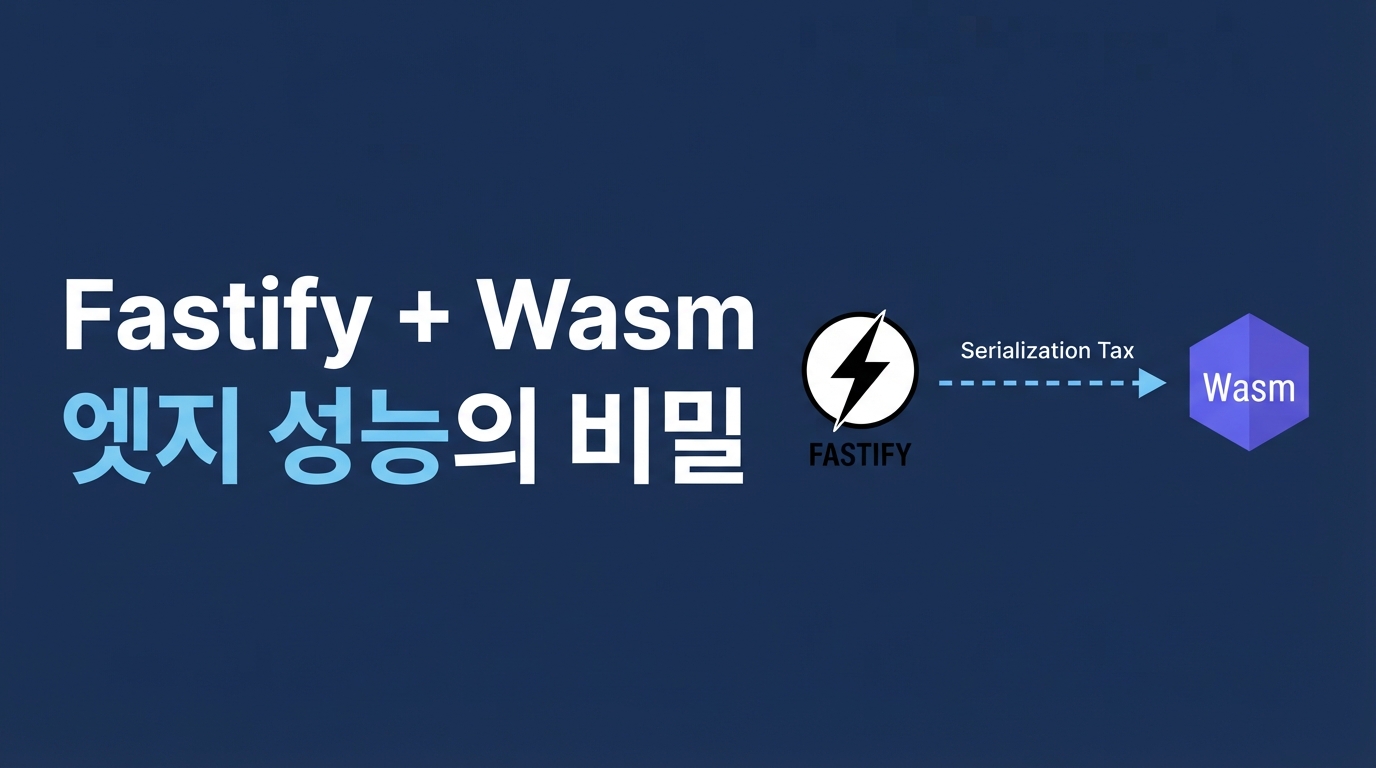
Fastify and WebAssembly — The Reality of 'Serialization Costs' That Eat Away at Edge Performance
There is a growing effort to adopt WebAssembly virtual machines in serverless edge environments to reduce cold starts. However, deploying standard Node.js frameworks like Fastify directly into an edge runtime often leads to unexpected compatibility errors and significant performance degradation. This post explores the reality of 'serialization costs'—a practical technical barrier encountered when running Fastify in a WebAssembly environment—and examines hybrid architecture alternatives to overcome them.
The Runtime Compatibility Barrier Faced by Fastify in Edge Environments
When deploying Fastify to WebAssembly-based edge runtimes like Cloudflare Workers' workerd, developers frequently encounter runtime errors from the boot phase. The primary culprit is a symbol compatibility flaw between Pino, Fastify's default logger, and the edge runtime. In fact, the type error occurring because Pino's core serialization symbols are undefined is a well-known, persistent compatibility barrier, documented in GitHub issue #5087.
Another barrier is the strict restriction by edge runtimes that prohibits asynchronous tasks during the global module evaluation phase. Fastify actively uses asynchronous I/O and timer scheduling during plugin registration and environment configuration. In environments like workerd, if such operations are detected during initial loading, the startup is immediately blocked with error messages stating that these are disallowed operations in the global scope, intended for security and cold start control.
Recently, there have been active attempts to bypass these portability barriers using virtualization layers. Wasmer's Edge.js, released in beta in August 2026, is a good example. Edge.js runs QuickJS inside a WebAssembly sandbox, allowing existing Node.js applications to run as-is without code modifications. This is gaining attention as an alternative approach that avoids the heavy initialization latency of the V8 engine while enabling Fastify's core modules to operate reliably in edge environments.
The Bottleneck of WebAssembly Environments: The Identity of 'Serialization Costs'
While WebAssembly-based runtimes drastically reduce cold starts to under 10 milliseconds in serverless environments, they can actually trigger severe performance bottlenecks in high-frequency API environments with heavy data processing. The core cause of this latency is the 'serialization tax' that occurs between the JavaScript engine and the WebAssembly virtual machine.
Because WebAssembly uses an independent linear memory structure for security and safety, it cannot share memory directly with the JavaScript domain. Consequently, every time an HTTP request payload entering through Fastify needs to be processed within a WebAssembly module, overhead is incurred to encode all data, copy it across the linear memory boundary, and then deserialize it again.
As the data size to be processed increases, the CPU computation required for this copying and memory conversion grows rapidly. Eventually, the physical cost consumed during data I/O outweighs the benefits gained from WebAssembly's fast computation speed, causing overall API response performance to noticeably degrade compared to running it in a standard Node.js environment.
Alternative: A Hybrid Architecture Using node:wasi for
To overcome the serialization bottlenecks caused by deploying WebAssembly across the entire edge runtime, a hybrid architecture is emerging as an alternative. This approach keeps Fastify as a high-performance I/O gateway in a standard Node.js environment while delegating only CPU-intensive, heavy computations to local WebAssembly modules within the same process. In this method, Fastify handles the proven routing and plugin ecosystem, while offloading complex algorithms or CPU tasks to WebAssembly.
Using Node.js's built-in node:wasi module allows for loading high-performance WASI modules directly without unnecessary network stacks or container overhead between the JavaScript engine and the virtual machine. In particular, by isolating heavy operations—such as tokenization for large-scale AI applications, cryptographic signing, or data parsing—to the WebAssembly tier, you can maximize computation performance without interfering with Fastify's single-threaded event loop.
This hybrid model demonstrates a throughput improvement ranging from at least 2x to up to 5x compared to simple JavaScript computations. It is the most realistic practical pattern that allows for seamlessly transplanting the high-speed computation capabilities of WebAssembly into the Node.js ecosystem, while completely bypassing the immature Node.js compatibility barriers of edge runtimes.
The following is a concise example of integrating local WASI components using an ESM structure in a Node.js 20 or higher environment.
By utilizing this method, Fastify can focus on what it does best—large-scale HTTP request management—while achieving optimal role distribution by safely pushing only heavy computing tasks into the WebAssembly sandbox.
Fastify and Hono: A Selection Guide for Developers
If ultra-lightweight execution and minimizing latency are your top priorities in serverless edge environments like Cloudflare Workers, Hono is the most natural choice. Hono was designed from the ground up to target global edge runtimes, resulting in virtually no unnecessary compatibility layers or boot overhead.
Conversely, for complex backend architectures that require sophisticated schema validation, a rich plugin ecosystem, and the ability to perform CPU-intensive computations in parallel, a hybrid configuration of Fastify in a standard Node.js environment with node:wasi is significantly more powerful. Instead of unconditionally migrating to the edge, you should carefully weigh the 'serialization costs' and runtime compatibility to choose the right tool for your service workload.
Reference Links