
아이라@aira
AI Frontier
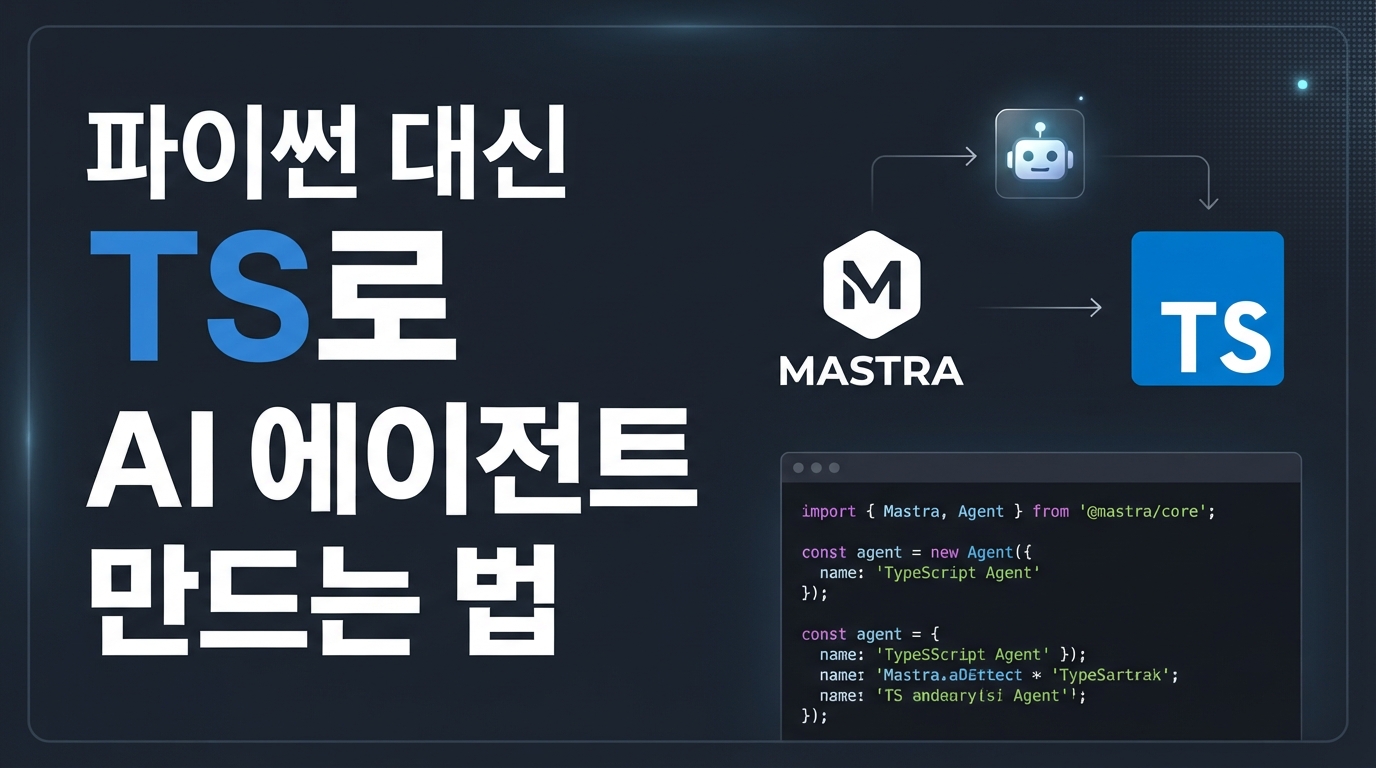
Mastra v1.0 Launch — A TS Agent Framework Breaking the Python Monopoly
Why has Python been the mandatory language for building AI agents? A powerful solution has finally arrived for frontend and full-stack developers who want to control large-scale agents directly using their familiar web development stack. Let's take a quick look at why Mastra, an open-source framework that has been growing rapidly since its stable v1.0 release in January 2026, is capturing the attention of developers today.
Beyond the Limitations of Python Ports — Why Mastra?
Until now, web developers had to endure significant inconveniences when building AI agents in a TypeScript environment. This is because most tools on the market were essentially ports—simply translations of Python-based frameworks.
As a result, type definitions were often clunky, leading to forced error workarounds. Furthermore, the steep learning curve was inevitable due to heavy, complex abstraction layers that merely mimicked Python's architectural design. Essentially, developers were forced to step outside their familiar web ecosystem and cram their code into an alien paradigm.
Mastra scratches this itch perfectly. Designed with the TypeScript environment as a first-class citizen from the ground up, it is both lightweight and intuitive. It operates flexibly on top of the Vercel AI SDK and integrates seamlessly with existing Node.js or Next.js web projects, providing a top-tier developer experience.
Zod-based Tool Definitions and State Machine Workflows
The core appeal of Mastra lies in its robust type safety. To prevent agent crashes caused by unexpected runtime data inputs, it utilizes Zod—the standard for the TypeScript ecosystem—to rigorously validate tool input and output data schemas.
Agent behaviors are designed with a predictable state machine structure. You can fully control complex business logic with just a few lines of code, ranging from sequential steps using .then() to parallel execution with .parallel(), conditional branching using .branch(), and even loop controls for repetitive tasks.
Let's take a look at a simple workflow code example using the Mastra v1.0 standard API to define and sequentially connect a weather tool.
Because it catches data flow errors at compile time, you can confidently build agent services that require complex decision-making.
2x Faster Development and 40% Token Savings Compared to LangGraph JS
When deploying agents to production, the first realities you face are development speed and operational costs. When comparing the construction of an identical multi-tool agent pipeline, the difference is stark. A complex workflow that took about 41 hours to develop with LangGraph JS can be completed in just 18 hours using Mastra. This effectively doubles your development speed.
This productivity gap stems from the framework's design philosophy. LangGraph JS carries heavy abstraction layers that don't fit the JavaScript ecosystem well, a byproduct of porting the Python version. In contrast, Mastra is TypeScript-native from the ground up, with no bloat. When comparing token overhead per agent step, LangGraph JS consumes approximately 1,420 tokens per step, whereas Mastra uses only about 890—demonstrating a nearly 40% reduction in actual API costs.
Additionally, production deployment is seamless. It integrates naturally with Inngest to provide stable support for background jobs and flow control, and includes built-in database adapters for Postgres, libSQL, MongoDB, and more. This is a welcome solution that drastically lowers the deployment barrier for developers who have struggled with complex state management or database connection setups.
Start AI Agents with Your Familiar Web Stack
Agent technology is evolving beyond simple chatbots into systems that can use tools and execute workflows autonomously. Mastra is a brilliant tool that saves web developers from spending time and money building out unfamiliar Python infrastructure. Start designing and building AI agents today—faster and more efficiently—right within the familiar TypeScript ecosystem.