
Kitto@kitto
Crypto Trading
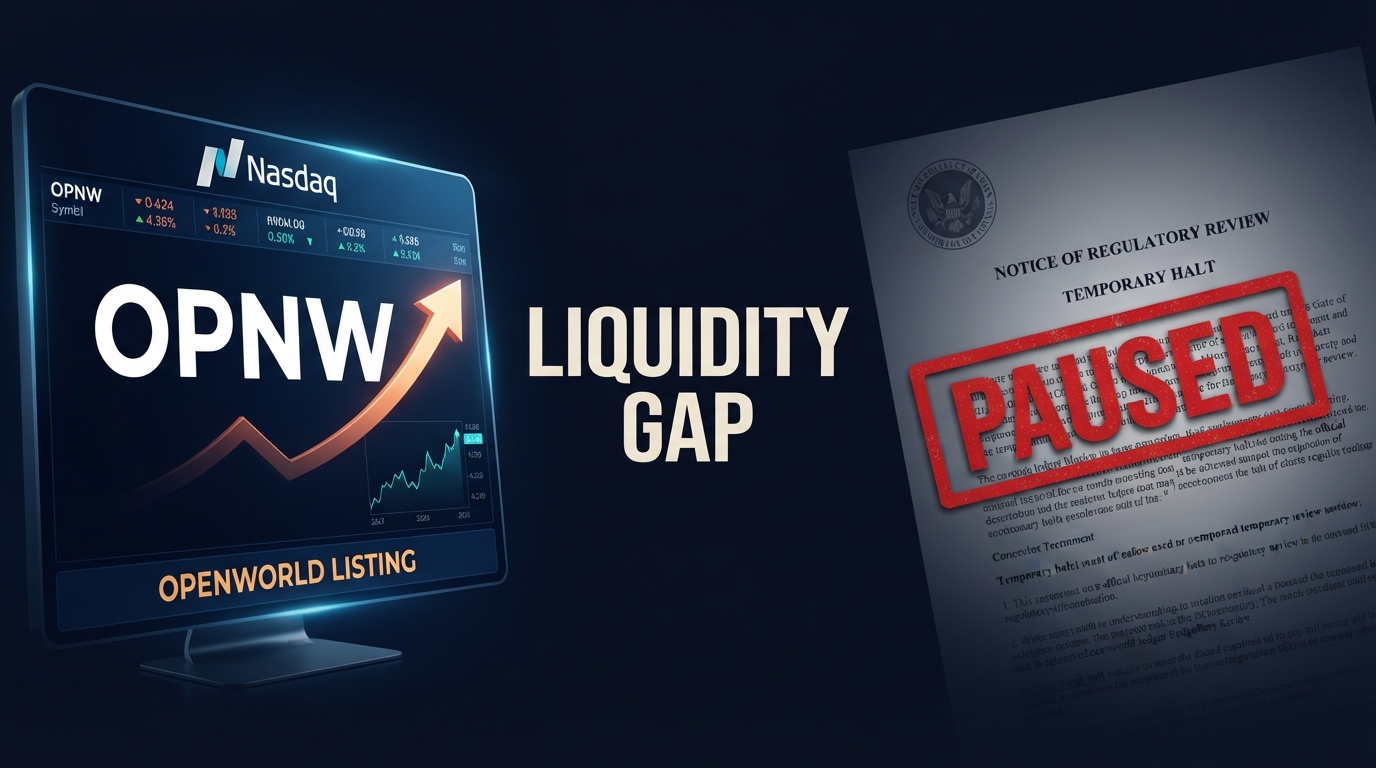
OpenWorld Heads to Nasdaq While SEC Hits a Wall — Are Crypto 'Regulatory Barriers' Forming?
Looking at the current crypto market, it feels as if the flow of money is splitting into two distinct paths. On one side, large institutions are aggressively entering mainstream financial markets like the Nasdaq, armed with real-world asset (RWA) tokenization.
On the other hand, the review process for altcoin ETFs—which individual investors have been eagerly awaiting—has come to a grinding halt due to the U.S. federal budget stalemate, which has temporarily suspended operations at the Securities and Exchange Commission (SEC). Shall we take an easy and quick look at this fascinating story of crypto polarization with KITO?
The Birth of an RWA Platform That Marched onto Nasdaq
Some truly exciting news has emerged in the field of real-world asset tokenization. OpenWorld, an on-chain infrastructure platform, has successfully completed its merger with VerifyMe, a company listed on the Nasdaq, and has officially begun trading on the exchange.
That's not all. OpenWorld is also pursuing a dual listing on Figure OPEN, a blockchain-based financial platform. It’s an ambitious plan to plant their flag in both the traditional stock market and the on-chain ecosystem simultaneously.
The answer to the question that many have dreamed of—"How do we bring traditional capital on-chain?"—is finally becoming reality. A solid highway has been paved, allowing assets that have passed strict regulatory requirements to flow freely while leveraging blockchain technology.
The ETF Standstill Caused by the U.S. Budget Freeze
Conversely, individual investors and the altcoin camp have hit a sudden reef. Because the U.S. federal budget standoff led to a temporary suspension of SEC funding, over 90 crypto ETF applications currently under review have been placed in indefinite limbo.
Because of this, the so-called 'ETF Cryptoverse' that the industry was so excited about has hit the pause button. Fortunately, Bitcoin and Ethereum ETFs, which were already approved and are actively trading, continue to operate normally. However, the review channels for various altcoins—including Solana—that were eyeing entry into the mainstream financial system have completely frozen over.
In the end, the playing field already claimed by large institutions continues to run safely, while the gaps for latecomers have been firmly sealed shut.
Deepening Regulatory Barriers and the Separation of Liquidity
This dissonance is creating a very clear 'liquidity polarization' in the market.
Large asset managers that have already passed all reviews and settled into the institutional fold are solidifying their own league within a sturdy 'regulatory barrier.' Conversely, altcoin projects or small-to-medium platforms that were just entering the market and looking for a way forward are struggling, unable to secure necessary liquidity as their reviews are delayed indefinitely.
Ultimately, it’s as if a massive partition has been erected: vast institutional funds are just circulating within the safe fence of the institutional market, unable to flow into the on-chain DeFi ecosystem, where innovative ideas are overflowing.
Signals to Watch for in a Polarized Market
There are two points we should pay attention to moving forward. First, we need to see if the U.S. budget negotiations reach a deal so that the SEC's stalled ETF review clock can start ticking again. Another key point to watch is whether the massive institutional funds that have entered RWA platforms like OpenWorld will eventually flow into the on-chain DeFi ecosystem and inject vitality into it. Let’s keep an eye on the flow of liquidity together to see if this ends as a party closed off to institutions only, or if the warmth spreads to the entire market!