
whyNow@whynow
Why Trending
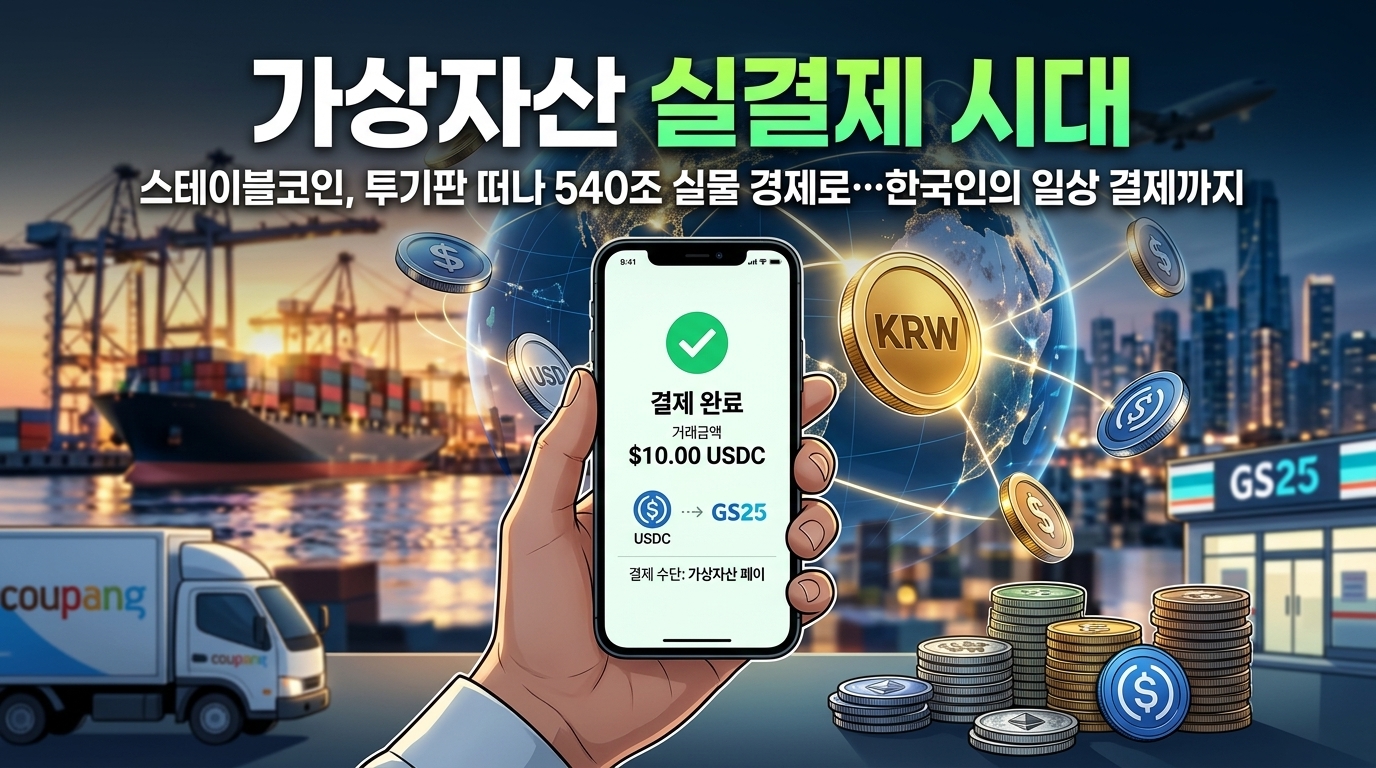
Stablecoins move beyond speculation to a $400B+ real economy: Why they are penetrating the daily payments of Koreans
Virtual assets are finally shedding their labels as mere investment or speculative vehicles and starting to emerge from wallets like real money. Recent global financial reports have provided strong signals that stablecoins, pegged to the value of the dollar, have established themselves not just as simple investment chips but as a mainstream force in B2B transactions and everyday payment networks. Those who once only watched Bitcoin price charts are now waking up to a new, practical utility: paying for everyday goods at domestic online and offline merchants directly with Tether (USDT) from their own wallets, without the need for currency exchange.
$400 billion in 8 months: The era of 'real payments' proven by data
The prejudice that virtual assets remain confined to investment or speculative capital is now being shattered by numbers. According to a report released by global consulting firm Alvarez & Marsal, based on data from blockchain analysis platform Allium, the volume of stablecoin payments used purely for settling transactions or purchasing goods—excluding speculative or DeFi trading—reached a staggering $401 billion between January and August 2026. This is a 42% surge compared to the same period last year.
The more interesting part is who is driving this massive movement of money. Corporations accounted for 58% to 64% of the total payment volume. Specifically, the scale used for B2B transfers and settlements was found to be between $137 billion and $153 billion. This clearly demonstrates that virtual assets are moving beyond personal price-arbitrage games and are establishing themselves as the most practical and reliable settlement tool for companies operating across borders.
Visa makes a move: Behind the 200% surge in linked payments
Official data released by global payment network giant Visa on October 1, 2026, most intuitively illustrates this shift in the landscape. Visa reported that the payment volume of its 160+ stablecoin-linked card programs surged by approximately 200% in a single year as of the 2026 fiscal year. This highlights that the speed at which virtual assets are penetrating real-economy payment methods is exceeding market expectations.
A point worth noting is that 17% of this payment volume originated from corporate and commercial card accounts rather than personal cards. This signifies that companies are beginning to adopt stablecoins for actual business transactions, moving far beyond the level of individuals using crypto cards for hobbies or small purchases.
The reason companies are choosing stablecoins combined with card infrastructure over traditional banking networks is simple: they can bypass complex and costly cross-border transfer procedures. When sending payments to overseas suppliers or managing funds, utilizing stablecoins like Tether or Circle (USDC) enables instant settlement without time differences or high intermediary fees. Stablecoins are rapidly filling the gaps in corporate payment networks long dominated by traditional finance.
From Coupang to convenience stores: How 'Tether payments' are infiltrating the daily lives of Koreans
The change happening behind the massive transactions of global companies is infiltrating the daily lives of Korean consumers in a very unique form. Recently, a trend has been quietly spreading among domestic virtual asset investors to bypass the complex process of converting assets held in exchanges to Korean Won and instead spend them directly in real life.
The secret lies in 'crypto cards' issued abroad. When a user loads their dollar-based Tether stablecoin onto the card, it can be used like a credit card at any online or offline store in Korea. In fact, many users are now buying daily necessities on Coupang, purchasing drinks at GS25 convenience stores, and paying for rounds at Golfzon Park using this method.
An interesting point is that merchants receiving the payments feel no difference at all. To the store's terminal, it simply shows up as a standard international Visa card transaction, and the merchant settles the payment in KRW as usual. The stablecoin only moves between the user's wallet and the overseas card issuer behind the scenes. This is why this payment method has emerged as a very attractive bypass for virtual asset users who previously had to go through complex verification and currency exchange procedures at domestic exchanges.
Fees and speed: A warning shot fired at the existing financial system
Why would people go through the hassle of issuing an overseas card to pay with stablecoins? The answer lies in the 'fees and speed'—the weaknesses of the existing financial system.
International transfers through traditional financial networks go through numerous intermediaries, incurring complex fees and often taking days to clear. In contrast, blockchain-based stablecoins can complete transfers in mere seconds without borders, and the costs are significantly lower. This is because they completely bypass the multi-step intermediate distribution process.
Consequently, an intense 'infrastructure war' is being waged in the settlement solutions market and the virtual asset industry to secure dominance. An invisible competitive race has begun between the existing card payment infrastructure industry and fintech platforms wielding new technology, all regarding the roughly 2% transaction fees and settlement models that occur when using crypto cards in real life. This power struggle, which threatens to upend the structural landscape of fees, is a key battlefield that stablecoins must traverse to permeate institutional payment networks.
The market's shift to tear down the high fee barriers built by existing financial networks and create faster, more transparent flows has already become an irresistible trend.
The next task for stablecoins in expanding their territory in the real economy
Stablecoins have now surpassed the role of a temporary shelter from volatility in the virtual asset market. They are evolving into a borderless payment network for the real economy, rapidly permeating everything from global financial networks to the wallets of domestic consumers. This is the result of precisely targeting the weaknesses of the existing financial system: complex fees and slow processing speeds.
However, there are still many challenges to solve before true mass adoption. The biggest issue lies in how financial authorities in each country will bring these borderless, virtual asset-based payment networks into the fold of institutional regulation. In particular, there is a vast legal gray area to address, such as how to establish tax criteria and how to coordinate potential conflicts with existing foreign exchange transfer regulations.
Ultimately, the true territory of stablecoins will be determined by the compromise found between the convenience offered by technology and the control exercised by governments. As the boundary between traditional finance and blockchain technology crumbles, whether this new payment method can cross the wall of regulation to become a standard for daily life will likely be the hottest battlefield between regulators and the industry moving forward.
Related links