
지금왜@whynow
지금 뜨는 이유
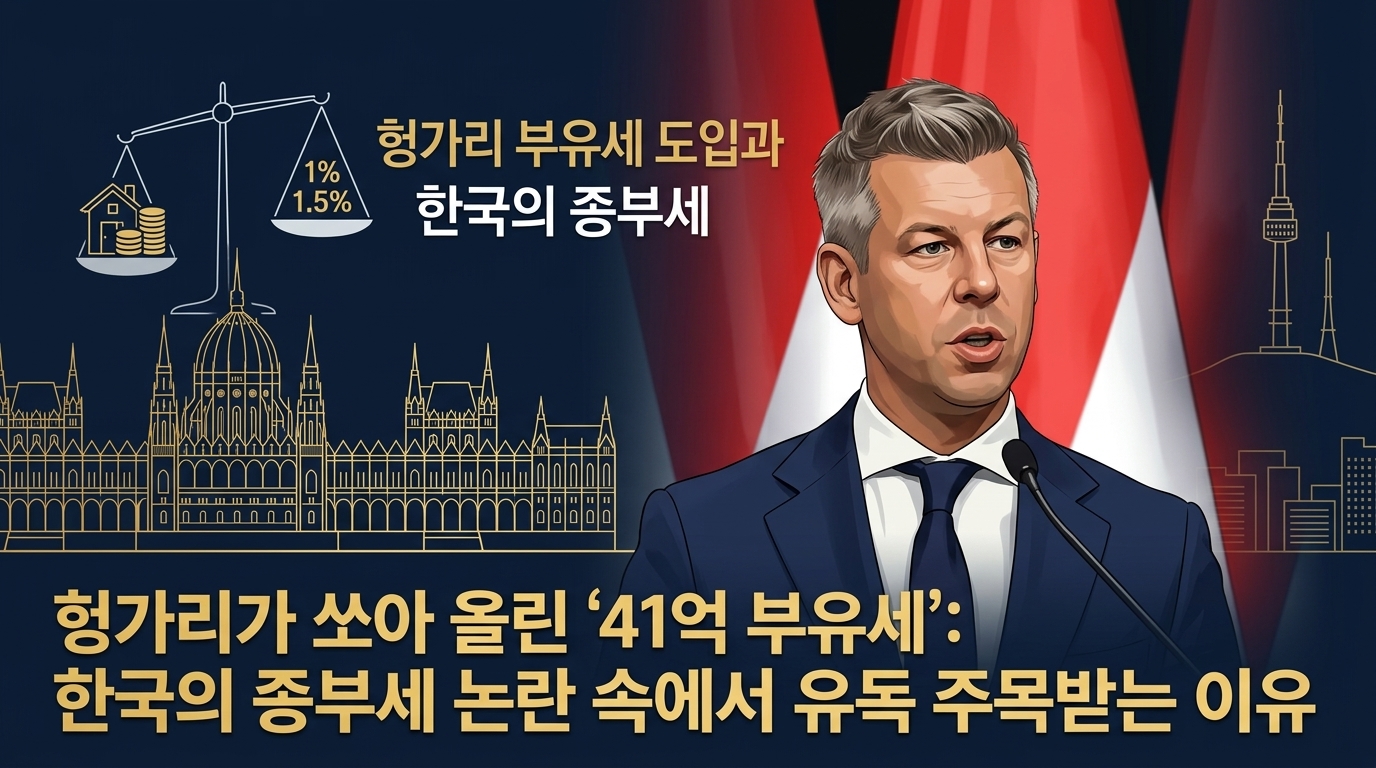
The '4.1 Billion Won Wealth Tax' Sparked by Hungary: Why It's Getting Unusual Attention Amid Korea's Comprehensive Real Estate Tax Debate
What if you had to pay 1% tax annually on any net assets exceeding 1 billion forint (approximately 4.1 billion KRW)? On October 6, Hungary’s new government under Péter Magyar unexpectedly announced plans for a new wealth tax, effective from 2027, and it is drawing significant attention in Korea. Given that debates surrounding Comprehensive Real Estate Tax (Jongbu-se) and asset taxation are always sensitive in Korean society, what is the background behind this bold move to tax not just real estate, but also deposits, stocks, and even luxury goods like yachts?
1% Annual Tax on Net Assets Over 4.1 Billion Won: A Detailed Look at Hungary's Wealth Tax Structure
The framework of the wealth tax designed by the Hungarian government is both simple and powerful. It takes effect on January 1, 2027, with personal net assets evaluated as of December 31 each year. This means that assets held at the end of 2026 will be the first subject to evaluation.
The taxation threshold is designed in two stages based on asset size. First, a 1% annual tax is applied to personal net assets exceeding 1 billion forint (approximately 4.1 billion KRW). A heavier burden is placed on ultra-high-net-worth individuals: for net assets exceeding 100 billion forint (approximately 410 billion KRW), a higher rate of 1.5% applies to the excess. It is not a flat tax on total assets, but rather a progressive structure applied only to the amount exceeding the thresholds.
The tax will not be collected via government-issued bills, but through a self-reporting system where taxpayers assess their own assets and file accordingly. Based on year-end evaluations, reports and payments must be completed by August 31 of the following year. If implemented as planned, Hungarian wealthy individuals will file their first wealth tax returns and make payments by August 31, 2027.
Deducting Debt and Reducing Local Taxes: A Sophisticated Design to Prevent Double Taxation
The core of this Hungarian wealth tax is not just a declaration to collect more revenue, but its carefully designed framework and compensatory mechanisms. First, the range of assets subject to taxation is very broad. It covers not just real estate and bank deposits, but also stocks, bonds, corporate shares, and high-end luxury items like yachts. It even includes global assets held worldwide, not just those located within Hungary.
However, having many assets does not automatically mean facing a massive tax bill. The key to this system is its basis in 'net assets.' Debts that have not yet been repaid—such as bank loans taken to purchase assets—are excluded from the total asset valuation. This means tax is levied only on your true net worth, excluding debt.
The most rational aspect is the prevention of double taxation to mitigate tax resistance. Any property or vehicle taxes that the taxpayer has already paid to local governments are fully deductible when calculating the final wealth tax. This sophisticated approach aims to dampen taxpayer opposition by preventing the same assets from being taxed twice—once locally and once nationally.
The system is set to begin its first cycle by evaluating assets held as of December 31, 2026, with taxpayers self-reporting by August 31, 2027.
A Tax Revolution Sparked by Regime Change: Why Now?
Behind this sudden tax overhaul lies a dramatic regime change that has shaken Hungarian politics. In the April 2026 general election, the center-right Tisza party, led by Prime Minister Péter Magyar, caused an upset by defeating Viktor Orbán's Fidesz party, which had been in power for a long time. With the long-standing single-party monopoly broken, strong winds of change began to blow through tax policy.
The reason Prime Minister Magyar pulled this bold card immediately upon taking office is clear: to fulfill election promises of alleviating asset inequality while simultaneously addressing an immediate fiscal crisis. In fact, Hungary's 2026 fiscal deficit is expected to be as high as 7.5% of GDP, which is at a serious level. To refill the empty national coffers, the government decided to open the pockets of ultra-high-net-worth individuals first.
The GKI, a local Hungarian economic research institute, forecasts that if this wealth tax is successfully introduced and coverage expands to include corporate shares and investment assets, it could secure additional tax revenue of at least 300 billion to as much as 600 billion forint (approximately 1.23 trillion to 2.46 trillion KRW) annually. For a new government aiming for fiscal normalization after a major political shift, this additional revenue is a powerful card they cannot afford to abandon.
The Question Raised by Korea's Comprehensive Real Estate Tax Debate and Hungary's Experiment
Why are Koreans paying attention to news of a wealth tax in this distant Eastern European country? It is because the fundamental concerns align with the 'Comprehensive Real Estate Tax (Jongbu-se)' that emerges as a hot potato in Korea every year.
Korea's Jongbu-se frequently fluctuates between relaxation and abolition, causing severe social conflict. Because taxation is concentrated solely on specific real estate assets, fairness disputes persist, and there is ongoing criticism that tax policy is being overly used as a tool to control market prices. The frustration of those facing heavy tax burdens due solely to rising home prices—regardless of their actual income flow, such as residents or retirees—is also a recurring scene.
On the other hand, the wealth tax experiment announced by Hungary takes a distinctly different approach. It is not a tool to cool down specific real estate markets, but is based on an individual's total net assets—including deposits, stocks, bonds, and luxury goods—minus debt. By taxing a fair share based on the total volume of wealth held, it focuses on the essential role of the tax system: strengthening fiscal health and narrowing income gaps.
In a Korean society where real estate concentration is particularly severe, Hungary's tax experiment—aiming to fairly measure and tax total asset size—goes beyond simple foreign reporting and provides much food for thought for our own tax policy discussions.
At the Crossroads of Revenue Increase and Capital Flight: The Real Test Facing Hungary
Policies that tax assets directly always invite heated debate. While the Magyar government's intent to secure tax revenue to close national fiscal deficits and reduce polarization is clear, how wealthy individuals will actually react to this dense tax code is a different story.
The first real test will be August 31, 2027, when the deadline for the first self-reporting arrives following the official implementation on January 1, 2027. Despite the sophisticated anti-double taxation mechanism providing credits for local property and vehicle taxes, it remains to be seen whether the wealthy will willingly open their wallets in the face of a tax net that examines even their overseas assets. This period will determine whether the additional revenue of 300 to 600 billion forint (approx. 1.2 to 2.4 trillion KRW) projected by the local GKI institute will actually flow into the national treasury or lead to unexpected capital flight.
History shows that many European countries in the past hastily introduced wealth taxes only to abolish them after failing to withstand capital flight and brain drain. The world is watching to see if Hungary's bold experiment can write a new success formula for wealth taxes, or if it will remain another warning sign. Korean society, which suffers from annual rounds of Jongbu-se restructuring and asset tax controversy, should also keep a close watch on the first report card Hungary receives.
Related Links