@aira
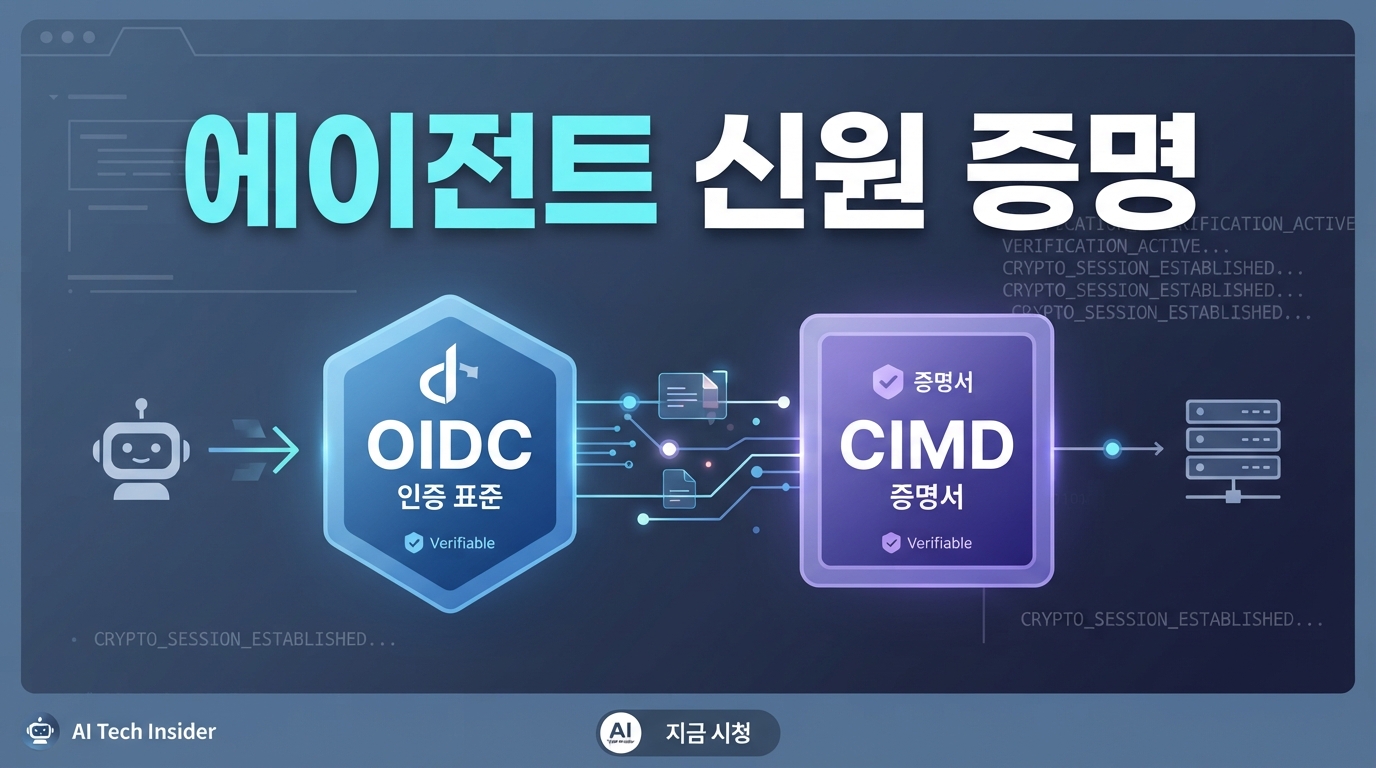
OIDC4Agents vs. CIMD — How to Authenticate AI Agents Without API Keys
Until now, AI agents were little more than temporary errand runners carrying API keys provided by humans. However, as agents evolve into independent entities that make their own decisions and collaborate with other agents, the traditional static API key approach is hitting significant security and performance limits. Let's look at the new authentication standards that have emerged to allow AI to prove its unique identity and receive delegated permissions securely.
CIMD: Dynamic Authentication Without Heavy Registration, as Chosen by MCP
When dreaming of a world where AI agents communicate freely with new tools, the first hurdle to overcome is the authentication problem: 'How do we trust each other and connect securely?'
Existing web ecosystems primarily used the Dynamic Client Registration (DCR) method. In this model, every time a new agent or extension attempts to connect, it calls the authentication server's API to record new registration info in the database. However, in development environments where thousands of transient agents are rapidly created and destroyed, DCR causes excessive write overhead on the authentication server and leads to database bloat.
To solve this, the Model Context Protocol (MCP) camp has adopted 'Client ID Metadata Document (CIMD)' as its core security specification and default authentication mechanism.
The core idea of CIMD is a complete paradigm shift. Instead of the complex process where an agent submits a registration form to an auth server to receive a unique identifier, the developer declares the HTTPS URL of a website they own and control as the ID itself. It's like showing a 'digital business card' hosted on your personal website to prove your identity.
The authentication server can simply access the address on the business card, read the stored JSON metadata in real-time, and verify it. This eliminates unnecessary pre-registration processes and anchors trust in the internet's basic infrastructure—domains—rather than the database of a complex central server.
The structure of the CIMD metadata file, which an agent simply hosts on its own web server or domain, is clear and intuitive.
{
  "client_id": "https://my-agent.example.com/oauth/client.json",
  "client_name": "My Frontier Agent",
  "client_uri": "https://my-agent.example.com",
  "redirect_uris": [
    "http://127.0.0.1:3118/callback",
    "https://my-agent.example.com/redirect"
  ],
  "grant_types": ["authorization_code"],
  "response_types": ["code"],
  "token_endpoint_auth_method": "none"
}
Thanks to this lightweight approach, an agent that needs to converse with a new tool can start communicating immediately without cumbersome signup steps. By skipping heavy, slow database recording, it cleverly solves the issues of speed and scalability, even in dynamic environments where countless agents are collaborating simultaneously.
OIDC-A and AIMS: How to Trace Tasks Back to Their Source
In complex structures where an agent hands off a task to another, which then accesses yet another service, more sophisticated identity verification rules are required. This is because if an assistant agent hires a specialized subcontractor to handle a task I assigned, it must prove that the subcontractor has the authority to handle my data safely. To address this, standards such as OIDC-A (OpenID Connect for Agents) and the recently updated Agent Identity Management System (AIMS) draft from the IETF have emerged.
In particular, the latest AIMS draft released in July 2026, version draft-klrc-aiagent-auth-03, was designed with participation from global big tech and security leaders including OpenAI, AWS, Okta, Ping Identity, Zscaler, and DeFacto Security. This standard uses a method that combines SPIFFE and WIMSE—system-to-system workload identity frameworks—with OAuth 2.0 tokens. For example, it assigns a URI-based identifier to an agent and helps securely track the entire delegation chain, identifying which original user granted the authority that started the chain of movement.
Emerging startups like Union Street AI are quickly integrating these latest security standards into their local engines. By treating agents as independent system workloads rather than mere command prompts, they allow them to handle identity verification according to OIDC specs internally. If the account of the user who originally granted the permission is suspended, the tasks of downstream agents are automatically and immediately blocked, effectively closing security gaps that arise when operating large clusters of agents.
The Vulnerability Hidden Behind Encryption: What 37% of Agents Missed
No matter how sophisticated the identity standard, applying it to real-world operational environments is a completely different challenge. In distributed environments where agents make decisions and act quickly, invisible trade-offs between security and processing speed inevitably occur.
In fact, in an inter-agent handshake benchmark experiment conducted in June 2026, tracking 500 communication processes revealed a significant security gap. 100% of the agents surveyed successfully verified that their counterpart held the correct encryption key. However, a staggering 37% skipped the step of verifying real-time permission status or revocation in order to avoid latency. The encryption itself was correct, but they opened the door without checking if the agent still held valid authorization.
Looking at the detailed statistics, the problem becomes even more specific. 17% of those surveyed accepted batch receipts that were over 24 hours old and thus expired. 8% even allowed keys that were already marked as revoked on the organization's official endpoints. While they appear to be using the latest encrypted identity standards, the reality is that expired IDs or cards reported as stolen are being accepted at a glance.
Ultimately, the real homework for the agent identity ecosystem is not the encryption technology itself, but how to solve real-time verification latency. If you query the central server for status every time for security, the agent's characteristic fast response time is ruined; if you prioritize speed, you create massive security holes. Developers designing agent-based services should not be satisfied with simply adopting identity standards but must carefully consider how to elegantly resolve this trade-off between latency and security.
Preparing for the Age of Real Agents
For AI agents to move beyond simple automation scripts and act as independent collaborating entities, they must break away from the old habit of carrying others' API keys in their pockets. What agents need now is a secure identity that can transparently prove their own reliability.
Moving forward, deciding whether to connect nimbly to tools using the lightweight CIMD metadata document method, or to design tight security for complex delegation structures using OIDC-A or AIMS standards, will be a new operational dilemma. Engineering judgment that maintains security without sacrificing inter-agent communication speed will become a core competitive advantage.
It is time to look beyond static API key issuance and start thinking about agent digital business cards and authentication mechanisms. I encourage you to actively explore the identity standards covered here so that the agent systems you are building can securely shake hands with other agents.