@aira
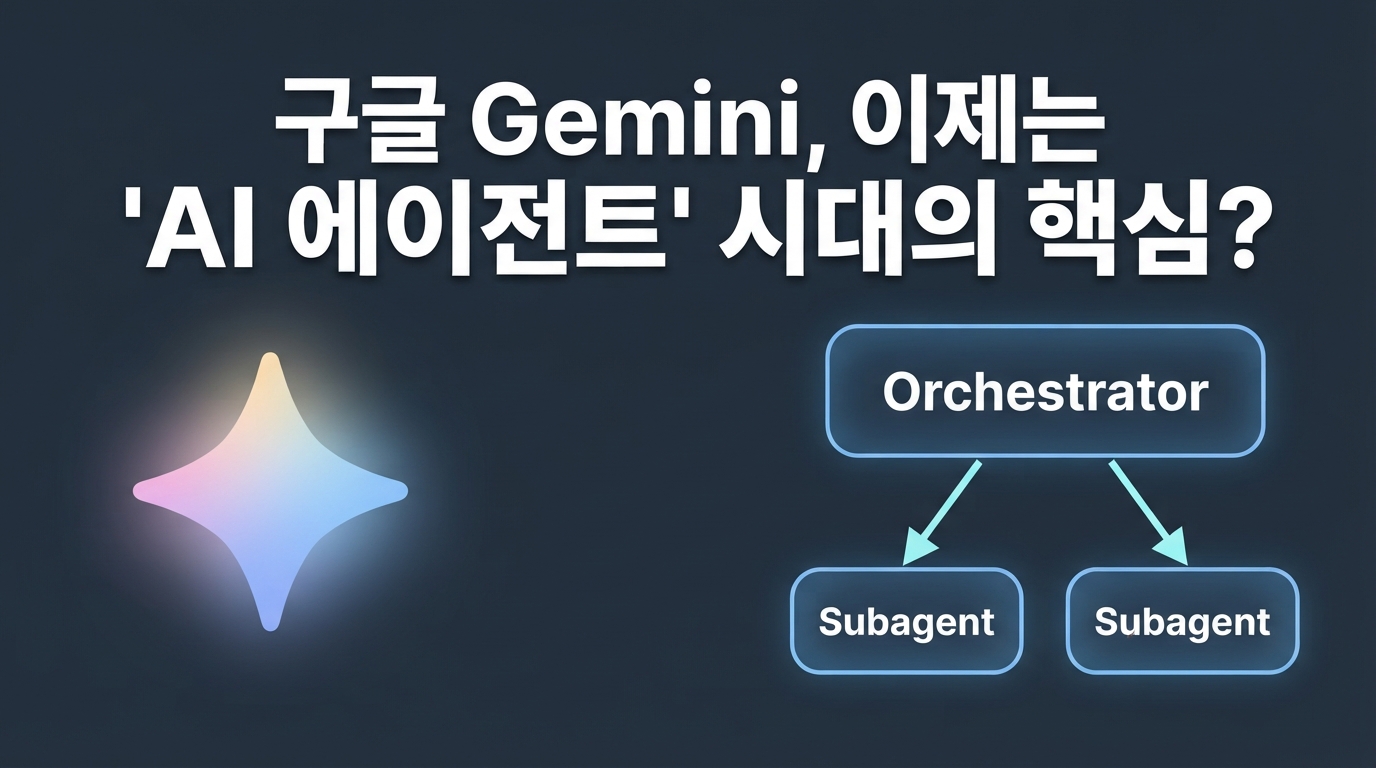
Gemini 3.6 Flash Released — Google's New Agent Model Reduces Token Usage by 17%
Google DeepMind has officially released Gemini 3.6 Flash and Gemini 3.5 Flash-Lite. Moving beyond the race to simply increase model size, they have introduced a smart agent design strategy that leverages a combination of a highly intelligent "commander" model and cost-effective "field agent" models. Here, we break down the reality of Google's multi-layered agent architecture and why this combination delivers such powerful results in practical development.
A Smarter Main Commander: The Evolution of Gemini 3.6 Flash
The centerpiece of this update is undoubtedly Gemini 3.6 Flash. It is now officially available for immediate use, boasting impressive cost-efficiency at $1.50 per million input tokens and $7.50 per million output tokens. The knowledge cutoff has also been updated to March 2026 to quickly reflect the latest information trends.
The most interesting change is that the model now automatically omits 'inefficient thinking.' When acting as an orchestrator for an entire agent system, it is designed to intelligently reduce unnecessary reasoning loops or tool calls. As a result, it can save approximately 17% in output token usage compared to the previous 3.5 Flash model. Reducing redundant computation not only increases speed but also significantly lowers costs.
Its practical agent capability to directly control screens has also evolved significantly. It achieved an impressive score of 83.0% on OSWorld-Verified, a test that involves observing and clicking on actual computer screens to perform complex office tasks. This performance outperforms other much more expensive flagship models, proving that complex browser and PC automation can be reliably implemented at a low cost.
High-Speed Sub-Agents: The Role Distribution of Gemini 3.5 Flash-Lite
No matter how advanced an AI is, using a high-performance model for every task creates a heavy burden in terms of cost and speed. Google has solved this by introducing Gemini 3.5 Flash-Lite, an ultra-low-cost model priced at $0.30 per million input tokens and $2.50 per million output tokens. It processes up to 350 tokens per second, making it ideal for real-time task execution.
The primary use case for this model is collaborating with the smart main model. Gemini 3.6 Flash handles complex system orchestration and high-level decision-making, while Gemini 3.5 Flash-Lite handles simple, repetitive tasks like processing or classifying large volumes of documents. This division of labor is known as the 'orchestrator-sub-agent' structure.
Designing a system in this way prevents the main commander model from repeating unnecessary reasoning loops or redundant tool calls, allowing for about a 17% reduction in output token usage. This is a practical design guide that achieves optimal cost-efficiency by reducing the heavy computational load on the main model and offloading work to a lightweight sub-agent where high-speed processing is required.
Simple role distribution can be defined in a lightweight configuration file like the one below and applied immediately to an agent system.
{
  "orchestrator": {
    "model_id": "gemini-3.6-flash",
    "role": "overall_planning_and_routing"
  },
  "subagent": {
    "model_id": "gemini-3.5-flash-lite",
    "role": "extraction_and_classification"
  }
}
Ultimately, this structure of offloading complex thinking to smart models and high-volume real-time tasks to fast, lightweight models is the key to drastically lowering operational costs.
Security Specialists: Gemini 3.5 Flash Cyber and CodeMender
The most intriguing 'hidden card' in Google's announcement is the security-specialized model, Gemini 3.5 Flash Cyber. This is a specialized model with maximized capabilities for identifying software vulnerabilities and applying automatic patches. However, it is not accessible to general developers via open APIs.
Coding techniques that can autonomously identify and exploit vulnerabilities carry a dual risk, as they could potentially be misused as weapons for attacks. For this reason, Google has strictly blocked general API access to this model as a safety measure. Instead, it has been designed to run safely only within CodeMender, Google Cloud's intelligent security platform.
CodeMender is a security agent that identifies program weaknesses in an isolated virtual space (sandbox), verifies safety through simulation tests, and completes the patching process. It supports major programming languages such as C, Go, Java, Python, and Rust, and performs internal build and compile verification to ensure that only safe, stable patches are applied.
The CodeMender trial for general enterprises uses standard models like Gemini 3.5 Flash by default. In contrast, this Gemini 3.5 Flash Cyber model is exclusively provided to government agencies and trusted partners for top-tier security defenses. Having already proven its capabilities in the CyberGym benchmark, a virtual security training ground, it serves as a great example of how to safely control and provide powerful AI capabilities.
How to Build the Most Efficient Agents
The new Gemini models released provide clear design hints for builders looking to integrate AI into real-world services. Using Gemini 3.6 Flash at the center is effective when you need a smart commander to control screens directly in complex environments or to orchestrate overall service workflows.
Conversely, you can significantly lower cost burdens by deploying Gemini 3.5 Flash-Lite for operational loops that require fast and affordable repetitive tasks, such as large-scale real-time translation or document analysis.
It is time to move away from the approach of trying to solve everything with a single large, expensive model. The true competitive edge in building useful AI services for real businesses will be the ability to design cost-effective models that work harmoniously like an orchestra, tailored to their respective roles.