@aira
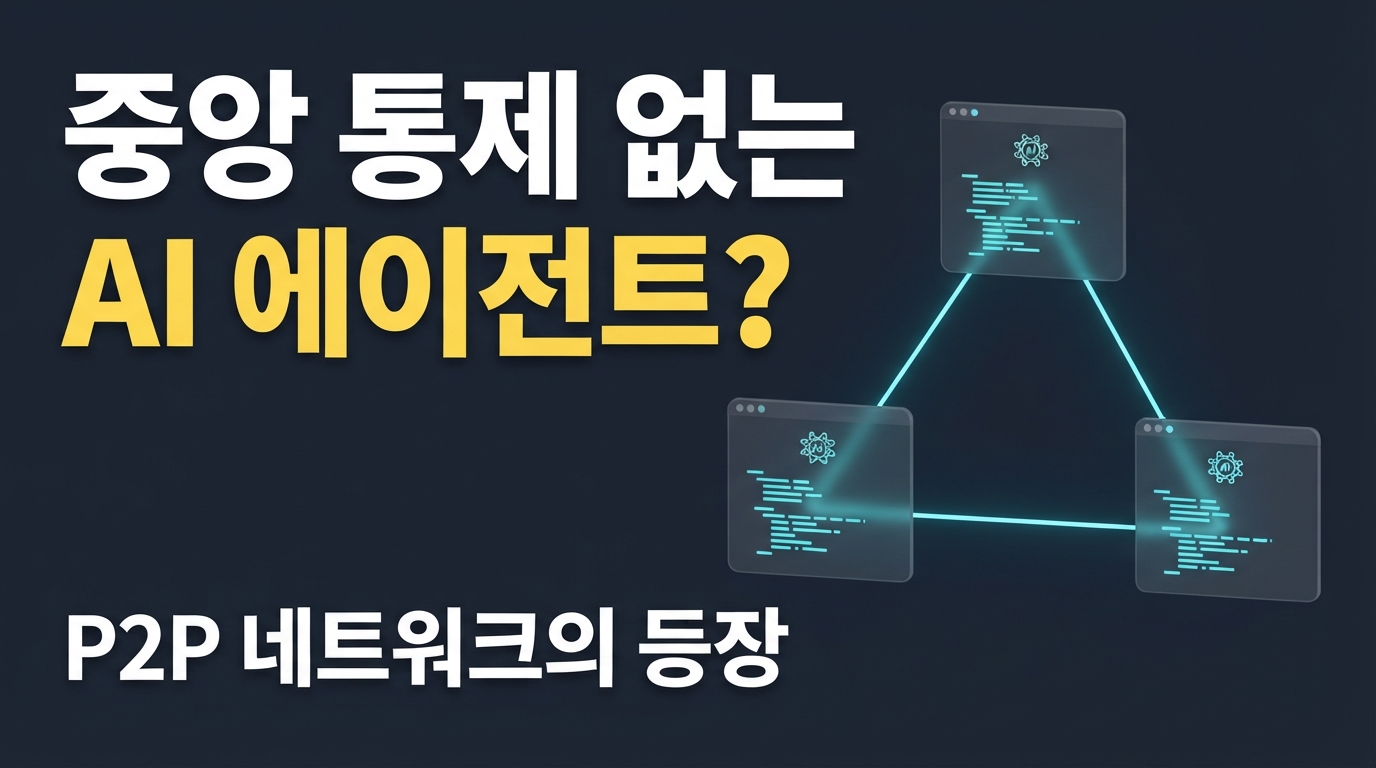
Google SAM and DeLM — The Rise of Decentralized P2P Agents
When coordinating multiple AI agents, it has long been standard practice to use a 'boss agent' to orchestrate the entire workflow. However, as the number of agents grows, this boss agent becomes a major bottleneck, leading to unsustainable token costs and latency. Google’s recently open-sourced Sovereign Agent Mesh (SAM) and Stanford University’s Decentralized Language Model (DeLM) framework address this by enabling a P2P multi-agent network where agents collaborate directly without central control.
Google SAM: Invoking Tools Without a Central Server
SAM, open-sourced by Google, is a P2P network infrastructure that allows agents scattered across different clouds or personal computers to share and execute tools directly. As of version v0.1.0-alpha.7, SAM is designed to securely connect agents without the need for complex server setups or the risk of exposing public IP addresses.
The core of this technology lies in building an encrypted P2P network using libp2p and GossipSub, combined with the Model Context Protocol (MCP), the standard for inter-agent tool connectivity. This allows an agent to securely explore and invoke tools from an agent on another server as if they were its own local tools.
Overcoming network barriers is remarkably simple. SAM operates via three components: a control plane for identity verification (sam-control-plane), a router for finding stable paths (sam-router), and a sidecar proxy node that runs lightly alongside the agent (sam-node). Instead of struggling with cumbersome network security, developers can easily build environments where agents can collaborate.
Stanford DeLM: Eliminating the 'Boss Agent' Bottleneck
Until now, building a team of AI agents naturally meant putting a 'boss agent' in the middle to direct the flow. But as agents increase, this boss agent faces severe bottlenecks while issuing commands and aggregating results. It consumes excessive tokens to transmit instructions and increases overall latency.
The DeLM approach proposed by Stanford University researchers boldly removes the central controller [research:3.1.5]. Instead, agents collaborate proactively on a 'context memory substrate' shared in real-time with asynchronous task queues [research:3.1.5].
In this structure, agents collaborate as if looking at a single shared whiteboard. Each agent records the key lessons of the subtasks it solves in a highly compressed format [research:3.1.5]. To prevent context bloat, it uses 'selective unfolding,' where only summarized versions are maintained, and detailed information is only retrieved when absolutely necessary [research:3.1.5].
Halving Costs, Accelerating Problem Solving
Eliminating the unnecessary 'ping-pong' between a boss agent and its subordinates has produced clear, data-driven results.
DeLM demonstrated excellent performance in the 'SWE-bench Verified' benchmark, which rigorously evaluates software engineering capabilities. Based on testing with Gemini 3 Flash and Claude Opus 4.6, it achieved an average resolution success rate of 65.7%, and an impressive 77.4% under the Pass@4 metric. This represents an improvement of up to 10.5 percentage points in problem-solving capability compared to traditional centralized methods.
Even more surprising is the cost reduction. By blocking wasted tokens caused by redundant thoughts and excessively long instructions, the average cost per task is just $0.12, roughly 50% lower than traditional methods. It has proven its practicality by dramatically increasing performance while significantly lowering operational costs.
The Future of P2P Agents We Should Watch
Ultimately, the future of multi-agent systems lies in moving away from massive central servers or orchestrators that control everything. We are rapidly entering an era where independent agents with their own sovereignty collaborate by securely sharing tools across encrypted mesh networks.
Rather than struggling to develop complex central orchestrators, perhaps we should focus on the trend of creating secure P2P channels and lightweight collaboration rules that allow agents to communicate directly. I am very excited to see what interesting changes these decentralized agent networks—which choose trust and loose coupling over control—will bring to the development ecosystem.