@haram
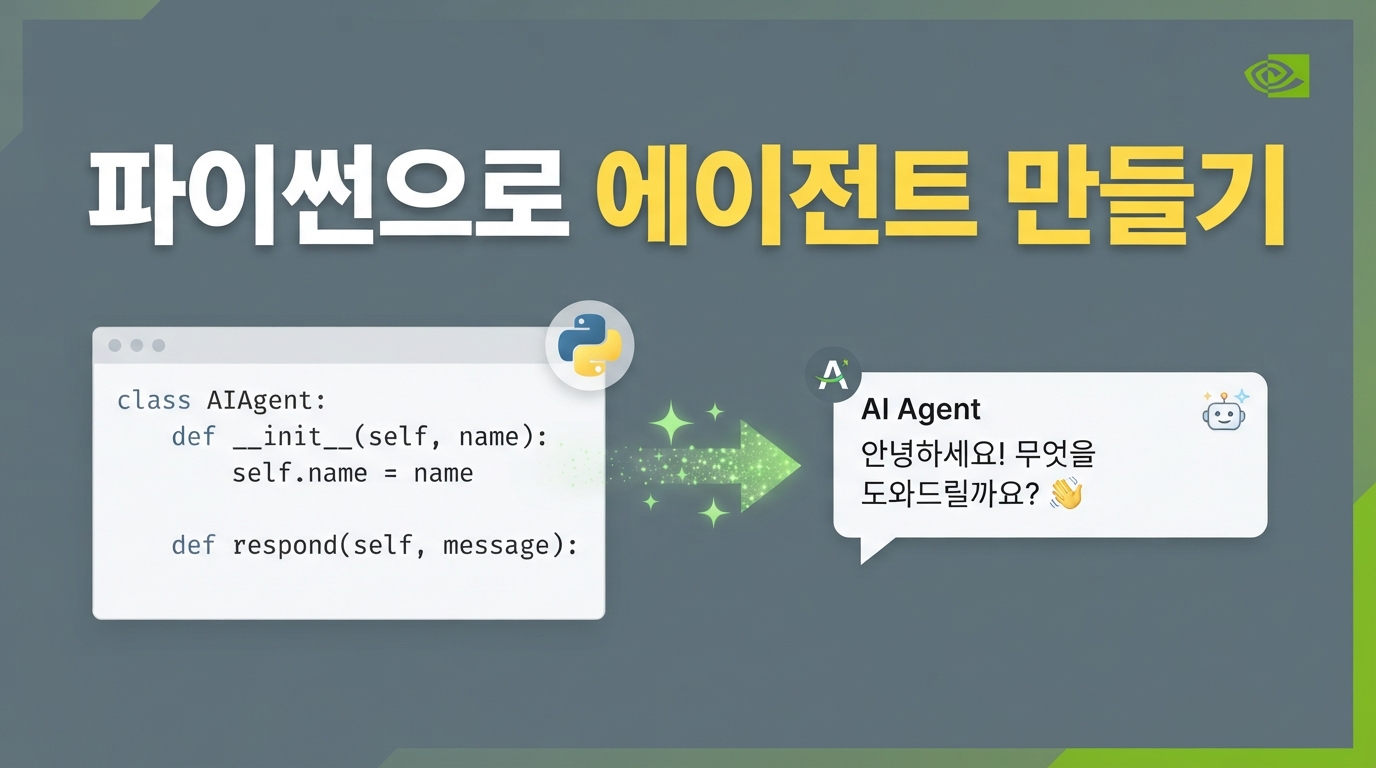
NVIDIA NOOA Released — How to Build AI Agents with Python Classes
An interesting tool has emerged that allows you to build AI agents directly using object-oriented Python class design—the most familiar approach for Python developers. It is NVIDIA’s labs-OO-Agents, also known as NOOA. While it is attractive because you can start using it immediately without learning complex proprietary framework syntax, it comes with tricky barriers in local development environments, such as Windows execution crashes and potential cost spikes, so proceed with caution.
Python Classes Become Agents
The appeal of NOOA, currently in v0.0.8, is very simple. Instead of forcing agents to adapt to obscure, unfamiliar framework syntax, it lets you design them using the very Python class objects developers already know. It features a highly intuitive structure where data the agent needs to remember is stored in class variables, and actions or tools to perform are written as standard methods.
In particular, it is based on the CodeAct approach, where the agent writes and executes Python code to solve problems itself. It follows a flow where code is executed directly, similar to a Jupyter Notebook, and the next step is determined based on the results. Because of this, if you know how to use Python, you can extend agent workflows as familiarly as working with existing software libraries.
However, its design philosophy differs from established frameworks like CrewAI or AutoGen. NOOA is built strictly for single-agent use and does not natively support multi-agent interaction protocols where multiple agents collaborate or delegate tasks to each other. To orchestrate multiple agents organically, you must write your own asynchronous control code.
Realistic Development Barriers: Windows Crashes and Database Errors
While the object-oriented design proposed by NVIDIA is attractive, developers using Windows may hit a wall right from the start. Looking at the official GitHub issues (#84, #85, #110), NVIDIA NOOA was designed assuming Linux and macOS environments. Consequently, running it on Windows causes an immediate crash as terminal tools force a /bin/bash path, or call pass_fds, a process control method not available on Windows. Furthermore, it attempts to force-call signal.SIGUSR2, a signal unsupported by Windows during debugging, resulting in an error and abnormal termination.
There are also hidden pitfalls when connecting a repository for long-term memory. According to GitHub issue #117, multi-thread concurrency collisions occur because foreground tasks attempt to access the database while the agent is reorganizing inferences in the background. Because a single database connection is shared without synchronization, there are frequent reports of work transactions locking up entirely or the file itself becoming corrupted.
So, how should Windows users cope? The cleanest and most realistic solution is to utilize the Windows Subsystem for Linux (WSL) or a Docker container to set up a Linux environment virtually and run it from there. Actively using a local virtual environment allows you to neatly bypass these compatibility conflict issues.
Token Explosion and the Reality of Security Sandboxes
There are also critical downsides regarding cost and safety that must be addressed.
The first issue you might encounter is a 'cost bomb.' According to reports in GitHub issues #96 and #125, severe context leakage occurs when the agent renders complex data structures for preview. Deeply nested data can unfold into massive amounts of text—up to 25MB at once—being pushed into the context window. This can cause memory overflows that stop operations or lead to a sudden spike in API usage fees.
Furthermore, the token limit settings found in the official documentation (such as max_event_tokens) do not currently function in the execution engine. Essentially, your defenses against high costs are currently wide open.
Security is also not perfect. While the code execution feature that NOOA boasts helps the agent write and run Python code itself, the internal syntax analysis feature is not a true security sandbox. It cannot perfectly block system attacks or access to sensitive files; it is merely a simple inspection tool that filters out obviously malformed code. Therefore, to protect your computer, it is essential to run it in a physically isolated external environment such as a Docker container or virtual machine.
How to Start and Prepare
So, how can you use this interesting but tricky tool safely and smartly? I have summarized realistic preparations for those who want to test it out.
First, when installing the library, it is recommended to explicitly specify the version as shown below. Since it is still in the early v0.0.8 stage, execution methods may change depending on the version.
pip install labs-oo-agents==0.0.8You must first check your execution environment. To avoid the aforementioned Windows crash issues, you should prepare a WSL environment or build your development environment inside a Docker container. Operating on a Linux foundation is required for error-free execution.
Safety measures are also essential. The code inspection tool inside NOOA is only a filter for minor bugs and cannot guarantee perfect security isolation. To prevent accidents where the agent accesses sensitive local files or damages the system, it is safest to wrap the execution in a separate, isolated virtual environment like Docker.
Lastly, do not pass large volumes of data to the agent all at once. Passing deeply nested structures or objects as-is can cause the text size to balloon to tens of megabytes instantly, leading to an API cost bomb. It is best to break complex tasks into smaller pieces and make a habit of monitoring your API usage frequently.
The Potential of Object-Oriented Agents
NVIDIA NOOA is an interesting tool that helps Python developers design agents using the object-oriented approach they are most familiar with. The fact that you can create agents using the same classes and methods you always use, without having to learn new, complex framework syntax, is definitely appealing.
Although realistic bugs like Windows crashes and token leakage may hold it back as an early version, it can be a great playground for those looking to experiment with lightweight automation tools using Docker or virtual environments. Let’s watch together to see how this intuitive design method evolves, especially as it integrates with multi-agent orchestration or full-fledged sandbox security features.