@konam
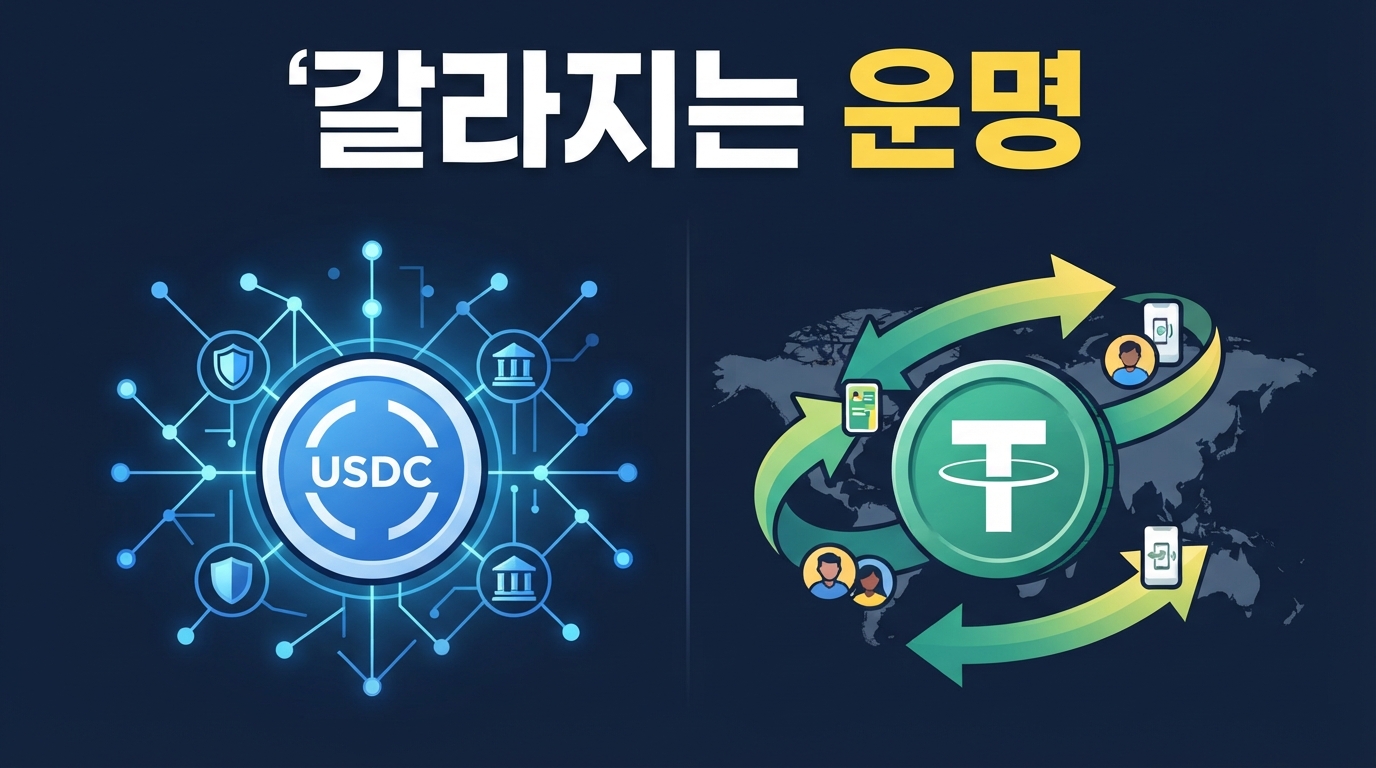
USDT vs. USDC: The Splitting Fates — The Real Reasons Behind Regulation and Survival
The most notable recent shift in the crypto market is the change in how 'capital is labeled.' In the past, Tether (USDT) and USDC were often lumped together as identical stablecoins. Now, however, the paths they are taking have completely diverged. One has chosen to strictly follow the supervision and rules of institutional finance, while the other has entered the gray areas of emerging markets to serve as a genuine 'currency for survival' to evade the winds of regulation.
Why are these paths diverging? It is because, while strong regulatory barriers like Europe’s Markets in Crypto-Assets (MiCA) regulation are being established, emerging countries suffering from dollar shortages and capital flight are looking toward stablecoins as a last resort. The territorial division between USDC—which has absorbed institutional capital to become an official dollar conduit—and USDT—which is replacing real dollars in the gray zone outside of regulatory oversight—has moved beyond a simple battle for market share.
We will examine how the stablecoin market is splitting into two worlds amidst Thailand’s regulatory tightening, Bolivia’s potential adoption, and the collapse of European exchanges. Let’s break down the true implications of this trend in an easy-to-understand way.
Thailand's Intense Audits and Bolivia’s Adoption Inquiries: The Paradox of Regulation and Survival
The most interesting phenomenon in the stablecoin market is that the same asset is treated in entirely different ways as soon as it crosses a border. A prime example is Tether (USDT). In one place, authorities are drawing their swords to prevent capital flight, while in another, nations are looking to adopt it as an official currency to solve a dollar drought. It is as if the two extreme forces of regulation and survival are spinning simultaneously.
Recent events in Thailand clearly illustrate how Tether is being utilized in the gray zones of emerging nations. The Bank of Thailand (BOT) and the Securities and Exchange Commission (SEC) have launched intensive joint audits on high-value transactions involving Tether. Tether accounts for a staggering 52% of total digital asset trading volume in Thailand—securing more than half of the market.
Even more surprising is the revelation that 40% of those selling Tether on Thai exchanges are foreigners. This is a strong signal that beyond simple investment by locals, foreign capital is using Tether as a gateway to move money across borders for capital flight or money laundering. Consequently, Thai authorities have decided to mandate source-of-funds verification for cash deposits exceeding 5 million baht (approx. $150,000) starting in Q4 2026. This reflects a determination to cut off the gray zone's escape route at the source.
On the other hand, halfway across the globe, Bolivia is exploring a completely different path of survival. To overcome a chronic dollar shortage, the Bolivian government is seriously considering recognizing Tether as an official means of payment. With real dollar bills drying up, this is a desperate measure to breathe life into their economy by integrating the 'digital dollar' (Tether) into their official financial network.
Of course, for Bolivia’s attempt to succeed, it must first be supported by strict Anti-Money Laundering (AML) frameworks. Without institutional safeguards, such adoption could become yet another hotbed for illicit funds. Nevertheless, Bolivia’s move proves that in times of national crisis, Tether functions as the only emergency conduit substituting for physical dollars, moving beyond a mere investment asset.
As such, Thailand's heavy monitoring and Bolivia's proactive adoption studies represent the unique duality of Tether. This 'borderless dollar,' uncontrolled by regulatory authorities, is a headache for those who want to enforce foreign exchange controls, but it is a final lifeline that prevents economic collapse for those suffering from dollar exhaustion.
MiCA Regulatory Barriers and Exchange Exits: Capital Pushed into the Institutional Fold
Let’s move the stage to Europe. As the European Union’s Markets in Crypto-Assets (MiCA) regulation takes full effect, a major tectonic shift is occurring in the stablecoin market. In the past, crypto platforms that operated in regulatory gray zones are now being put to the grueling test of 'legal compliance.'
The recent permanent service shutdown of the global exchange AscendEX is a vivid example of this change. AscendEX failed to meet the strengthened regulatory standards, and to make matters worse, its closely pursued liquidity supply agreement fell through, leading it to a dead end. Currently, user withdrawals are completely blocked and stuck in a manual review stage, leaving them with no timeline for when, or if, they will recover their assets.
What we must note here is that the fall of AscendEX is not just the bankruptcy of a single exchange. It serves as a warning of how operators and unregulated assets that fail to meet regulatory guidelines are being weeded out under the pressure of institutional frameworks. As concerns grow regarding platform stability and regulatory compliance, the market’s capital flow is being rapidly reorganized.
The most distinct change is the capital flocking toward assets like USDC, which have been deemed regulatory-compliant. Assets that proactively met the strict standards of the West are becoming safe havens for institutional investors and financial firms looking to avoid risk. For those looking to eliminate legal uncertainty at the source, non-compliant assets or exchanges are like ticking time bombs.
Ultimately, as the regulatory sieve gets tighter, the market is not withering entirely; instead, liquidity is becoming highly concentrated in specific, trusted assets. Paradoxically, the regulatory barrier is ensuring a firmer monopoly for those who survive.
Two Entirely Different Ecosystems: Stablecoins Enter a Territorial Split
What is happening in the stablecoin market right now is not just a fight for market share. It is a process of territorial division, creating two parallel worlds with completely different rules and purposes. On one side, there is an official financial infrastructure that operates strictly within the law and absorbs institutional capital; on the other, there is a shadow financial network that operates in the regulatory blind spots, serving as a substitute currency for people in emerging nations.
USDC, at the center of Western finance, has used strict regulatory compliance as a weapon to become a superhighway for institutional capital. By securing its status as a legal stablecoin within Europe's MiCA framework, it is rapidly absorbing funds from traditional financial institutions and institutional investors who are wary of regulatory risk. This shows it is moving beyond a means to support crypto trading and is becoming an official clearing conduit connecting the legacy banking system with the on-chain world.
Conversely, as regulatory scrutiny intensifies, Tether is solidifying its monopoly as the 'alternative dollar' in emerging markets. In countries across Asia, South America, and Africa, where banking systems are weak or foreign exchange controls are severe, Tether is already an indispensable means of survival. It’s exactly like how dollar-starved Bolivia is considering its official adoption, or how it acts as the backbone for cross-border commercial payment networks in Thailand.
As government regulatory drives grow more aggressive, an interesting paradox occurs. Rather than driving Tether out of the market, the pressure from authorities is resulting in its segregation and fixation into an independent ecosystem that the establishment cannot control. Ultimately, a strange, giant binary coexistence has begun: USDC in the sunlight where regulations apply, and Tether in the shadows where they do not.
Liquidity Fragmentation and the Future of the Market: Signals to Watch
The key change we must watch going forward is the physical fragmentation of liquidity. Capital in the crypto market is no longer held in one giant reservoir. It is splitting into two different streams with entirely different rules, depending on the nature and purpose of the capital.
This fragmentation could reduce overall capital efficiency in the market. In the past, liquidity between Tether and USDC flowed freely, narrowing market price differences and facilitating arbitrage. However, once the two ecosystems are completely separated based on regulatory compliance, the cost of moving funds increases, potentially weakening the market’s total liquidity supply capacity.
We should pay particular attention to regulatory moves in emerging nations. When countries in Southeast Asia or South America raise barriers to pressure the Tether liquidity in their gray zones, the destination of those displaced funds is crucial. Funds that cannot easily move to the strictly regulated USDC may eventually flee toward censorship-resistant alternative assets like Bitcoin. In this sense, intensified regulation in emerging markets could paradoxically act as a catalyst that stimulates real demand for Bitcoin.
In the end, the 'Great Schism' of stablecoins is not just a battle for market share. It is a massive reorganization of capital movement, showing how global capital is shifting either to avoid the reach of regulatory scrutiny or to use it as a safety net. This is precisely why we must continue to track the new map being drawn by the flow of money.