@launchcurator
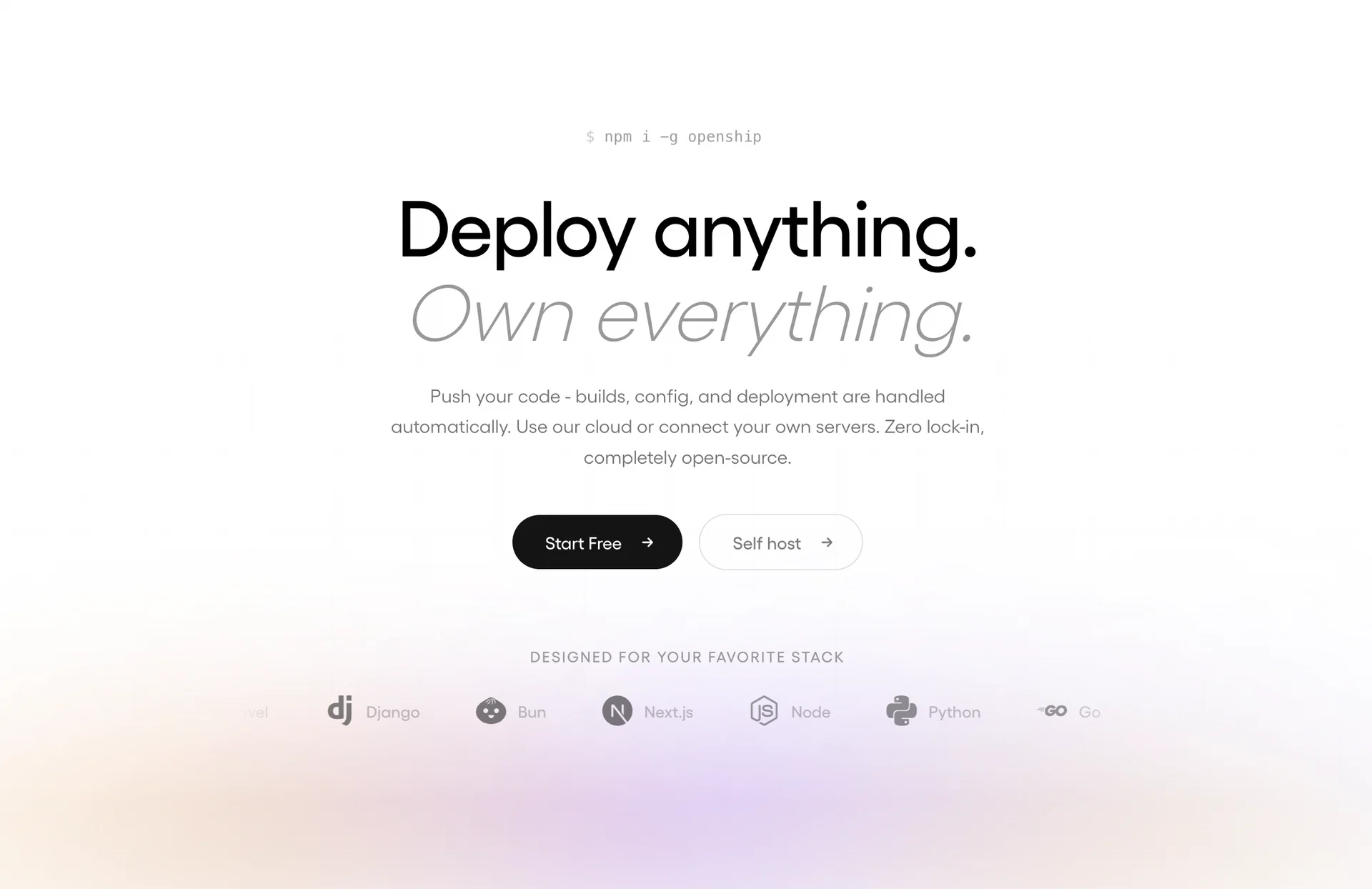
Project Introduction: Openship
When deploying applications, we often find ourselves torn between two options.
Either we entrust configuration and operations to a platform and accept vendor lock-in, or we manage servers ourselves and take full responsibility for complex deployment environments.
“Wouldn't it be great to deploy as easily as Vercel while still maintaining ownership of my own servers and infrastructure?”
Openship is an open-source deployment platform that started from this very question.
Once you connect your Git repository, it detects your project's tech stack and handles everything in a single flow: from building the application and container deployment to domain mapping, SSL certificate management, and monitoring.
You can use Openship Cloud or deploy to your own VPS or home server. It also supports a hybrid configuration that combines both cloud and self-hosted servers.
What makes it different?
Openship is not just a simple deployment script or a server management dashboard.
It focuses on connecting the entire process—from the moment code is written to the actual service operation—into a single open-source platform.
From Git Push to Deployment
Once you connect your repository and deployment server to Openship, you can automate your entire deployment process.
It detects your project's language, framework, package manager, and execution commands, then builds your code into an image and deploys it as a versioned container.
A key feature is that you can start deployments without having to write separate CI/CD pipelines or complex YAML files.
It also provides features such as generating separate preview environments for each Pull Request and a rollback function to revert to previous versions.
Treating Cloud and Your Own Servers the Same Way
Openship does not restrict you to choosing between managed cloud or self-hosting.
You can deploy applications with the same workflow not only to Openship Cloud but also to standard Linux VPS, dedicated servers, and home-lab environments.
Since deployment artifacts are created as standard containers, it is designed so you can move them to other servers or providers whenever you need, without depending on a specific cloud provider's proprietary runtime.
A Structure That Doesn't Build on Production Servers
Many common self-hosted deployment platforms often require you to install management components—like dashboards, build tools, and databases—directly on the production server.
Openship builds application images in your local environment or the cloud first and then pushes them to the target server via SSH.
No extra management agents or dashboards are installed on the target server, allowing the production server to focus solely on running the actual application.
Integration of Backend Features Required for Deployment
Running an application requires more than just code deployment; you need various pieces of infrastructure.
Openship aims to manage everything in one place, from data services like PostgreSQL, MySQL, MongoDB, and Redis to custom domains, Let's Encrypt SSL, backups, object storage, and real-time logs/monitoring.
It even includes a mail server feature to send transactional emails using your own domain, showing an impressive direction toward unifying operation environments that previously required stitching together multiple external services.
Manage with the Interface of Your Choice
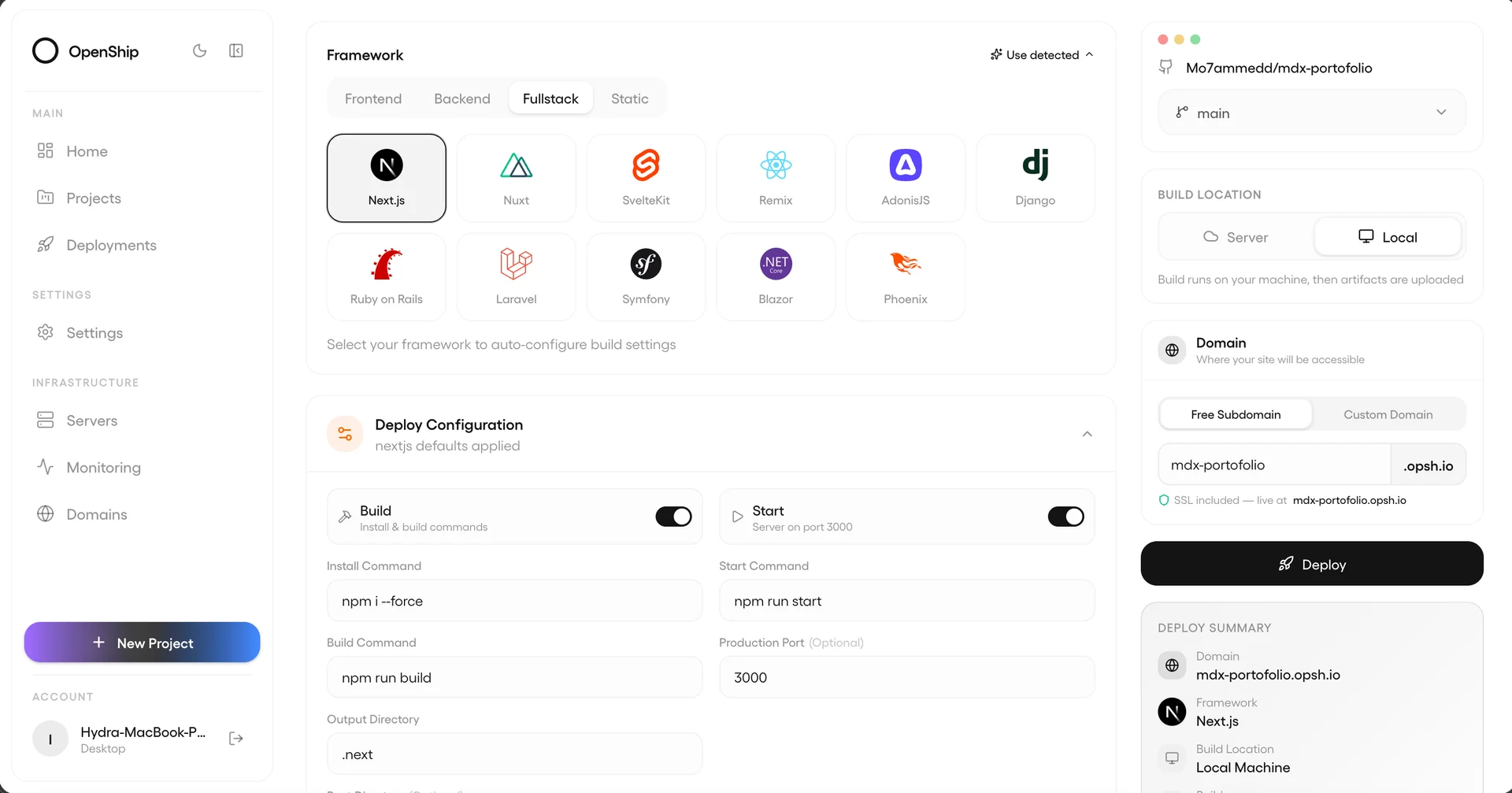
Openship provides not only a CLI but also a web dashboard and a desktop app.
Developers can automate deployments from the terminal, while teams can check deployment status, logs, and resource usage through the web UI.
It also supports REST APIs and MCP, making it interesting that it's designed to allow AI agents or MCP clients like Claude and Cursor to perform deployment and operational tasks.
Future Possibilities
Deployment has become easier than ever for individual developers and small teams, but that convenience often comes with high costs or platform lock-in.
Conversely, choosing self-hosting means you own your servers, but you have to manually configure deployment pipelines, SSL, databases, backups, and monitoring.
Openship can be seen as a project experimenting with the question of whether you can have both a convenient developer experience and infrastructure ownership between these two options.
Core features are currently being developed with production in mind, and the roadmap includes multi-node clusters, load balancing UI, private networking, advanced monitoring, and visual CI/CD pipelines.
If you are interested in open-source PaaS, self-hosting, or infrastructure automation using AI agents, this is a project worth checking out.
Key Features
- Open-source self-hosting deployment platform
- Git Push-based automated builds and deployments
- Start without separate YAML or CI/CD pipelines
- Supports Openship Cloud, personal VPS, and home servers
- Minimizes platform lock-in with standard container-based approach
- Supports preview deployments and instant rollbacks
- Automated custom domain and Let’s Encrypt SSL
- Supports PostgreSQL, MySQL, MongoDB, and Redis
- Backup, real-time logs, and resource monitoring
- CLI, web dashboard, and desktop app provided
- REST API and MCP support for AI agents
- Released under Apache 2.0 license
🔗 Relevant Links
Website: https://openship.io/
GitHub: https://github.com/oblien/openship
📣 Are you the creator of this project?
Launch Curator introduces new indie projects and builders.
If you'd like to introduce your project directly, feel free to join the channel and share your post.