@samcoding
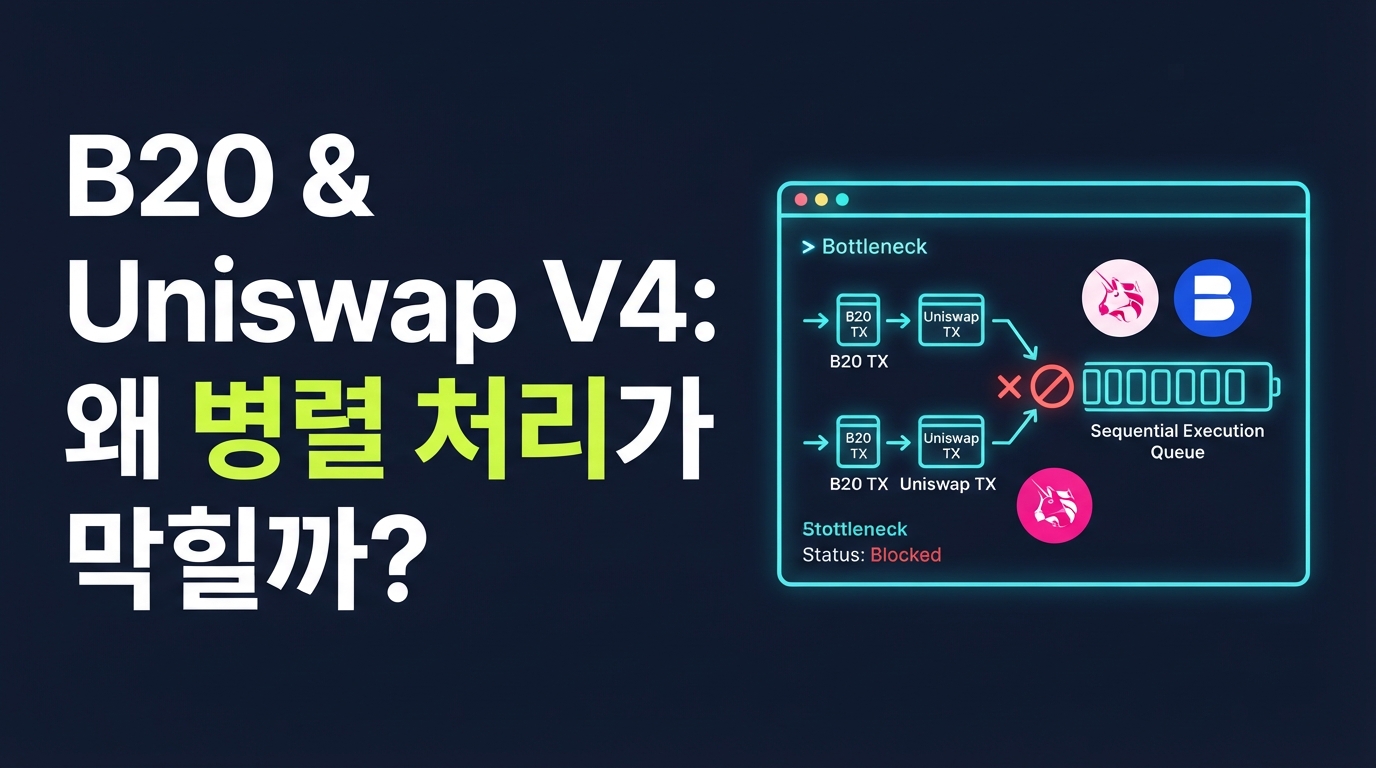
Base B20 and Uniswap V4 — Lower Gas Fees, But Why the Bottleneck?
The introduction of the B20 native token standard, powered by Rust precompiles on the Base mainnet, has significantly reduced gas costs for individual transactions. However, as the first Uniswap V4 pools go live, an unexpected execution bottleneck is emerging in high-frequency parallel execution environments. We analyze the technical root causes from the perspective of the execution engine to understand why high-performance tokens with reduced gas consumption face reduced concurrency when paired with Uniswap's singleton structure.
B20's Native Gas Savings: The Power of Rust Precompiles
Instead of the traditional ERC-20 method of interpreting EVM bytecode, the B20 standard adopts a direct call approach to the Rust precompiler embedded in Base's execution engine, the Reth V2 node. By offloading standard token operations to high-performance, system-level Rust code immediately, bypassing the EVM interpreter, it achieves substantial gas fee reductions and increased operational efficiency.
According to data released on the GitHub repository fahimahmedx/b20-benchmark, B20 precompiles have demonstrated consistent performance improvements compared to the official Solidity-based reference implementation, MockB20. In particular, it can save approximately 17% in gas when transferring to a receiver that already holds a balance, providing excellent gas efficiency for frequent on-chain payment flows.
| 작업 유형 | Native B20 (Gas) | Solidity MockB20 (Gas) | 절감률 |
|---|---|---|---|
| transfer (existing) | 16,777 | 20,212 | -17.0% |
| transfer (zero) | 33,877 | 37,312 | -9.2% |
| transferFrom (max) | 36,039 | 41,150 | -12.4% |
| mint (existing) | 20,825 | 23,242 | -10.4% |
This cost reduction from a single-transaction perspective provides a powerful advantage to developers designing on-chain infrastructure. However, reducing gas consumption for individual operations does not necessarily mean that the actual throughput of the entire network will increase linearly. In high-performance engine environments where multiple transactions must be processed in parallel, combining this with Uniswap V4's singleton architecture results in a concurrency bottleneck where state updates are concentrated in a single point, preventing the benefits of parallelization from being realized.
The Conflict Between Uniswap V4 Singleton Architecture and Parallel Execution
Despite the gas savings for individual transactions, a serious bottleneck is observed in high-frequency environments where actual trading is concentrated. The Uniswap V4 B20/ETH pool, which first went live on the Base mainnet on July 8, 2026, processed over 12,611 transactions and $1.16 million in trading volume on its first day alone, exposing this bottleneck problem. While gas efficiency improved at the single-transaction level thanks to Rust precompiles, the network's execution engine saw a sharp drop in processing speed when countless transactions poured in simultaneously.
The technical cause of this performance degradation lies in the structural conflict between the optimistic parallel execution of the Reth V2 execution engine and the singleton structure of Uniswap V4. Reth V2 uses an optimistic execution model, where multiple transactions are first executed in parallel to maximize concurrent throughput and only committed to the block if there are no state conflicts. However, Uniswap V4 adopts an architecture where the state and balances of all pools are centrally managed in a single PoolManager contract.
Ultimately, when multiple swap requests targeting the same B20/ETH pool flow in simultaneously, these transactions attempt to modify the same storage spaces (tick, liquidity, transient storage) within the PoolManager contract at the same time. This inevitably creates a state-write hotspot. As soon as the execution engine detects a state conflict, it stops parallel processing and triggers a fallback mechanism to re-execute those transactions sequentially, effectively negating the bandwidth benefits of the parallel processing engine and causing total throughput to plummet.
Setting Up a Local Simulation Environment: Tips for Foundry Developers
Since B20 native tokens have no on-chain EVM bytecode, testing them in a standard Foundry environment results in a non-contract address error because the environment assumes calls are being made to a non-existent contract address. This is because they point directly to system-level Rust precompiler addresses.
To solve this problem, you must install base-foundryup, a dedicated toolchain provided by the Base team. When you run the installation script in your terminal, the dedicated base-forge and base-cast binaries, which support precompiled address recognition, will be set up in your local environment.
After installing the toolchain, you need to add an emulator activation flag to your project's foundry.toml configuration file.
[profile.default]
src = "src"
out = "out"
libs = ["lib"]

# Base B20 프리컴파일 에뮬레이션 활성화
base = true
Once this setting is complete, the local test runner will correctly call B20Factory and various other system precompile addresses. Even before mainnet deployment, you can verify calculation flows and perform precise gas benchmarks identical to the actual execution environment, without the need for off-chain mock objects.
The Trade-off Between Efficiency and Bandwidth, and the Road Ahead
The B20 token standard has demonstrated clear efficiency in reducing the gas cost of individual transactions through the Rust precompiler. However, when combined with a singleton architecture like Uniswap V4—where all pool states are managed in a single contract—it experiences bottlenecks where the benefits of parallel processing are negated as write operations concentrate on the same storage areas. This is a clear case showing that optimizing individual operations does not immediately lead to the maximization of total network bandwidth.
Therefore, developers must think deeply about smart contract structures that do not compromise parallel execution performance when designing dApps that experience high-frequency traffic. It is essential to use architectural approaches that either distribute hotspots where state records concentrate or minimize transaction conflicts.
The Base Cobalt upgrade, scheduled for September 2026, is also a turning point to watch. Once native account abstraction based on EIP-8130 and EIP-8140 is integrated into the Reth V2 engine, extreme execution efficiency without bundler overhead, along with gas sponsorship through B20 tokens, is expected to become possible. The process of combining such gas-optimization infrastructure with improvements in parallel processing will be a crucial milestone in pushing the performance limits of next-generation on-chain applications.
Reference Links
- GeckoTerminal & BaseScan — Uniswap V4 B20/ETH Pool Metrics and Day One Performance on Base
- Hyperledger Besu & Reth Core Engineering Analysis — State Write Hotspots and Parallel Re-execution in Optimistic Rollup Pipelines
- Base Documentation & Crypto Briefing — Base Mainnet Activates B20 Native Token Standard on July 8, 2026