@samcoding
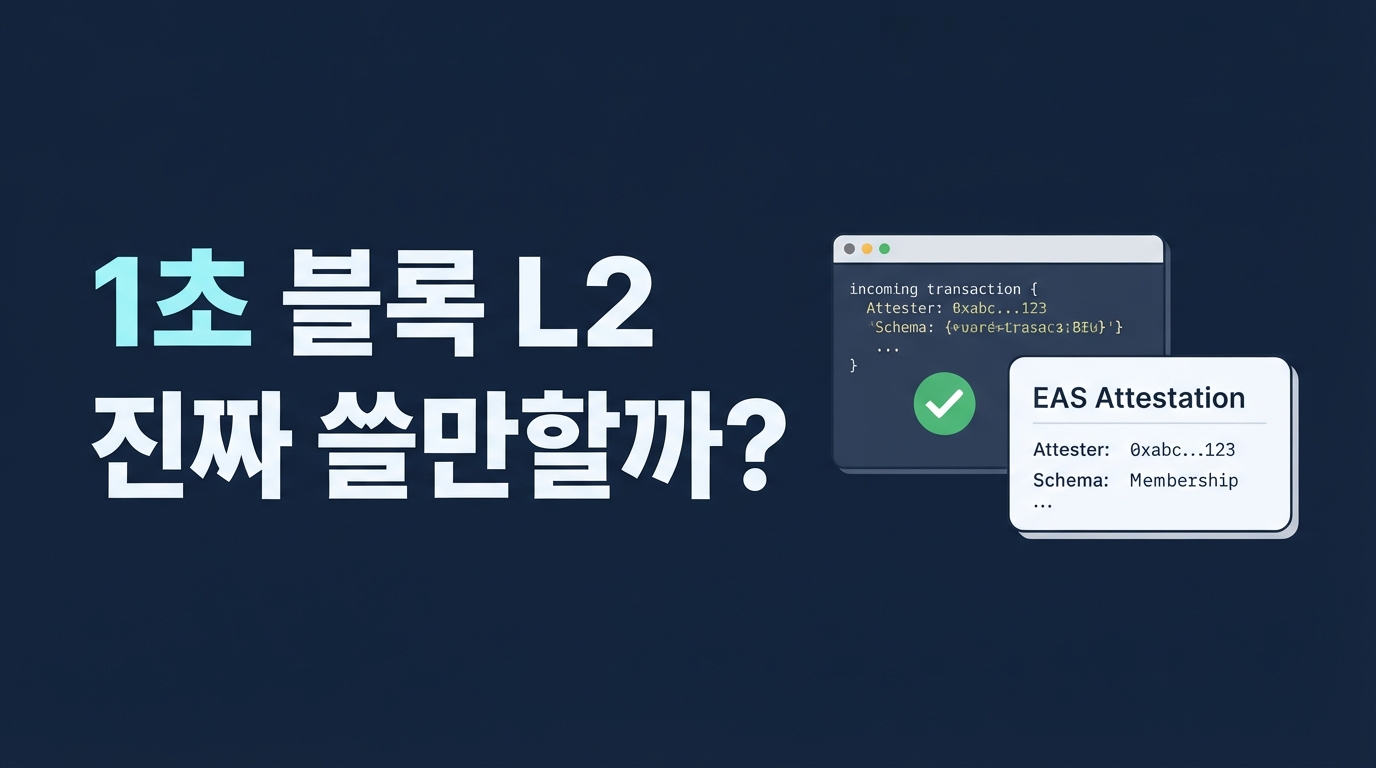
GIWA Chain Analysis — What You Can Build with 1-Second Blocks and the Dojang Identity Layer
A new OP Stack chain for enterprises and institutions has emerged in the Ethereum Layer 2 ecosystem. The GIWA Chain, built by Dunamu, offers a differentiated development environment with a unique technical structure that goes beyond a simple rollup. With 1-second block times, flashblock pre-confirmation technology under 200ms, and the EAS-based Dojang identity layer, it provides a level of performance and regulatory compliance distinct from existing Layer 2 solutions. We analyze the core technical elements available for immediate practical application and the shifts from a developer's perspective through the testnet.
Independent Sequencer and 1-Second Blocks — OP Enterprise Self-Managed Architecture
The GIWA Chain is an OP Stack-based Layer 2 that is the first to implement the 'Self-Managed' tier of Optimism's enterprise license, OP Enterprise. Unlike standard rollups that use a shared sequencer pool, Dunamu operates its own sequencer independently. This gives them sovereignty, allowing full control over transaction ordering rules and block space operation policies according to enterprise requirements.
Additionally, the standard OP Stack 2-second block time has been shortened to 1 second, halving transaction processing latency. While builders can currently build freely on the GIWA Sepolia Testnet (chain ID 91342), the future production mainnet will be deployed as a private, whitelist-only environment for authorized partners. Builders should keep the access restrictions required for mainnet deployment in mind during the initial architectural design.
Node infrastructure optimization, aimed at pushing execution layer performance to its limits, is also noteworthy. Following the Cast Hardfork in July 2026, official support for the legacy op-geth was discontinued, and the execution layer has fully transitioned to the Rust-based high-performance client, op-reth. With this upgrade, engine-level rule changes have been applied—such as capping the gas limit at 16,777,216 per transaction and adjusting the P256VERIFY precompile gas cost to 6,900—which should be referenced when optimizing contracts.
User Experience Under 200ms — Flashblock RPC Integration
In fields requiring immediate responses, such as on-chain payments or real-time gaming, even a 1-second block time can feel like a delay. The GIWA Chain solves this by introducing flashblock technology, which provides pre-confirmation in under 200ms before a transaction is finally recorded on-chain.
Developers can implement and test this high-speed user experience directly using the dedicated RPC endpoint provided by the GIWA Sepolia Testnet.
- Dedicated Flashblock RPC Endpoint:
https://sepolia-rpc-flashblocks.giwa.io
Integrating this endpoint allows your frontend to update in real-time by receiving the pre-confirmation signal sent instantly by the node while the transaction is still in the mempool. It eliminates the bottlenecks encountered by traditional L2 nodes when receiving transactions, estimating gas, and waiting for full block generation, ensuring responsiveness comparable to Web2.
However, there are development constraints to note for actual production use. While anyone can freely integrate this performance on the GIWA Sepolia Testnet (chain ID 91342), the official mainnet will be operated as a private, whitelist-based chain where only authorized builders can deploy smart contracts. Therefore, you should verify flashblock integration performance during the testnet development phase and consider designs and operation policies tailored to the mainnet's entry barriers.
EAS-Based Identity Layer — On-Chain Regulatory Compliance with the Dojang Protocol
The most significant differentiator of the GIWA Chain is the Dojang protocol, a proprietary identity authentication system implemented on top of EAS. Dojang links the real-name account verification info from Upbit (held off-chain) to an on-chain wallet address without exposing personal data. Users can prove their KYC status as verifiable data within their wallet without revealing sensitive personal information.
Developers manage identity data via the EAS contracts deployed on the GIWA Sepolia Testnet (0x4200000000000000000000000000000000000021) and the schema registry (0x4200000000000000000000000000000000000020). Specifically, using the verified address schema UID (0x072d75e18b2be4f89a13a7147240477481c4b526d5795802acba59046b426e08) allows you to immediately determine the authentication status of a specific address on-chain. By using the provided DojangScroll contract (0xd5077b67dcb56caC8b270C7788FC3E6ee03F17B9), you can complete verification with a single call, bypassing complex EAS data parsing.
For example, you can implement regulatory-compliant control logic in Solidity smart contracts to block access from unauthorized addresses as follows:
interface IDojangScroll {
    function isVerified(address addr, bytes32 attesterId) external view returns (bool);
}

contract VerifiedAction {
    address private constant DOJANG = 0xd5077b67dcb56caC8b270C7788FC3E6ee03F17B9;
    bytes32 private constant UPBIT = 0xd99b42e778498aa3c9c1f6a012359130252780511687a35982e8e52735453034;

    function secureAction() external view {
        require(IDojangScroll(DOJANG).isVerified(msg.sender, UPBIT), "Forbidden");
    }
}
Currently, anyone can freely integrate the Dojang protocol to build dApps on the GIWA Sepolia Testnet (chain ID: 91342). However, the actual production mainnet will operate as a whitelist-based private chain where only authorized services can be deployed. Therefore, builders should actively use this identity layer during the testnet stage to proactively verify the viability of regulatory-sensitive DeFi or settlement protocols.
Practical Deployment and Development Environment for L2 Builders on GIWA Chain
The GIWA Sepolia Testnet (chain ID 91342) is fully EVM-compatible, allowing for the use of standard Ethereum development tools like Hardhat or Foundry. Anyone can quickly set up a development environment and deploy smart contracts using the RPC endpoints and faucet provided by the official infrastructure partner, Nodit. In particular, the gas cost is set at approximately 1 KRW per transaction, making it suitable for testing microtransactions or frequent on-chain interactions without cost burdens.
However, a key constraint to be aware of is the difference in operational models between the testnet and the mainnet. Unlike the testnet where anyone can deploy freely, the GIWA mainnet, where production will run, is built on a whitelist-based private model where only pre-authorized partners can deploy and use smart contracts. Therefore, builders must clearly design on-chain access structures from the initial planning stage, considering the mainnet roadmap.
The most reliable pathway to entering this restricted mainnet ecosystem is Dunamu's builder program, GASOK. Providing a total of $100,000 in milestone-based funding, the program offers selected teams infrastructure and technical consulting, along with priority rights for future private mainnet deployment.
GIWA Chain Adoption Guide — Practical Checklist for Developers
The GIWA Chain offers undeniable appeal to dApp builders with its independent sequencer, sub-200ms high-speed pre-confirmation, and the Dojang identity layer for regulatory compliance. However, you must establish an entry strategy while acknowledging that the actual production mainnet is deployed as a whitelist-based private model, unlike the public testnet (chain ID 91342).
Furthermore, your architecture should account for the fact that an L2 sequencer accepting a transaction is not synonymous with finality on the Ethereum mainnet, and that there is a withdrawal delay inherent to rollups when crossing the bridge. If you are balancing regulatory-conscious contract design with high-performance UX, it is best to start by deploying smart contracts directly on the GIWA Sepolia Testnet.
Reference Links