@whynow
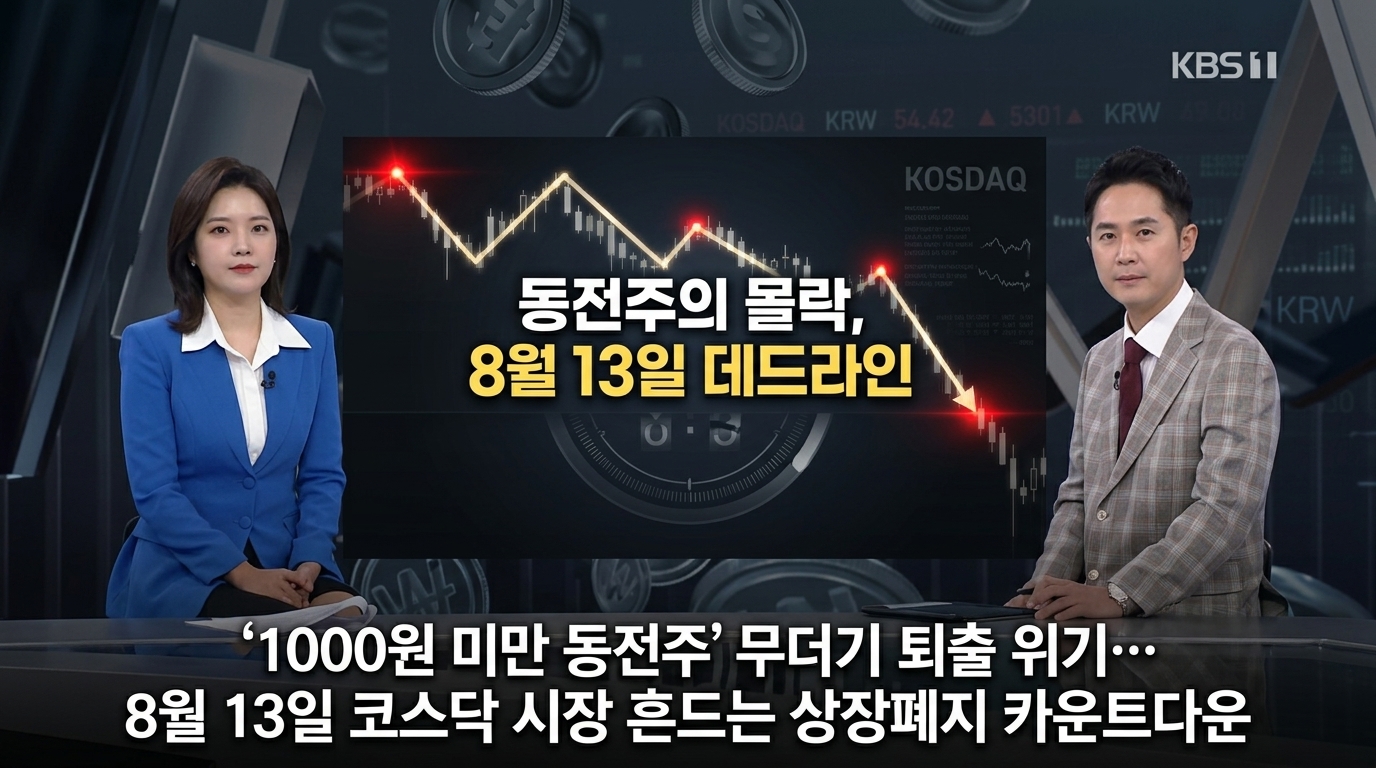
'Penny Stocks Under 1,000 KRW' Face Mass Delisting Crisis… The Countdown Begins for KOSDAQ on August 13
Could my stocks end up worthless? The concern over 'delisting' that has recently dominated search results is no mere alarmism. Due to strict delisting regulations introduced by the Korea Exchange (KRX) on July 1, KOSDAQ penny stocks priced under 1,000 KRW are at risk of being collectively designated as administrative issues. With the first judgment day arriving this Thursday, August 13, investors are frantically searching for information to see if their holdings are at risk of being delisted.
The August 13 Warning: Why 1,000 KRW Determines Their Fate
At the center of this situation, which investors have dubbed the 'penny stock delisting order,' is a strict new listing maintenance standard implemented by the Korea Exchange on July 1. Under the revised rules, any KOSDAQ-listed company whose stock price remains below 1,000 KRW for 30 consecutive trading days will be immediately designated as an administrative issue. The first day of reckoning for this intense countdown is August 13.
Ever since tension gripped the market on July 1, there have been 46 KOSDAQ companies that failed to cross the 1,000 KRW threshold for 25 consecutive trading days as of August 7. Their last chance is August 12. If they cannot pull their stock price above 1,000 KRW by the close of the market that day, they will all be hit with the 'administrative issue' red label the following day, August 13.
This is not just a minor issue about the number of digits in a share price. The 1,000 KRW mark is the minimum defense line confirming that a company maintains normal trading value in the market. As the exchange begins strictly enforcing this baseline, marginal companies that have survived without performance improvements are being pushed to the edge of the cliff.
First Delistings Expected by October… An Unavoidable Timetable
Designation as an administrative issue is only the preview; the real survival game begins afterward. Under the new rules, companies designated as administrative issues are given only 90 trading days to normalize their stock price. During this time, they will engage in a grueling battle to protect their stock price.
The threshold for normalization has also become much stricter than before. Tricks to artificially boost the stock price for a day or two are designed to fail from the start. To avoid delisting, a company must maintain a closing price of 1,000 KRW or higher for 45 consecutive trading days out of the 90-day grace period. If it slips below 1,000 KRW for even one day during that time, the 45-day count restarts from zero.
If these strict conditions are not met, the company will immediately face delisting without any additional improvement periods or relief procedures. If a mass designation of administrative issues becomes a reality on August 13, the first wave of penny stocks could be delisted from the KOSDAQ as early as this October, following this breathless survival timetable.
Pharma and Biotech Industries Pressed for Time Despite Stock Consolidation Cards
The pharmaceutical and biotech industries are the most anxious. Once-touted bio companies like Abion, LabGenomics, CMG Pharmaceutical, Chapelier, and Noel have found themselves on the hit list for these penny stock regulations. Facing urgent pressure, these companies have scrambled to use stock consolidations (reverse splits) to force their stock prices higher.
Stock consolidation is a method of merging multiple shares into one to increase the price per share. For example, combining multiple shares worth a few hundred won to push the price above 1,000 KRW. On the surface, it looks like a perfect escape route to easily clear the Korea Exchange's 1,000 KRW delisting threshold.
However, the problem is time. To consolidate shares, a company must convene a shareholder meeting, pass a resolution, notify shareholders and creditors, and endure a period of trading suspension. The point at which new shares are actually listed on the market after all these legal procedures is usually in September or October.
In other words, it is not enough to avoid the judgment day of being designated as an administrative issue that is right around the corner on August 13. Ultimately, these companies are caught in a dilemma where they must face the bad news of being designated as an administrative issue—which is effectively a red label—before the physical consolidation process is even complete. They have begun a precarious tightrope walk where they must endure the remaining grace period while branded by regulation.
Market Cap Bar Set Higher… KOSDAQ Weeps Over Mass Warnings
The reason this penny stock crisis is so frightening is that it doesn't end with just the stock price metric. Another massive barrier determining the survival of numerous small and medium-sized listed companies—the market capitalization maintenance criteria—has also been significantly raised. As of July 1, the Korea Exchange adjusted the KOSPI market cap requirement from 20 billion KRW to 30 billion KRW, and the KOSDAQ requirement from 15 billion KRW to 20 billion KRW, citing the need to assess the health of listed companies.
Even if they force their stock price above 1,000 KRW, it is useless if their total market capitalization cannot meet this threshold. The KOSDAQ market is bearing the brunt of this storm. Out of the 1,820 listed companies currently on the KOSDAQ, a staggering 194 companies fall short of the new 20 billion KRW standard. This represents about 10.6% of all KOSDAQ companies, meaning one in ten is in a precarious state where they could receive a mass delisting warning from the exchange at any time.
With the double whammy of the penny stock delisting order and the higher market cap barrier, the market is filled with deep concern. As the new regulations take full effect, the prevailing dark outlook is that there will be more companies closing their doors and leaving the KOSDAQ market this year than new ones entering it. Another heavy chain has been placed on the already chilled KOSDAQ investment sentiment.
Rather Than Short-Term Fixes, Focus on Improving Fundamentals… Signals for Investors
Ultimately, stock consolidation, which artificially raises the price per share by merging multiple shares, is merely a temporary fix that only changes the outward appearance. Moreover, the timing for most of the companies that have opted for consolidation falls in September or October. If they cannot bring their stock price above 1,000 KRW by August 12, they will immediately be designated as administrative issues on the following day, August 13; the companies' response speed is lagging behind the effect of the regulations.
Although pharma and biotech companies such as Abion, LabGenomics, CMG Pharmaceutical, Chapelier, and Noel are releasing stock defense measures one after another, they must endure the harsh market evaluation while carrying the red-flagged administrative issue label for the time being. Investors should also carefully assess whether these companies have the capacity to actually generate revenue and improve their financial structures, rather than feeling reassured by temporary attempts to meet stock price criteria.
They only have 90 trading days left. Whether they can prove solid performance or substantial financial improvement within this short time to meet the difficult condition of maintaining a 1,000 KRW closing price for 45 consecutive days, or whether they will disappear into the real delisting storm expected as early as October—the real survival game starts now.
1000원 미만 동전주’ 무더기 퇴출 위기 8월 1 이후, 다음 흐름을 가를 신호
1
tUSDC
1000원 미만 동전주’ 무더기 퇴출 위기 8월 1의 관심이 이어질지 판단하기 위해 후속 공식 움직임과 반응 지속성에서 무엇을 먼저 확인할지 짚습니다.
Related Links