@whynow
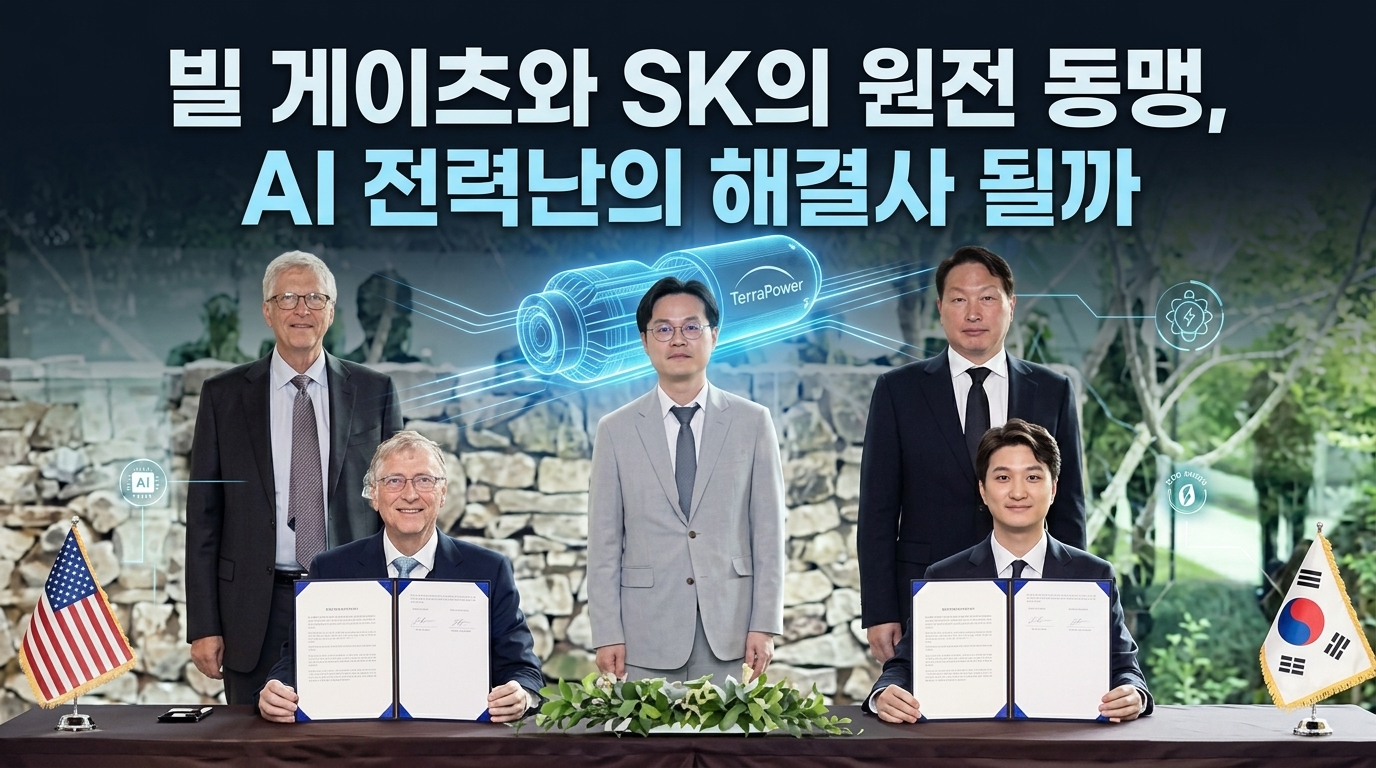
Bill Gates’ Korea Visit Led by TerraPower: Why Major Korean Firms Are Betting Everything on the 'SMR Alliance'
TerraPower, the next-generation nuclear power company founded by Microsoft’s Bill Gates, has recently become the center of attention in Korea. During his two-day visit to Seoul starting August 13, Chairman Bill Gates successfully brought major Korean conglomerates—including SK Group, Hyundai E&C, and Doosan Enerbility—into the next-gen nuclear power ecosystem. Moving beyond simple equity investments, these companies have now secured contracts for actual plant construction and the supply of core components, marking the rise of the Korean manufacturing and construction industries as key hubs in the global small modular reactor (SMR) supply chain.
Seeking Power Solutions for the AI Era: The Samcheong-dong Dinner Between Chey Tae-won and Bill Gates
On the evening of August 14, 2026, the lights at Seonhyewon in Samcheong-dong, Seoul, stayed on late. Chey Tae-won, Chairman of SK Group, and Bill Gates, Microsoft co-founder and Chairman of TerraPower, sat down for a private dinner. The core topic on their agenda was the 'AI-era power shortage,' which has recently emerged as the greatest challenge for the tech industry.
Running AI data centers without interruption requires a truly massive amount of electricity. This is exactly why SMRs are drawing attention as a realistic alternative to provide a constant supply of energy while reducing carbon emissions in response to climate change.
SK had already secured its position as the second-largest shareholder by investing $250 million (approx. KRW 330 billion) in TerraPower in 2022. However, with this Samcheong-dong meeting, SK has made it clear that it will not remain a passive financial investor. It has signaled the start of a serious endeavor to act as a hands-on co-operator running the next-gen nuclear power ecosystem alongside TerraPower.
Beyond Simple Investment to Direct Operations: The Reality of the 'K-Natrium' Alliance
SK Innovation has shifted its standing from a simple financial investor to a 'joint player' directly operating nuclear plants. On August 14, 2026, SK Innovation signed a Head of Agreement (HOA) with TerraPower for global cooperation to expand the Natrium business, a next-gen reactor based on sodium-cooled fast reactor technology. Four years after becoming the second-largest shareholder with a $250 million (approx. KRW 375 billion) investment in 2022, they have moved past simple equity stakes into the very heart of the nuclear power business, encompassing design, construction, and operation.
Through this agreement, SK Innovation will directly participate in the 'Kemmerer Unit 1' demonstration project currently under construction in Kemmerer, Wyoming, to gain practical operational experience. Kemmerer Unit 1, which received construction permits from the U.S. Nuclear Regulatory Commission (NRC) and officially broke ground this spring, is the first advanced commercial reactor in the U.S. and aims for completion by 2030. By absorbing on-site know-how from this initial demonstration stage, SK Innovation is turning its concrete blueprint into reality, aiming to complete the first domestic 4th-generation SMR by 2035.
The partners have agreed not to just stop at technology imports, but to jointly develop a 'K-Natrium' business model that leverages Korea’s manufacturing competitiveness to target Asian markets such as Vietnam and Indonesia. It is a bold initiative to add a Korean-style manufacturing ecosystem to global reactor design technology and re-export it overseas. This is a strategic move to secure the next-generation energy hegemony in the Asian market, going far beyond merely contributing to U.S. nuclear plant construction.
Joining Forces with Hyundai E&C and Doosan Enerbility: A Complete Alliance from Design to Equipment Manufacturing
TerraPower's alliance is not limited to SK. With Hyundai E&C and Doosan Enerbility joining as partners for construction and core equipment production respectively, a perfect triangle has been formed, covering everything from design to equipment supply and construction. Doosan Enerbility has entered the center of the global SMR supply chain by signing an official contract to manufacture and supply core components, such as the reactor protection vessel and support structures, for the first Natrium unit (Kemmerer Unit 1). HD Hyundai has also committed to handling the production of the reactor vessel, further cementing the domestic heavy industry's superiority in the manufacturing supply chain.
Hyundai E&C has signed a basic agreement to secure the Engineering, Procurement, and Construction (EPC) rights for up to eight subsequent commercial units of TerraPower’s projects. TerraPower’s Natrium reactor features a 345MW output, with an advanced model capable of storing energy and boosting output to 500MW during peak times. However, voices of caution have emerged within and outside the domestic construction industry, suggesting that careful measures are needed regarding the warranty risks Hyundai E&C must bear. It is reported that TerraPower requested stringent conditions from Hyundai E&C—not just for completion and pricing, but also for performance guarantees—to secure standard commercial financing. This is why concerns are being raised that excessive financial and technical risks from an unverified reactor type, which lacks commercial track records, could be unfairly shifted to Korean companies.
This private-led global cooperation, in particular, contrasts with the development schedule of the 'Innovative SMR,' a Korean-developed proprietary reactor pushed by the government, highlighting a sobering reality. The government is accelerating the development of its own i-SMR, aiming to file for standard design approval in 2026 and achieve commercialization by 2035. In contrast, TerraPower’s Natrium reactor has already obtained construction permits from the U.S. NRC as of spring 2026, started construction on the demonstration unit, and set a concrete goal for commercial operation by 2030 or 2031. A critical challenge moving forward is how to balance practical profits and risk-sharing within supply chain alliances with global leaders while the Korean SMR advances its technology and clears licensing hurdles.
Government Support, the Future of K-SMR, and Challenges Ahead
The government is also providing full support, backing the conglomerates' moves. On August 14, Minister of Trade, Industry and Energy Kim Jeong-gwan met with Chairman Bill Gates and agreed to accelerate the global commercialization of SMRs by combining TerraPower’s standard design technology with Korea’s excellent nuclear manufacturing and construction supply chain. The plan is to open a breakthrough for nuclear exports by having the government set the stage for overseas entry, companies handle design and construction, and policy financial institutions like the Export-Import Bank of Korea provide financial packages such as loans and guarantees.
However, behind this flashy alliance lies a heavy and cold reality that our companies must face alone. The biggest contention is the warranty terms of the basic agreement signed by Hyundai E&C. Hyundai E&C has agreed to provide comprehensive guarantees for up to eight future commercial Natrium reactors, taking responsibility not just for completion deadlines and costs, but also for power generation performance.
Unlike the Kemmerer Unit 1 demonstration unit, which receives budget support from the U.S. government, subsequent commercial reactors must raise funds entirely from private financial markets. To gain the trust of financial institutions, the contractor, Hyundai E&C, has shouldered the heavy burden of 100% guaranteeing completion and performance. The problem is that TerraPower’s Natrium reactor is an unverified model whose safety has not yet been proven through commercial operation anywhere in the world. Even a slight delay in construction or failure to hit target output could transfer astronomical financial risks directly to the Korean contractor. This is why warnings are being issued that history could repeat itself, recalling how contractors were pushed to the brink of bankruptcy by warranty liabilities in past overseas large-scale nuclear power projects.
The competitive landscape against our proprietary 'K-SMR' technology is also something that must be evaluated coolly. Through the recently announced road map for future growth engines, the government unveiled plans to commercialize the Korean Innovative Small Modular Reactor (i-SMR) in Gijang, Busan, by 2035. Conversely, TerraPower’s Kemmerer Unit 1 demonstration unit already received construction permits from the U.S. Nuclear Regulatory Commission (NRC) last March and began construction this spring, with a completion target of 2030—five years ahead of ours.
There is a risk of a paradoxical situation where U.S. nuclear technology, which has borrowed the excellent construction and manufacturing capabilities of Korean conglomerates, might capture the global market before our own proprietary technology has a chance to blossom. It is time for thorough profit-and-loss calculations to see if our companies can secure substantial leadership and benefits rather than remaining mere 'subcontracting bases' within the U.S.-led supply chain.
The Die Cast by the TerraPower Alliance: Signals to Watch Closely
The TerraPower supply chain alliance, cemented by Bill Gates’ visit to Korea, provides a practical milestone for the domestic nuclear industry that goes beyond mere expectation. Among all the talk surrounding the SMR market, the first test bed to determine true commercial viability is undoubtedly the Kemmerer Unit 1 demonstration reactor under construction in Wyoming. As of March 2026, Kemmerer Unit 1 became the first advanced non-light-water reactor to receive construction permits from the U.S. NRC, and construction is in full swing, aiming for completion and commercial operation in the early 2030s.
An interesting point here is the timeline gap compared to the development of our domestic K-SMR technology. The commercialization target for the government-promoted light-water i-SMR is 2035, and construction for non-light-water SMRs is not planned until the 2030s. Compared to TerraPower’s goal of commercialization by 2030 or 2031, there is a gap of at least 4-5 years. Ultimately, major Korean firms have made a pragmatic choice to hop onto the TerraPower supply chain, which is moving faster than anything else in the world, to secure a commercial 'track record' first rather than simply waiting for domestic technology to mature.
However, hidden behind this flashy alliance are heavy financial risks. The conditions set by TerraPower, which tapped Hyundai E&C as the main EPC contractor for up to eight subsequent commercial projects, were for guarantees on completion, price, and performance. It is a contractual structure where a domestic construction firm must fully bear the burden of construction schedules and final performance for an unverified reactor model that has no operating history anywhere in the world. As there are precedents where EPC contractors suffered from trillions of won in construction delays and warranty liabilities during the construction of the Vogtle nuclear plant in the U.S., how they navigate the caps on warranty liabilities through sophisticated negotiation will be the key to success in future commercialization.
미국 SMR 동맹이 한국 기업에 던진 무거운 보증 리스크
1
tUSDC
빌 게이츠의 테라파워 동맹이 성사되었지만, 한국 대기업들이 떠안은 완공 및 성능 보증 조건의 세부 득실과 향후 시장 주도권을 가를 핵심 관전 포인트를 짚어봅니다.
Related Links