@whynow
No Steering Wheel, No Pedals: The Real Reason Tesla's 'Cybercab' Is Hitting the Road Later This Month
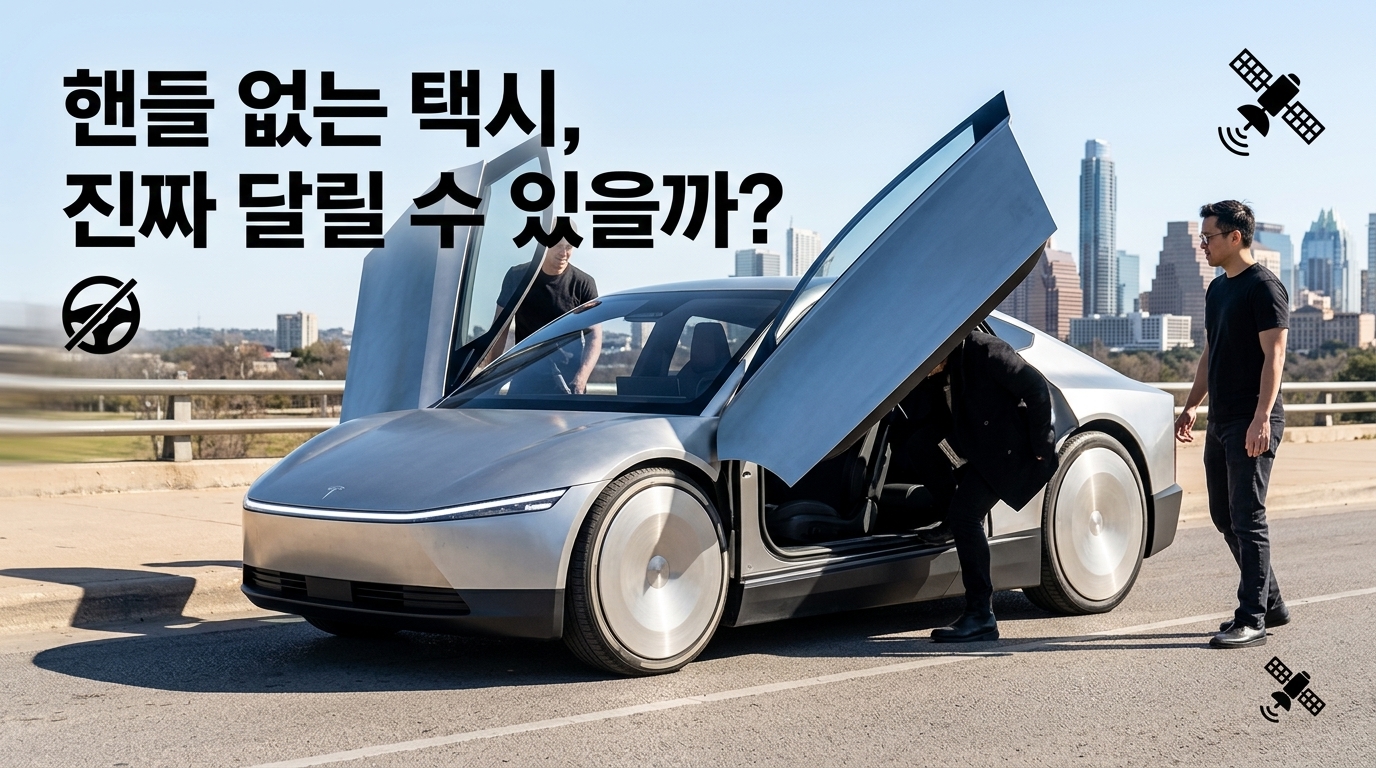
The term 'taxi,' one of the most common words we encounter on the road, has suddenly been setting search engines on fire. This is due to reports that Tesla plans to deploy the 'Cybercab'—a dedicated robotaxi with no steering wheel or pedals—to public roads in Austin, Texas, as early as late August 2026. The futuristic, driverless taxi that has long been shrouded in secrecy is finally making its move to leave private property and join the ranks of commercial services that charge actual fares.
Cybercab's Path to Public Roads: Why It's More Than Just a Rumor
Tesla's plan to put the Cybercab on real roads by the end of this month is no mere rumor. According to reports from the tech news outlet The Information, Tesla has set a specific internal goal to begin pilot operations on public roads in Austin, Texas, in late August 2026. A scenario has already been mapped out: starting with ferrying Tesla employees, then transitioning to an official, fare-charging robotaxi service within a few weeks.
Traces of the preparation process are visible everywhere. Since July, Tesla has been conducting steady test drives on private roads within Giga Texas. They have even completed emergency response drills with Austin fire authorities and other first responders in preparation for unexpected situations. Furthermore, over 100 test-production vehicles have been spotted around the factory, and specialized cars with integrated Starlink antennas on their roofs to prevent wireless network drops have been seen in action, proving that preparations for hitting public roads are well underway.
The most decisive clue was revealed via social media. Tesla's official robotaxi account launched a sweepstakes event for existing users to win invitations to the 'Cybercab launch event.' The event runs until August 23, with winners to be announced on August 25. This adds weight to the prospect that we will see the Cybercab moving on actual roads before the end of the month.
The Legal Barrier: Can a Car Without a Steering Wheel Get a License Plate?
The real obstacle facing the Cybercab is 'law,' not technology. Current U.S. traffic regulations fundamentally prohibit vehicles without physical control mechanisms, like a steering wheel or brake pedal, from operating commercially on public roads. This means that no matter how advanced the AI, if there is no physical way for a human to intervene in an emergency, the car cannot be legally placed on the road.
To clear this hurdle, Tesla must receive special exemption approval from the National Highway Traffic Safety Administration (NHTSA). It remains unclear whether Tesla has fully secured the necessary administrative permits ahead of this Austin deployment. If they rush into operation or attempt to find loopholes without sufficient prior approval, even a minor malfunction could easily lead to a major safety scandal.
Additionally, Tesla's insistence on using only cameras for its 'Full Self-Driving (FSD)' system faces intense scrutiny from regulators. While competitors rely on expensive LiDAR and radar sensors, Tesla depends solely on what its cameras see. Whether regulators can trust a car that lacks both steering controls and traditional sensors remains the biggest challenge for its entry onto Austin's roads.
200 Million Miles vs. 380,000 Miles: The Gap Between Tesla and Waymo
The true challenge for the Cybercab lies less in the technology itself and more in how to overcome the massive gap between it and competitors who have already cornered the market. Compared to Waymo, the Google-backed leader in autonomous driving, Tesla still has a long road ahead.
The gap is starkly visible in the numbers. As of July 2026, Tesla's cumulative autonomous driving mileage stands at approximately 380,000 miles (approx. 610,000 km). In contrast, Waymo, which is already operating commercial robotaxi services in various U.S. cities, has amassed a staggering 220 million miles (approx. 350 million km) of real-world driving data. Given that the volume of data dictates the performance of autonomous AI, there is a massive chasm between the two companies.
Their approaches to technology are also completely opposite. While Waymo covers its vehicles with expensive LiDAR and radar sensors and drives safely based on precision mapping, Tesla relies entirely on its camera-based FSD software. The strategy is to slash costs by reducing sensors, but it remains questionable whether a camera-only system can guarantee perfect safety in rain, snow, or other poor weather conditions.
Ultimately, this Austin pilot will serve as a testing ground to prove whether Tesla's seemingly reckless, camera-only adventure can perform as safely as Waymo in complex real-world traffic.
Between Showmanship and True Innovation
This Austin deployment is the real testing ground for the future of autonomous driving that Tesla has long promised. It is the first real-world test where a system that has previously remained at the level of driving assistance will have its credibility as a fully driverless, unmanned system evaluated by the public.
Tesla is already building hype by signaling major developments later this month. They have finished an event that gave existing users a chance to win tickets to the Cybercab launch, with winners to be announced on August 25. The fact that the announcement is imminent suggests that the day we see the vehicles showcased to the public—beyond just trial runs—is near.
Ultimately, what matters is the reality on the road, not the flashy aesthetics. Because the vehicle lacks a steering wheel and pedals, there is no way for a passenger to intervene physically if the AI makes even one minor error in judgment. The key to the success or failure of the Austin trial will be whether the camera and software performance alone can perfectly manage the unpredictable nature of city streets.
Whether Tesla's latest attempt manages to clear the regulator's high bar and becomes a success story of safely navigating Austin's streets, or whether it reveals technical limitations and remains another incomplete promise, depends on the first turn of the wheels coming later this month.
운전대도 페달도 없다 테슬라 사이버캡’이 이달 말 이후, 다음 흐름을 가를 신호
1
tUSDC
운전대도 페달도 없다 테슬라 사이버캡’이 이달 말 의 관심이 이어질지 판단하기 위해 후속 공식 움직임과 반응 지속성에서 무엇을 먼저 확인할지 짚습니다.
Related Links