@whynow
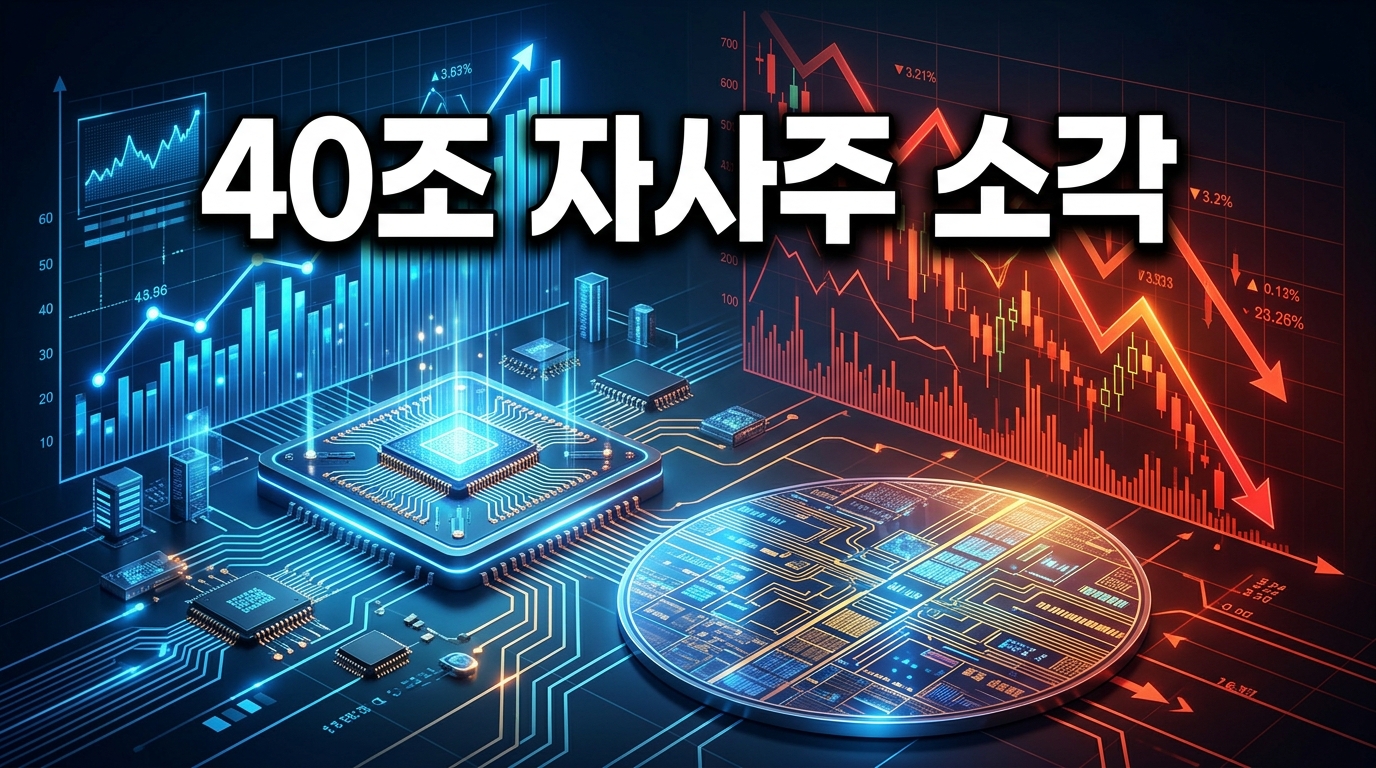
A 9.75% Crash in One Day and 40 Trillion Won in Share Buybacks: The Truth Behind SK Hynix's (000660) Record-Breaking Move
After a 9.75% intraday crash on August 19, 2026, left shareholders in shock, SK Hynix pulled an unprecedented card immediately after the market closed: a 40 trillion won share buyback and total cancellation, the largest in the history of the Korean stock market. This single surprise announcement caused the stock to rebound over 6% in after-hours trading, reclaiming the 1.6 million won level, while search portals exploded with activity. Investors are looking past the dramatic price rally to dig deeper into the complex governance calculations and the controversy surrounding the Nasdaq listing of the subsidiary, Solidigm.
The Largest Ever 40 Trillion Won Shareholder Return: What’s Inside?
The capital return program launched by SK Hynix is unprecedented in scale and speed in the Korean market. Following a 9.75% plunge to 1.5 million won during regular hours on August 19, 2026, the surprise disclosure sent the stock up over 6% after hours, quickly recovering to the 1.6 million won range. The core of this shock announcement is the declaration that the company will spend a massive 40 trillion won over just three months to buy back and burn all those shares.
The disclosure states that the company plans to secure the shares through open-market purchases over three months starting August 20 and cancel them entirely. This amounts to approximately 3.3% of SK Hynix's total outstanding shares, or about 24.07 million shares. This is a direct approach to clearly boost shareholder value by drastically reducing the number of circulating shares, rather than just a temporary fix to defend the price.
Furthermore, the company has radically overhauled its basic shareholder return framework. SK Hynix decided to increase its shareholder return criteria from the previous "within 50% of free cash flow" to "over 50%." By removing the ceiling and resetting it as a floor, they are promising to return more than half of their future earnings to shareholders.
However, behind this dramatic move involving tens of trillions of won lies a high-stakes equation that goes beyond simple stock price boosting. With public backlash from retail investors and the market growing over the push for a US IPO of the newly profitable subsidiary Solidigm, the company has played an enormous card to appease angry sentiment and change the game itself.
From 'Painful Finger' to Cash Cow: The Return of Solidigm
The background behind SK Hynix's sudden ability to deploy an unprecedented 40 trillion won financial card lies in the remarkable turnaround of its NAND flash subsidiary, Solidigm, which has finally begun to pull its weight. Since the acquisition, Solidigm had been a representative "painful finger" for SK Hynix, racking up trillions of won in losses every year. The white elephant that sparked market doubts—even raising rumors of total capital erosion—has now transformed into its most reliable cash generator.
Solidigm's performance in the first half of 2026 was nothing short of exceptional. In the first half alone, it recorded 12.25 trillion won in revenue and 5.84 trillion won in net profit, instantly dispelling concerns about capital erosion. Notably, the net profit saw a dramatic surge, increasing 44-fold compared to the same period last year.
The key to this massive turnaround was the global AI data center market. Solidigm successfully absorbed the explosive demand for high-capacity enterprise SSDs. Having already captured the HBM market, SK Hynix has now gained momentum from Solidigm, completing its AI memory alliance.
The '5-Step Double Listing' Controversy and Cold Gaze on Governance
However, Solidigm's dramatic shift to profitability has brought unexpected conflict. As SK Hynix pushed for a Nasdaq listing, shareholders and governance groups began to voice sharp criticism. The persistent concern over double listings—that the enterprise value of the parent company suffers when a profitable subsidiary is listed overseas—has resurfaced.
In fact, on August 13, 2026, the Korea Corporate Governance Forum strongly criticized the push for the Solidigm IPO as a "5-step double listing" within a complex governance structure, labeling it a typical case that fuels the undervaluation of the Korean stock market. Critics point out that while retail investors endured Solidigm's long tunnel of losses, the benefits are flowing elsewhere. This is because other SK affiliates, including the holding company SK Inc., SK Innovation, and SK Telecom, participated in capital increases to split shares of the parent entity of Solidigm at a cheap valuation of 10 to 15 trillion won.
The criticism that other affiliates are snapping up shares at a bargain and taking the spoils while retail investors shared the pain of losses has become a critical Achilles' heel for SK Hynix. The market does not view this 40 trillion won share buyback as a mere price-boosting tactic. The prevailing interpretation is that it is a highly defensive strategy to win back the hearts of retail investors turned cold by governance controversy and to preemptively block shareholder opposition during the upcoming listing phase.
The Emergence of Hybrid Memory: An AI Weapon to Cut Costs by 78%
Beyond the 40 trillion won financial card to appease shareholders, SK Hynix unveiled a completely new technological weapon on the same day: "hybrid memory," which combines DRAM and NAND-based SSDs.
The greatest appeal of this technology is that it dramatically reduces the memory capacity required to run AI models. When applied to the "key-value (KV) cache" area, which serves as a temporary storage space during AI calculations, the demand for expensive DRAM is reduced to 1/16th of its original level. While successfully slimming down core components, it still maintains 70% of the original performance.
As a result, the total cost of building and operating memory systems for data centers can be slashed by as much as 78%. For global big tech companies struggling with the physical limitations of scaling HBM and the geometrically rising infrastructure costs, a realistic savior has appeared. This is also why the market is placing more trust in SK Hynix's announcement than just stock price-boosting efforts.
The High-Stakes Equation Remaining After the 40 Trillion Won Promise
The 40 trillion won shareholder return card thrown by SK Hynix is not merely for one-time stock price defense. It is a multi-purpose move to immediately recover from the 9.75% shock in the regular session on August 19 by rallying over 6% in after-hours trading, and to confront the governance conflict surrounding Solidigm's Nasdaq IPO head-on. Solidigm's solid fundamentals, which saw a turnaround with 12.25 trillion won in revenue and 5.84 trillion won in net profit in the first half alone, along with hybrid memory technology that reduces system costs by 78% while preserving 70% performance, are clear weapons in SK Hynix's arsenal.
However, the declaration to buy back and burn 40 trillion won in shares by raising the free cash flow return ratio to over 50% does not solve all conflicts. The "5-step double listing" concern and the sense of alienation among retail investors, sharply criticized by the Korea Corporate Governance Forum, are difficult to fully resolve through short-term financial prescriptions. Whether the US IPO of this highly profitable subsidiary becomes a textbook case of the "Korea Discount" eroding the parent company's value or a new platform for global expansion depends on how trust with retail investors is managed as the IPO process takes shape. The market's eyes are now looking past the thrilling 40 trillion won fireworks toward the essential test bed: the rational improvement of corporate governance.
하루 만에 -9 75 폭락과 40조 자사주 소각 S 이후, 다음 흐름을 가를 신호
1
tUSDC
하루 만에 -9 75 폭락과 40조 자사주 소각 S의 관심이 이어질지 판단하기 위해 후속 공식 움직임과 반응 지속성에서 무엇을 먼저 확인할지 짚습니다.
Related Links
- Smartkarma — SK Hynix (000660 KS): Synthetic Expert Call Transcript (18 Aug 2026)
- BigGo Finance — SK NAND Subsidiary Solidigm Posts H1 Net Profit of ₩5.8 Trillion (approximately $4.1 Billion), Up 44-Fold Year-on-Year
- 아시아경제 — "Shame on You, Chairman"... Governance Forum Criticizes SK hynix's Five-Tier Cross-Listing