@whynow
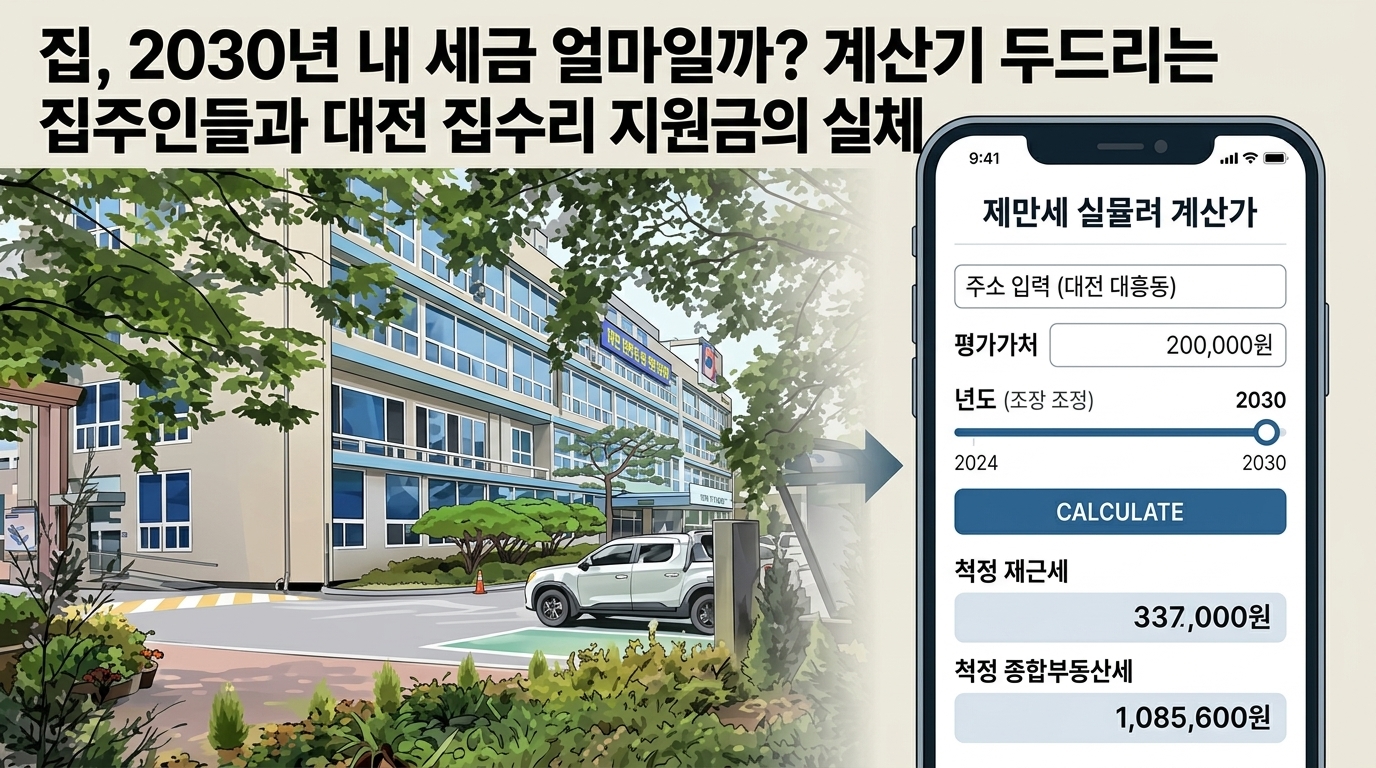
Home, what will my taxes be in 2030? The reality of landlords crunching numbers and home repair subsidies in Daejeon
Why was the single word 'home' searched so intensely on August 23rd? It wasn't because of typical price fluctuations in the real estate market, but rather a convergence of two factors: the arrival of virtual tax calculators that kept homeowners across the country glued to their smartphones, and news of unconventional home repair subsidies announced in Daejeon. A virtual simulator that calculates property taxes through 2030 just by entering an address has swept the internet, and combined with the practical policy from Daejeon's Jung-gu district—which provides up to 14.41 million KRW for exterior repairs on aging homes—it has triggered a proactive movement among those aiming to protect the present and future of their properties.
What will my taxes be by 2030? The simulation frenzy sparked by the 'Rich Tax Law Firm' calculator
Why are people searching for 'home' right now? At the center of it is the urgent tapping of smartphones by homeowners nationwide. The hot topic that set real estate communities and group chats ablaze was the map-based '2030 Real Estate Tax Simulator' released by the team at Rich Tax Law Firm, led by representative tax accountant Lee Jang-won. It is a free mock simulation program that calculates property taxes and comprehensive real estate taxes annually through 2030 just by entering an address.
The reason this calculator suddenly went viral is the complexity of the tax reform plan announced by the government on August 3rd. This reform shifts the foundation of taxation from the number of homes owned to the value of the homes and whether they are used for actual residency. Whether you actually live in the home and the total value of your holdings, rather than just the number of properties, have now become the core criteria for determining tax.
It is hard to grasp how the current multi-homeowner tax criteria differ from the virtual effects of the upcoming reform just by hearing about it. However, the simulator clearly demonstrates this difference in numbers. Once the property tax scenarios showing exactly how much will leave their wallets annually under the new reform were visualized, a wave of simulation mania followed, with owners flocking to see the future of their assets for themselves.
The hidden '2028 deadline': Why multi-homeowners are timing their sales
There is another issue that has become the real topic of conversation among multi-homeowners who have calculated their future property taxes: the '2028 sales deadline' hidden within the government's tax reform timeline. What initially seemed like a distant future concern has, through repeated analysis, become a concrete timetable requiring them to dispose of assets within just a few years.
The backdrop for this urgency is the combination of the expiration of capital gains tax surtax exemptions and major changes to the long-term holding deduction method. According to analyses, the grace period for the capital gains tax surtax exemption for multi-homeowners is rapidly approaching its end between 2027 and 2028. Once this grace period ends, multi-homeowners will face heavy tax burdens once again.
The coup de grâce is the reform to the long-term holding special deduction, which will take effect in 2029. Previously, taxes were reduced based on how long a home was held, but from 2029 onwards, it will be restructured to be based solely on the duration of actual residency. In other words, for multi-homeowners who have held multiple properties without living in them, years of accumulated tax benefits could become useless overnight.
Ultimately, a clear guideline emerges: to avoid the surtax on capital gains and fully retain existing long-term holding deduction benefits, sales must be completed by the end of 2028 at the latest. This is why homeowners using tax calculators are moving beyond just checking this year's tax amount and have begun working on concrete exit strategies to find their escape route.
Up to 14.41 million KRW for exterior repairs: Daejeon Jung-gu's unconventional 'New Village' experiment
While people across the country are racking their brains simulating tax bills, Daejeon's Jung-gu district has introduced a practical cash subsidy program that has owners of aging homes excited. As part of the government's 'New Village' housing improvement policy, they are offering an unconventional proposal to extensively remodel the exteriors of old houses.
Kim Je-seon, the head of Daejeon's Jung-gu office, has begun recruiting participants for a program that will provide up to 14.41 million KRW in exterior repair costs—such as roofs, outer walls, and windows—for 40 detached houses in the Daeheung district that are over 20 years old. While the scale of support is eye-catching, the truly unique part is the owner's share of the cost: the national and local governments cover 90% of the total construction cost, leaving the homeowner to pay only 10%.
They have also cleverly included a mechanism to ease the worries of tenants. If a landlord signs a co-existence agreement to freeze rent for four years, the owner's share is further reduced to just 5%. It is a smart design that aims to thoroughly renovate the aesthetics of old, dark alleys in the original downtown area while simultaneously securing residential stability for vulnerable, low-income tenants.
Small-scale redevelopment under 500 units to be designated by district heads; bypassing Seoul City for faster supply
In the future, small-scale redevelopment or reconstruction projects of under 500 units in Seoul might no longer require long waits while waiting for approval from the Seoul Metropolitan Government. The government and the Democratic Party of Korea agreed in a high-level consultation to push for a plan to transfer the authority for authorizing small-scale urban maintenance projects in Seoul from the Mayor of Seoul to the heads of individual autonomous districts.
The core of this measure, which emerged in the first high-level consultation since Kim Min-seok became the Democratic Party's representative, is to significantly transfer the designation and approval authority for small-scale reconstruction and redevelopment maintenance zones of under 500 units in Seoul from the existing Mayor to district heads. The idea is to alleviate the administrative review bottleneck that has been concentrated in the Seoul Metropolitan Government and instead resolve it quickly at the district level to boost the speed of housing supply.
Expectations are rising among owners of small villas or old detached houses that a path for urban renewal may finally be opening in their neighborhoods. In particular, if district heads are able to designate zones directly without going through complex review stages, some predict that project preparation time could be dramatically reduced, increasing the real value of these small-scale maintenance zones.
However, fierce pushback is expected before actual legislation and enforcement occur. The People Power Party has strongly opposed this agreement, calling it a show of force that bypasses the Mayor of Seoul, undermines the administrative system of local government, and effectively neutralizes the Mayor's authority. For owners considering project initiation, it is necessary to have the insight to watch the actual passage of the amendment to the Urban and Residential Environment Maintenance Act in the National Assembly and the specific response from the Seoul Metropolitan Government, rather than acting rashly based on mere expectations.
The future of my home faced through numbers: Why cool calculation and strategy are needed
The phenomenon of the word 'home' being incessantly entered into search bars today goes beyond simple interest in residential space. It is more akin to a fierce survival strategy of people trying to solve the puzzle of ever-changing policies to protect their assets. The frenzy for a virtual calculator that shows estimates for comprehensive real estate and property taxes through 2030 just by entering an address is, in the end, the result of smart homeowners gathering to assess the fallout of the complex August 3rd tax reform in advance.
In particular, the clock for multi-homeowners is now ticking rapidly toward the '2028 deadline.' The exemption for capital gains tax surtaxes is coming to an end, and from 2029, the long-term holding special deduction will be extensively reorganized to be based on actual residence duration rather than holding period. This is compounded by the high-level policy of rapid supply that transfers the authority for designating small-scale redevelopment and reconstruction zones of under 500 units to district heads, and the subsidy for aging home repairs of up to 14.41 million KRW announced in Daejeon's Daeheung district. For reference, Daejeon's unconventional repair subsidy comes with a clear prerequisite: a '4-year rent freeze' to ensure tenant stability, showing that we are now in an era where one must examine the fine print behind the visible benefits.
Ultimately, what we need now is not to stand on the sidelines engulfed in vague anxiety. We need to calmly simulate the tax scenarios for our assets, sharply identify the newly reorganized supply systems and regional renewal opportunities, and redraw our residential maps. Since a single choice can sway asset values by tens of millions to hundreds of millions of won, it is necessary to have smart eyes that trace the legislative trends of the coming tax reform and the mechanisms of policy implementation to the very end.
2030 세금 계산기와 소규모 개발 호재 뒤에 숨은 실전 입법 변수
1
tUSDC
시뮬레이터가 보여준 2028년 매도 데드라인과 서울 소규모 재개발 권한 이양책이 실제로 실현되기 위해 통과해야 할 국회 일정과 시장의 핵심 관전 포인트를 짚어봅니다.
Related Links