@whynow
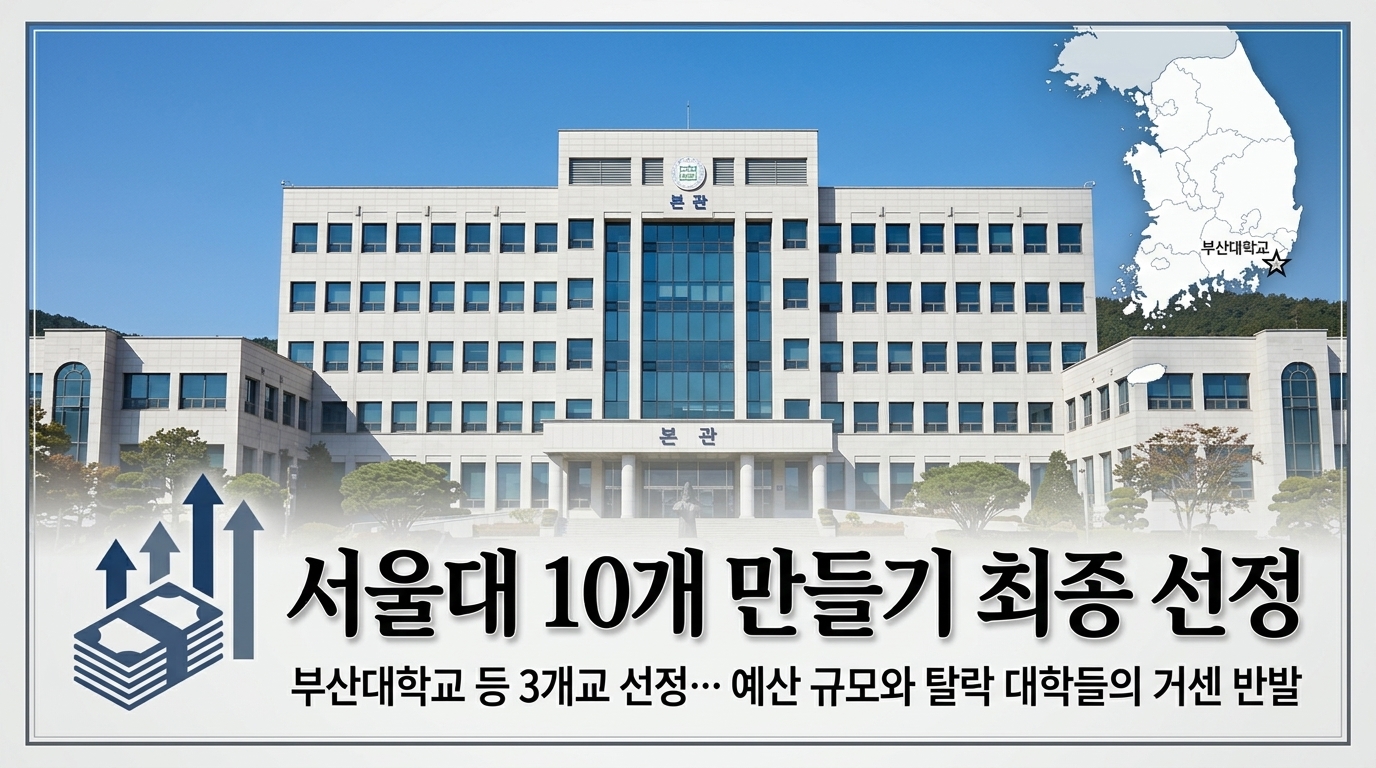
‘Ten Seoul National Universities’ Project Selects Pusan National University and Two Others: Budget Scale and Fierce Backlash from Rejected Universities
Pusan National University has suddenly captured public attention following the announcement of the final results for a major university financial support project by the Ministry of Education. The Ministry selected Pusan National University, Chonnam National University, and Chungnam National University as the inaugural beneficiaries of the ‘Ten Seoul National Universities’ package support program, which aims to foster non-capital regional flagship national universities to the level of Seoul National University. As a mega-project involving a staggering 390 billion KRW per university, the announcement has caused a clear divide between the celebrating selectees and the rejected universities, stirring up the entire regional community.
390 Billion KRW in Funding per University: The Reality of ‘Ten Seoul National Universities’
The government has launched an ambitious project to nurture flagship national universities outside the capital region to the level of Seoul National University. Pusan National University, Chonnam National University, and Chungnam National University were the first to be selected for this flagship national university package support program, known as ‘Ten Seoul National Universities.’ This initiative stems from a key education campaign promise by the Lee Jae-myung administration, designed to overcome the concentration of resources in the capital region and the threat of regional extinction through exceptional support for regional national universities.
The reason this support is drawing significant attention is the unprecedented scale of the budget. According to the Ministry of Education, massive funding will be concentrated into the three selected universities, sourced from a newly established future response fund. Each university will receive approximately 70 billion KRW this year, followed by an additional 80 billion KRW annually from 2027 to 2030. In total, each university stands to receive a staggering 390 billion KRW over five years.
This massive funding is dedicated to transforming the universities' fundamentals. The selected institutions plan to solidify the roots of basic academic disciplines while significantly strengthening the capacity of graduate schools and research centers closely linked to local core strategic industries. The goal is to build robust infrastructure from undergraduate education to the research level, creating an environment where regional talent can achieve world-class research outcomes without having to move to the capital region.
Three Distinct Survival Strategies: Pusan, Chonnam, and Chungnam National Universities
The secret to how these three universities beat out numerous competitors in this evaluation lay in their concrete execution plans, which went beyond mere declarations. The blueprints to integrate regional core industries with university curricula like interlocking gears earned high marks from the evaluation committee.
Pusan National University, which is receiving the most attention, has chosen a strategy to maximize its regional strengths in traditional manufacturing infrastructure and the maritime sector. It has confirmed the establishment of an 'Innovative Manufacturing and Maritime Convergence College' by 2028, and plans to set up customized contract departments in partnership with major companies like LG Electronics and Hanwha. Furthermore, it has presented a specific roadmap to establish a large-scale artificial intelligence specialty college by 2027 to lead the digital ecosystem across regional industries.
Chonnam National University is focusing on creating an ecosystem for the next-generation growth engine: semiconductors. It plans to establish an advanced convergence college centered on the semiconductor field and expand the cooperative model already established with Amkor Technology—a semiconductor packaging company—to include Samsung Electronics and Korea Electric Power Corporation. Through this, they plan to strengthen a regional talent development network that encompasses both large corporations and public enterprises.
Chungnam National University has played a bold card by breaking down barriers with neighboring institutions. It will establish a 'Nexus College of Science and Technology' in 2028 and build a joint governance structure with KAIST, a powerful research partner in the Daejeon area. The idea is to create a breakthrough for regional innovation through a cross-regional cooperation model that goes beyond simple exchange to jointly operating curricula.
Why Was Chonbuk National University Rejected? Differences in Concreteness
One of the most heated points of contention regarding the final selection results of this flagship national university package support program is the rejection of Chonbuk National University. Chonbuk National University threw its hat in the ring with a core model of industry-academic cooperation based on physical artificial intelligence, featuring collaboration with Hyundai Motor Company, but ultimately failed to pass the final threshold.
The decisive reason for rejection cited by the Ministry of Education's evaluation team was the concreteness and feasibility of the plan. While competitors like Pusan National University had advanced to the stage of signing actual contracts with large corporations to secure binding force, the collaboration blueprint with Hyundai Motor Company submitted by Chonbuk National University was still in the planning and proposal stage. The lack of concrete implementation guarantees, regardless of the positive direction, proved to be a painful point deduction factor.
News of the rejection has caused significant unrest in the Jeonbuk regional community and political circles. In particular, the Jeonbuk provincial chapter of the People Power Party issued a statement strongly criticizing the lack of mediation and negotiation skills of local politicians, including those from the Democratic Party of Korea, which holds a majority in the region. With the so-called 'regional neglect theory'—that the Jeonbuk region is once again being sidelined in major national projects—gaining traction, the issue is escalating into a political battle beyond mere technical shortcomings in the university evaluation.
Kyungpook National University Raises Suspicions of ‘Regional Balancing’ and Concerns Over New Hierarchy
Among the rejected universities, the backlash from Kyungpook National University is particularly strong. The faculty council and alumni association have raised strong questions about the evaluation results, arguing that there is no objective reason for Kyungpook National University to fall behind when assessing international capabilities or academic competitiveness. Critics suggest that the selection of one university each from the Yeongnam, Honam, and Chungcheong regions indicates that political ‘regional balancing’ may have taken priority over evaluation criteria.
Underlying this individual university backlash are concerns about the future of national universities as a whole. Academic groups, including the Korean National University Professors Union, warn of the side effects of the government's concentrated investment approach. They point out that concentrating astronomical budgets on only a few flagship universities will only create further hierarchy and gaps within the national university system.
The criticism is that, contrary to the original intention of bridging regional gaps, funneling limited resources to a few universities is only deepening conflicts among them. The fear that the ambitious ‘Ten Seoul National Universities’ concept could actually lead to ‘the rich getting richer and the poor getting poorer’ among national universities and solidify university stratification is becoming a reality.
A Savior to Stop Regional Extinction, or the Start of a New Hierarchy?
The ‘Ten Seoul National Universities’ project put forward by the government is a resolute gamble to break the chronic trend of centralization in the capital region and regional extinction by intensively fostering non-capital flagship national universities. With an unprecedented budget of approximately 390 billion KRW per university being invested, this project could be a turning point that reshapes the survival landscape for regional universities beyond mere financial support.
However, there are many mountains to climb before this massive experiment can succeed. Whether the new contract departments with major corporations or the establishment of advanced convergence colleges promised by Pusan, Chonnam, and Chungnam National Universities will actually lead to the revitalization of the regional industrial ecosystem ultimately depends on execution. If flashy blueprints are thwarted by internal university regulations or lack of cooperation, it will be hard to avoid criticism that massive financial resources have been wasted.
The bigger task is managing the side effects this policy will bring. As feared by parts of academia, such as the Korean National University Professors Union, funneling resources through selection and concentration could actually solidify a new hierarchical system within national universities and widen gaps. As evidenced by the fierce backlash from regional politics and rejected universities, demonstrating the transparency of evaluation criteria and soothing the sense of loss in rejected regions are also difficult challenges the Ministry of Education must solve.
The ambitious vision of elevating regional flagship universities to the level of Seoul National University has just taken its first step. Starting with the first allocation of approximately 70 billion KRW this year, how the innovation plans presented by each university are realized, and how the government mitigates the intensifying fires of regional conflict, will be the true test that determines the success or failure of this massive policy experiment.
Related Links